Introduction
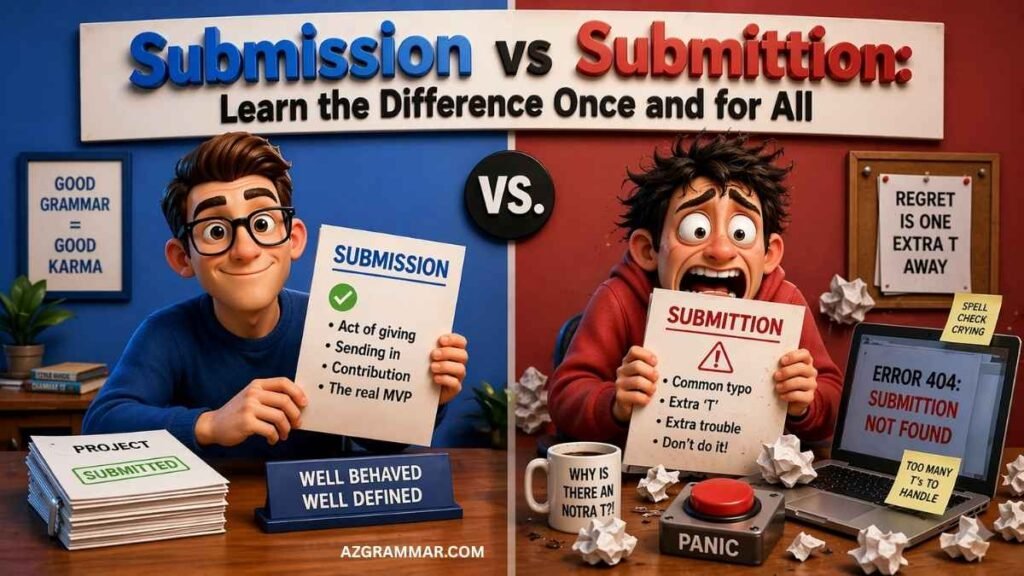
Submission vs submittion which spelling is actually correct? This common confusion often shows up in writing, especially when similar-sounding words make it hard to spot mistakes. At first glance, both versions might seem acceptable. However, only one follows standard English spelling rules. In this guide, you’ll learn the correct form, understand why the mistake happens, and see practical examples so you can use the word confidently in any context.
Which One Is Correct: Submission vs Submittion?

Submission is correct. Full stop.
“Submittion” is not a word. It doesn’t appear in Merriam-Webster, Oxford, Cambridge, or any other recognized English dictionary American or British. No grammar guide acknowledges it. No style manual lists it. It simply doesn’t exist.
Yet people write it constantly. And the reason why makes perfect sense once you understand how English suffixes work.
Address vs Adress: Which Spelling Is Correct? [2026]
What Does “Submission” Actually Mean?
Before diving into the spelling mechanics, it helps to understand what the word actually means because “submission” carries more than one meaning depending on context.
At its core, submission is a noun. It refers to:
- The act of handing something in “Please send your submission before the deadline.”
- The document or item itself “Her submission was the strongest in the competition.”
- Yielding to authority or accepting someone’s control “The treaty required the full submission of the opposing forces.”
- A formal proposal or argument presented for consideration “The lawyer prepared a written submission for the tribunal.”
The word comes from the Latin submittere, which means “to send under” or “to put forward.” That Latin root sub (under) + mittere (to send) is exactly why the spelling works the way it does. The suffix isn’t -tion. It’s -ssion, following the Latin pattern of words derived from mittere.
Here’s how that looks in real sentences:
“The research team completed its submission to the journal three days early.”
“Her submission of the visa documents took longer than expected.”
“The prisoner’s submission to the court’s authority ended the standoff.”
Each usage feels different but they all share the same core idea: something being put forward, handed over, or yielded.
Why “Submittion” Feels Right But Isn’t
Here’s where it gets interesting. The mistake isn’t random. It’s actually a logical error the kind that makes complete sense if you don’t know the underlying rule.
Most people learn early that you add -tion to verbs to form nouns. Think about it:
- Act → Action
- Collect → Collection
- Condition → already ends in -tion
- Position → same pattern
So when someone sees the verb submit, their brain runs the same calculation: submit + -tion = submittion. It feels right. It follows a pattern they know.
The problem? English didn’t get its suffix rules from one neat source. Latin-derived words especially those ending in -mit follow a different pattern entirely. When a verb ends in -mit, its noun form takes -ssion, not -tion.
No major dictionary, grammar authority, or style guide including AP Style, Chicago Manual of Style, or the Oxford English Grammar has ever listed “submittion” as an accepted variant.
That’s not an accident. It’s because the word was never formed correctly to begin with.
The -mit → -ssion Rule: Your Spelling Anchor
This is the rule worth memorizing. It’s consistent, reliable, and covers several common English words you already know.
| Verb | Wrong Noun Form | Correct Noun Form |
|---|---|---|
| Submit | Submittion | Submission |
| Permit | Permittion | Permission |
| Omit | Omittion | Omission |
| Admit | Admittion | Admission |
| Commit | Committion | Commission |
| Transmit | Transmittion | Transmission |
| Emit | Emittion | Emission |
Notice the pattern? Every single verb ending in -mit produces a noun ending in -ssion. Not -tion. Not -mition. Always -ssion.
Once you see this table, “submittion” becomes impossible to write with confidence. The correct form is obvious.
Enunciate vs Annunciate: Which One Is Actually Correct?
How to Remember the Correct Spelling of Submission vs Submittion
Knowing the rule is one thing. Remembering it under pressure mid-sentence, mid-email is another. Here are a few tricks that actually stick.
The “Mission” Trick
Break the word down visually: sub + mission = submission. You’re submitting your mission. Every time you write “submission,” you’re really just adding “sub” to a word you already know perfectly well.
The “-ssion Family” Trick
Group submission with its cousins: permission, omission, admission, commission, transmission. They all end in -ssion. They all come from Latin -mittere verbs. If you can spell one, you can spell them all.
Visual Breakdown
S – U – B – M – I – S – S – I – O – N
Two S’s in the middle. Always. That double-S is the signature of the -ssion suffix and the feature most often dropped when people misspell the word.
Submission vs Submittion: Full Grammar Breakdown and Word Forms
Understanding the correct spelling is just the start. Using the word correctly in sentences requires knowing its full grammatical profile.
Noun — Submission
- Singular: a submission, the submission, her submission
- Plural: submissions (simply add -s)
- Countable: Yes “I reviewed three submissions today.”
Verb — Submit
- Present: submit / submits
- Past: submitted
- Present participle: submitting
- Future: will submit
Adjective — Submissive This is where people sometimes get confused. Submissive is related to submit but it doesn’t mean “relating to a submission.” It describes a person or behavior that yields to authority or control. It’s a behavioral adjective, not a descriptive one for documents.
So you wouldn’t say “a submissive document.” You’d say “a formal submission.”
No adverb form of submission exists. You’d use submissively only when describing behavior never when describing the act of handing something in.
Submission vs Submittion: Common Misspellings to Watch For
People misspell “submission” in several predictable ways. Here’s a quick reference table:
| Misspelling | What Went Wrong |
|---|---|
| Submittion | Added -tion instead of -ssion |
| Submition | Missing one s and used -tion |
| Submision | Dropped one of the double s‘s |
| Submussion | Vowel confusion in the suffix |
| Submmission | Doubled the m instead of keeping the double s |
| Submishion | Phonetic spelling gone wrong |
Every one of these is wrong. Every one of them will get flagged by a spell-checker. And every one of them can damage your credibility in a professional or academic document.
Sweeped vs Swept: Which Word Is Correct?
Submission vs Submittal — Are They the Same Thing?
Here’s something that surprises most people: submittal is also a real English word. But that doesn’t make it interchangeable with submission.
Submission is the general-purpose word. You use it in:
- Academic writing (“thesis submission”)
- Legal contexts (“written submission to the court”)
- Creative fields (“open for story submissions”)
- Everyday professional communication (“email submission”)
Submittal, on the other hand, lives almost exclusively in construction, architecture, and engineering. In those fields, a “submittal” refers to a specific package of documents shop drawings, material samples, product data sent from a contractor to an architect or engineer for formal review and approval.
“The contractor sent the first submittal package to the project engineer for review.”
Outside of that technical context, “submittal” sounds awkward and out of place. If you’re not in construction or engineering, stick with submission every time.
Submission in Academic Writing
In academia, submission is one of the most important words in a student’s vocabulary and it carries real consequences.
A submission in the academic world refers to any work formally handed in for evaluation. This includes:
- Essays and research papers
- Dissertations and theses
- Journal article manuscripts
- Conference abstracts
- Grant proposals
The difference between a draft and a submission matters. A draft is a working version you’re still revising. A submission is the final version you’ve officially handed over for grading, review, or publication. Once submitted, many institutions treat the document as locked changes may not be allowed without formal permission.
Common academic phrases you’ll encounter:
- “Final submission deadline: Friday, 11:59 PM”
- “Online submission portal opens two weeks before the due date”
- “Late submissions will receive a 10% grade penalty per day”
Missing a submission deadline in an academic setting can mean anything from a grade deduction to outright rejection of your work. Most universities treat submission dates as hard deadlines not suggestions.
Submission in Legal Contexts
In law, the word submission takes on an even more formal weight. It signals that something has been officially presented to a court, tribunal, or authority and that word choice matters in legal documents.
Common legal uses include:
- Written submission — a formal written argument presented to a judge or panel
- Submission of evidence — the formal act of presenting evidence for the record
- Counsel’s submission — arguments made by a lawyer on behalf of their client
- Submission to jurisdiction — a legal concept where a party accepts that a particular court has the authority to hear their case
“The defense counsel’s submission argued that the evidence had been obtained unlawfully.”
In legal contexts, you would never use “submittion” or any variant. The error would undermine the document’s credibility immediately.
Caliber vs Calibre: Which Spelling Is Correct?
Submission of a Document — Real-World Scenarios
The phrase “submission of a document” appears across virtually every professional field. Here’s how it plays out in real life:
Job Applications
“Complete the online form and ensure the submission of your resume and cover letter before midnight.”
Immigration and Visa Applications
“The submission of your passport and supporting documents is required at the consulate.”
Tax Filing
“Electronic submission of your tax return is faster and more secure than mailing a paper form.”
Publishing
“The magazine accepts submissions of short fiction up to 3,000 words.”
Grant Proposals
“Your submission must include a detailed budget breakdown and project timeline.”
Contract Bidding
“Sealed submissions for the construction tender close at 3:00 PM on the 30th.”
Each of these uses “submission” as a formal noun the thing being handed over or the act of handing it over. None of them could logically use “submittion” because that word simply doesn’t exist.
Submission Date — What It Means and Why It Matters
A submission date is the deadline by which your document, form, or work must be received. It sounds simple but the details matter more than most people realize.
“Submission date” and “due date” are often used interchangeably but they can differ in one critical way: some institutions define the submission date as the date the document must be received, not the date it must be sent. If you email a document at 11:58 PM and the server timestamps receipt at 12:01 AM, you may have missed the deadline even though you sent it “on time.”
Consequences of missing a submission date vary by context:
| Context | Typical Consequence |
|---|---|
| Academic | Grade penalty or zero |
| Legal | Case dismissal or default judgment |
| Grant applications | Automatic disqualification |
| Job applications | Application not considered |
| Tax filing | Financial penalties and interest |
The safest approach? Treat the submission date as your target and aim to submit at least 24 hours early.
Submission vs Application — Knowing the Difference
These two words often appear together but they don’t mean the same thing.
An application is the overall process or request. You apply for a job, a course, a grant, or a visa. The application is the entire package your intent, your information, your supporting material.
A submission is the act of handing that package in or a specific piece of work within it.
Think of it this way: an application contains submissions. You submit your resume as part of a job application. You submit your essays as part of a college application. The submission is one action within a larger process.
“Your application for the scholarship requires the submission of two reference letters and a personal statement.”
Using them interchangeably creates confusion especially in formal contexts where precision matters.
Practice Section: Test Your Understanding
Fill in the Blank
Choose the correct word — submission or submittion — for each sentence:
- “Please ensure your ________ reaches us before the closing date.”
- “The professor rejected the late ________ without exception.”
- “Her ________ to the literary journal was accepted on the first try.”
- “There is no such thing as a ‘________’ — it’s not a real word.”
- “The legal team prepared a written ________ for the tribunal.”
(Answers: submission, submission, submission, submittion [used to illustrate the error], submission)
Spot the Error
Identify and correct the misspelling in each sentence:
- “Please complete your submittion by Friday.”
- “The submision was returned for revision.”
- “We received over 400 submisions this quarter.”
- “Her submution of the grant proposal was flawless.”
(All should be corrected to “submission” or “submissions”)
Feen vs Fein: Most People Spell It Wrong
Reference Cambridge Dictionary Definitions
Here’s a trusted source for clear Grammar:
FAQs Submission vs Submittion
Is “Submittion” Ever Correct in Any Form of English?
No not in American English, British English, or any recognized dialect. “Submittion” has never appeared in Merriam-Webster, Oxford, or Cambridge dictionaries. It’s a spelling error that formed by incorrectly applying the -tion suffix to the verb “submit.” The only correct noun form is submission.
What Is the Correct Spelling Submission vs Submittion?
Submission is always correct. The confusion happens because most people expect verbs to follow the simple verb + -tion pattern. But “submit” comes from the Latin root submittere so it takes the -ssion suffix just like permit → permission and omit → omission.
Why Do So Many People Write “Submittion” Instead of “Submission”?
The brain applies a pattern it knows: act → action, collect → collection. So it tries submit → submittion. That logic feels right but it ignores the Latin -mit → -ssion rule. It’s one of the most common suffix mistakes in English especially among ESL learners and students writing under pressure.
Why Doesn’t “Submission” Follow the Normal -tion Rule?
Because it doesn’t come from a standard English verb structure it comes from Latin. Words derived from Latin -mittere verbs consistently produce -ssion nouns, not -tion nouns. English inherited this pattern directly and never changed it. That’s why submit, permit, omit, admit, and commit all produce -ssion nouns.
How Do You Use “Submission” Correctly in a Sentence?
Use it as a countable noun referring to the act of handing something in or the document itself. For example: “Her submission reached the editor two days before the deadline.” You can also use it in the plural: “The committee reviewed all submissions before voting.” Never use it as a verb that role belongs to “submit.”
How Is “Submission” Different From “Submitting”?
“Submitting” is a verb it describes the action in progress. “Submission” is a noun it refers to the act itself or the item handed in. Think of it this way: you are submitting a submission. Both words come from the same root but they play completely different grammatical roles in a sentence.
What’s the Most Common Misspelling of “Submission” Besides “Submittion”?
The second most common error is “submision”dropping one of the double s letters. Others include submussion, submition, and submmission. All of these stem from the same root problem: writers aren’t sure where the double letters go. Remember the double s sits in the middle: sub-miss-ion.
Can “Submissive” Be Used Instead of “Submission” in Formal Writing?
No and this is a mistake even advanced learners make. Submissive is an adjective that describes a person’s behavior or attitude someone who yields easily to authority. It doesn’t describe a document or a formal act. You’d never say “a submissive report.” The correct word for formal contexts is always submission.
Is “Submittal” the Same as “Submission”?
They’re related but not interchangeable. Submittal is used almost exclusively in construction, engineering, and project management where it refers to formal document packages sent for technical review. In academic, legal, and everyday professional writing, submission is the correct and natural choice. If you’re not in a technical field, don’t use submittal.
How Can ESL Learners Remember the Correct Spelling of Submission?
Use the “sub + mission” trick. You already know the word mission just add sub to the front. That gives you submission every time, no suffix rules required. You can also group it with words you know: permission, omission, admission they all end in -ssion and follow the exact same pattern.
Here’s a powerful conclusion for the article:
Conclusion: Submission vs Submittion
Let’s be honest English spelling rules don’t always make sense at first glance. But this one actually does once you see the pattern clearly.
Submission is correct. Submittion is not a word. It never was and it never will be no dictionary, grammar guide, or style manual has ever recognized it as valid in any form of English.
The real takeaway here isn’t just about one word. It’s about understanding why the spelling works the way it does. When a verb ends in -mit submit, permit, omit, admit, commit the noun always takes -ssion. That single rule eliminates an entire category of spelling mistakes in one shot.
So next time you sit down to write a job application, turn in an academic paper, or prepare a legal document, you won’t pause. You won’t second-guess yourself. You’ll type submission with complete confidence and move on.
Here’s your quick reference to carry forward:
- ✅ Submission — correct, real, dictionary-approved
- ❌ Submittion — incorrect, not a word, never use it
- 📌 Remember: sub + mission = submission
- 📌 The rule: -mit verbs → -ssion nouns (always)
Whether you’re a student racing against a deadline, a professional drafting a formal proposal, or an ESL learner building your English vocabulary this is one spelling you’ve now locked in for good.
And that’s exactly what good grammar knowledge does. It removes doubt so you can focus on what actually matters your ideas, your work, and your message.

James Walker is an English language educator with over 5 years of experience in grammar teaching. He specializes in spelling corrections, confusing word pairs, and grammar rules for everyday use. As the lead author at AZ Grammar, he has helped thousands of students and learners worldwide write English with confidence. His simple, practical approach makes even the most complex grammar rules easy to understand.
Email: azgrammar29@gmail.com
Website: azgrammar.com