
The trama vs trauma confusion happens more often than you’d think. You’re typing a psychology essay, filling out a medical form, or posting about mental health and your fingers skip a letter. Suddenly trauma becomes trama and spell-check waves it right through without a single warning.
Here’s what you need to know immediately: trauma is the only correct English spelling. Trama does not exist in English. It won’t appear in Oxford, Merriam-Webster, Cambridge, or Collins because it was never an English word to begin with. If you’ve been writing trama, you’ve been making a spelling error that no dictionary recognizes.
There’s one small exception worth knowing upfront: trama is a real word in Italian and Spanish but it means something completely unrelated to injury or distress. In those languages it means plot or scheme. In English? It means nothing at all.
This guide settles the trama vs trauma question completely with the correct definition, Greek etymology, types of trauma, real usage examples, and a memory trick that makes the right spelling permanent.
What Does Trauma Mean? The Complete Definition
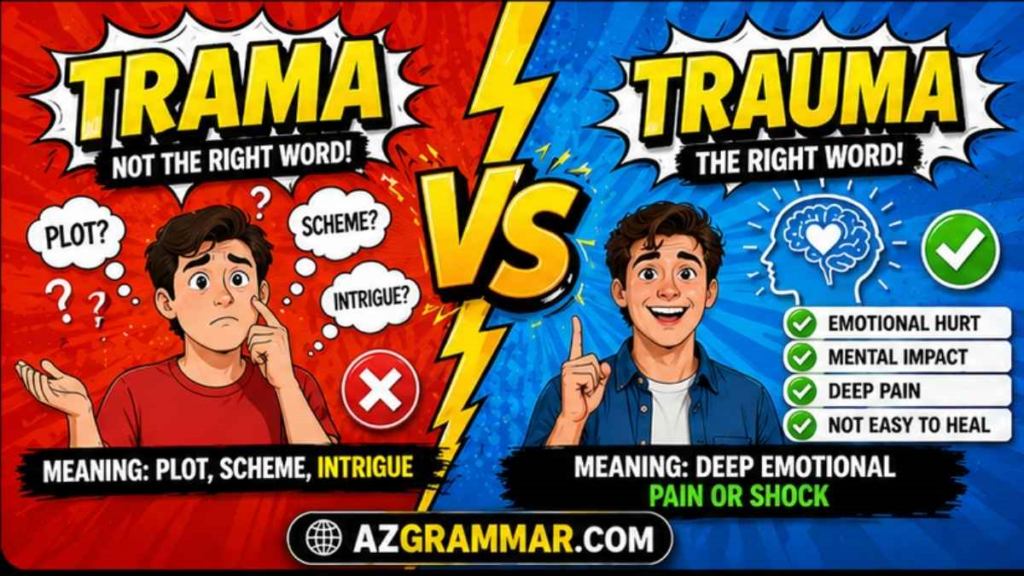
Trauma is a noun with two powerful and distinct meanings one physical, one psychological. Both are widely used in medicine, mental health, journalism, and everyday conversation.
Pronunciation: TRAW-muh not TRAM-uh, not TRAY-muh. The au combination produces an aw sound, just like in awful or August.
Part of speech: Noun (both countable and uncountable depending on context)
“Is It Hopping or Hoping? The Spelling Rule You Need”
The Two Core Meanings of Trauma
Physical trauma refers to bodily injury caused by an external force. This is the definition emergency medicine and trauma surgery operate from every day. A car accident, a fall from height, a stab wound, a severe burn all constitute physical trauma. Hospitals maintain dedicated trauma units and trauma centers specifically to treat life-threatening physical injuries.
Psychological trauma refers to lasting emotional damage following a deeply distressing experience. Unlike a broken bone, psychological trauma isn’t always visible but its effects are just as real. Abuse, assault, bereavement, war, natural disasters, and childhood neglect all produce trauma responses that can persist for years without proper care.
Example Sentences Using Trauma Correctly
- “The trauma team stabilized the patient within minutes of arrival at the emergency department.”
- “Childhood trauma significantly increases the risk of anxiety disorders and depression in adulthood.”
- “She began trauma therapy after years of struggling with the emotional wound left by the accident.”
- “Blunt force trauma to the chest required immediate surgical intervention.”
- “The community experienced collective trauma following the devastating flood.”
What Is Trama — And Is It Ever Correct in English?
Let’s be direct: trama is not an English word. Full stop.
No English dictionary not Oxford, not Merriam-Webster, not Cambridge, not Collins lists trama as a valid entry. It has no definition, no etymology, and no history in the English language. Using it in any formal English writing is always an error.
Where Does Trama Actually Come From?
Trama is legitimate in two other languages but its meanings have nothing to do with injury or distress:
| Language | Word | Meaning |
|---|---|---|
| Italian | Trama | Plot, scheme, storyline, weft (in weaving) |
| Spanish | Trama | Plot, scheme, conspiracy, weft |
| English | Trama | ❌ Does not exist |
This is a classic case of cross-language interference a linguistic phenomenon where a word from a speaker’s native language bleeds into their English writing. ESL learners whose first language is Italian or Spanish are particularly vulnerable to this error because trama looks and sounds close enough to trauma to feel right especially when typing quickly.
But even for native English speakers, trama appears as a typo or phonetic spelling mistake. The au combination gets dropped under speed and trauma becomes trama in a single careless keystroke.
Vinal vs Vinyl: Which Is Correct? (2026)
Why Do People Write Trama Instead of Trauma?
Understanding the root causes makes the mistake easier to prevent permanently.
Reason 1 — Fast typing and keystroke skipping The au vowel combination sits between two consonants in trauma. Under typing pressure, fingers jump from tr straight to ma dropping the au entirely. It’s one of the most common mechanical typing errors in English.
Reason 2 — Phonetic spelling trap Depending on accent and speech speed, some speakers compress the au sound significantly when saying trauma. Writers who spell what they hear rather than what the dictionary shows end up with trama.
Reason 3 — Cross-language interference from Italian or Spanish Native speakers of Italian and Spanish encounter trama in their own languages constantly. When writing English, the familiar form surfaces automatically especially in non-careful writing situations like social media or quick emails.
The Core Difference: Trama vs Trauma at a Glance
| Feature | Trauma | Trama |
|---|---|---|
| Correct English spelling | ✅ Yes | ❌ No |
| Found in English dictionaries | ✅ Yes | ❌ No |
| Greek and Latin origin | ✅ Yes | ❌ No |
| Used in medical writing | ✅ Always | ❌ Never |
| Used in psychology | ✅ Always | ❌ Never |
| Real word in any language | ✅ English, Greek, Latin | Italian and Spanish only |
| Accepted in formal academic writing | ✅ Always | ❌ Never |
| Passes English spell-check reliably | ✅ Yes | ⚠️ Sometimes incorrectly |
The verdict is absolute. In English whether American, British, Australian, or Commonwealth trauma is always correct and trama is always wrong.
Etymology: The Greek Root That Explains the Spelling Forever
Here’s where the trama vs trauma question gets permanently resolved and it takes just one fact.
Trauma comes directly from Ancient Greek. The Greek word trauma (τραῦμα) meant wound or injury. It entered Latin unchanged and passed into English medical vocabulary in the 1690s carrying its original Greek spelling with it.
The au vowel combination isn’t a quirk or an accident. It’s a preservation of the original Greek form. Removing it doesn’t simplify the word it destroys it.
Other Greek Medical Words That Preserve Unusual Vowel Combinations
| Word | Greek Origin | Unusual Vowel Combo |
|---|---|---|
| Trauma | τραῦμα (wound) | au |
| Pneumonia | πνεύμων (lung) | eu |
| Aesthetic | αἴσθησις (sensation) | ae |
| Euthanasia | εὐθανασία (good death) | eu |
| Anaemia | ἀναιμία (bloodlessness) | ae |
Greek gave English medicine most of its core vocabulary. The unusual vowel patterns come with the territory and trauma is one of the clearest examples. The au stays because the Greeks put it there first.
Key insight: If you know how to spell traumatic or traumatize and most people do you already know how to spell trauma. The trau- stem is identical in every related word.
Recognize vs Recognise Explained: Easy Guide 2026
Types of Trauma You Should Know
Trauma isn’t a single uniform experience. Modern medicine and psychology recognize several distinct types each with different causes, presentations, and treatment approaches.
Physical Trauma
Physical trauma is bodily injury caused by an external force. It’s the domain of emergency medicine and trauma surgery.
Common causes:
- Road traffic accidents
- Falls from height
- Penetrating wounds (stab or gunshot)
- Burns and crush injuries
- Sports injuries
- Surgical complications
Hospitals with dedicated trauma centers are classified by level Level I trauma centers provide the highest and most comprehensive care, operating 24 hours a day with full surgical teams on standby.
Psychological and Emotional Trauma
Psychological trauma results from exposure to events that overwhelm a person’s ability to cope. Unlike physical trauma, it leaves no visible wound but the emotional damage can be just as disabling.
The DSM-5 (Diagnostic and Statistical Manual of Mental Disorders, 5th Edition) defines a traumatic event as direct or witnessed exposure to actual or threatened death, serious injury, or sexual violence. This definition forms the clinical basis for diagnosing PTSD, acute stress disorder, and adjustment disorders.
Common causes of psychological trauma:
- Physical or sexual abuse
- Domestic violence
- Childhood neglect
- Combat and war exposure
- Natural disasters
- Sudden bereavement
- Serious accidents
Acute Trauma
A single intense event that produces immediate and severe psychological distress. Examples include a violent assault, a car crash, or witnessing a sudden death. Acute trauma has a clear starting point and typically a defined end — though its effects can persist indefinitely without treatment.
Chronic Trauma
Repeated or prolonged exposure to distressing events over an extended period. Domestic abuse, ongoing childhood neglect, and repeated community violence all produce chronic trauma. The cumulative effect often exceeds what any single event would cause alone.
Complex Trauma (C-PTSD)
Complex trauma results from multiple traumatic events typically interpersonal, repeated, and often beginning in childhood. The WHO’s ICD-11, updated in 2022, formally recognized Complex PTSD (C-PTSD) as a distinct diagnosis for the first time acknowledging that chronic interpersonal trauma produces a symptom profile that standard PTSD criteria don’t fully capture.
C-PTSD symptoms include:
- Difficulties with emotional regulation
- Persistent negative self-perception
- Disturbances in relationships
- All core PTSD symptoms plus the above
Vicarious and Secondary Trauma
Vicarious trauma also called secondary trauma affects people who support or witness trauma survivors without experiencing the traumatic event directly. Healthcare workers, therapists, social workers, journalists covering disasters, and first responders are all at significant risk.
Research published in medical journals consistently shows that trauma-informed care approaches which recognize the widespread impact of trauma on behavior, health, and wellbeing significantly improve outcomes for both patients and practitioners.
Cutesy vs Cutsie: Don’t Make This Spelling Mistake!
How to Use Trauma Correctly in Different Writing Contexts
The correct spelling of trauma matters most in formal contexts but good habits in casual writing matter too.
Medical and Clinical Writing
✅ “The patient presented with blunt force trauma to the thoracic region requiring emergency intervention.” ✅ “The trauma unit admitted 47 patients during the 12-hour shift following the highway collision.”
Psychological and Mental Health Writing
✅ “Adverse childhood experiences (ACEs) are strongly associated with long-term trauma responses including anxiety, depression, and substance use disorders.” ✅ “Trauma-informed care approaches have become standard practice in many mental health services since 2020.”
Academic and Exam Writing
For students writing IELTS, TOEFL, O-Level, or A-Level papers spelling trauma correctly is non-negotiable. It’s a high-frequency academic word that appears in psychology, health studies, sociology, and English literature contexts. Misspelling it as trama costs marks directly.
Common Trauma Collocations to Know
| Collocation | Example |
|---|---|
| Trauma survivor | She is a trauma survivor who now advocates for others. |
| Trauma response | Fight or flight is a classic trauma response. |
| Trauma therapy | He began trauma therapy after the accident. |
| Trauma center | The Level I trauma center serves five counties. |
| Childhood trauma | Childhood trauma shapes adult mental health significantly. |
| Emotional trauma | Emotional trauma can be as debilitating as physical injury. |
| Trauma-informed | The school adopted a trauma-informed teaching approach. |
Synonyms and Related Terms for Trauma
Expanding your vocabulary around trauma strengthens your writing precision and avoids repetition:
| Term | Meaning |
|---|---|
| Distress | Extreme emotional or physical suffering |
| Anguish | Severe and prolonged emotional pain |
| Psychological distress | Mental suffering affecting daily function |
| Wound | Physical or emotional damage |
| Ordeal | A prolonged and painful experience |
| Shock | Sudden overwhelming emotional or physical response |
| Adversity | Difficult or harmful circumstances |
| Post-traumatic stress | Ongoing distress following a traumatic event |
| Emotional wound | Lasting psychological damage from a distressing experience |
| PTSD | Post-traumatic stress disorder the clinical diagnosis |
Why Spelling Trauma Correctly Is Non-Negotiable
In casual digital communication, a typo slips by. In professional, academic, and clinical contexts it doesn’t.
Here’s why the correct spelling of trauma genuinely matters:
- Medical records containing trama immediately signal carelessness to supervisors and colleagues
- Psychology essays and research papers require precise terminology misspelling a core term undermines the entire document’s credibility
- Healthcare job applications and clinical portfolios are scrutinized for exactly this kind of error
- ESL students writing high-stakes English exams lose marks for misspelling high-frequency academic vocabulary
- Journalism and public health writing especially mental health coverage demands accuracy because the audience includes vulnerable readers who deserve careful language
“Precision in language is precision in thought. In medicine and mental health, careless words can carry serious consequences.”
Enrolment or Enrollment: Which One Is Correct?
Memory Trick: Never Misspell Trauma Again
Three anchors that make the correct spelling automatic:
Anchor 1 — Use the word family Think of traumatic, traumatize, traumatology. Every related word starts with trau-. If you can spell traumatic — and almost everyone can — you already know how to spell trauma. Just remove -tic.
Anchor 2 — The Greek vowel rule Trauma came from Greek unchanged. Greek medical words preserve their original vowel patterns — au, eu, ae, ph. These combinations feel unusual in English but they’re historically correct. The au in trauma belongs there because the Greeks put it there 2,500 years ago.
Anchor 3 — The AU anchor word Think of AUTUMN — a common English word with the same au combination. Autumn → au → trauma. Both words carry the au sound. Once you link them, the pattern sticks.
One-sentence rule: If the word family has trau- — and it does — then the root word has it too.
Reference Cambridge Dictionary Definitions
Here’s a trusted source for clear Grammar:
FAQs About Trama vs Trauma
What is correct: trama or trauma?
The correct spelling is trauma.
“Trama” is usually a misspelling in English, though it may appear in other languages like Spanish or Italian.
Trama vs trauma: which one should you use?
Always use trauma in English writing.
“Trama vs trauma” confusion happens because the words look similar, but only one is correct in standard English.
Why do people confuse trama vs trauma?
The confusion comes from missing the “u” in fast typing or pronunciation.
Also, in some languages, trama is a real word, which adds to the mix-up.
Why is “trama” not correct in English?
English spelling rules require the “au” vowel combination in trauma.
Dropping the “u” changes the word and makes it incorrect in English contexts.
How do you use trauma in a sentence correctly?
Use it to describe physical or emotional injury.
Example: The accident caused serious trauma to his leg.
Can trauma refer to emotional situations?
Yes, it often does.
Example: She is still dealing with emotional trauma after the event.
What are common mistakes with trama vs trauma?
A frequent mistake is writing trama instead of trauma in essays or exams.
Another is not proofreading, especially when typing quickly.
Is “trama” ever correct in English writing?
No, it’s not standard English.
However, it may appear in foreign language contexts or names, but not in regular English usage.
How can you remember the correct spelling of trauma?
Think of “au” as “ouch” both relate to pain or injury.
That simple trick helps lock in the correct spelling.
Does trauma only mean physical injury?
No, it includes both physical and emotional harm.
In modern usage, it’s often used for psychological experiences as well.
Conclusion
The trama vs trauma debate has exactly one answer: trauma is always correct trama is always wrong in English.
Trauma preserves its Ancient Greek spelling because it entered English directly from Greek medical vocabulary in the 1690s. The au combination isn’t optional it’s the historical and structural foundation of the word. Remove it and you don’t create a shorter version. You create a misspelling that no English dictionary has ever recognized.
The fastest way to lock in the correct spelling? Think of traumatic. That word starts with trau- and so does trauma. Every time, without exception.

James Walker is an English language educator with over 5 years of experience in grammar teaching. He specializes in spelling corrections, confusing word pairs, and grammar rules for everyday use. As the lead author at AZ Grammar, he has helped thousands of students and learners worldwide write English with confidence. His simple, practical approach makes even the most complex grammar rules easy to understand.
Email: azgrammar29@gmail.com
Website: azgrammar.com