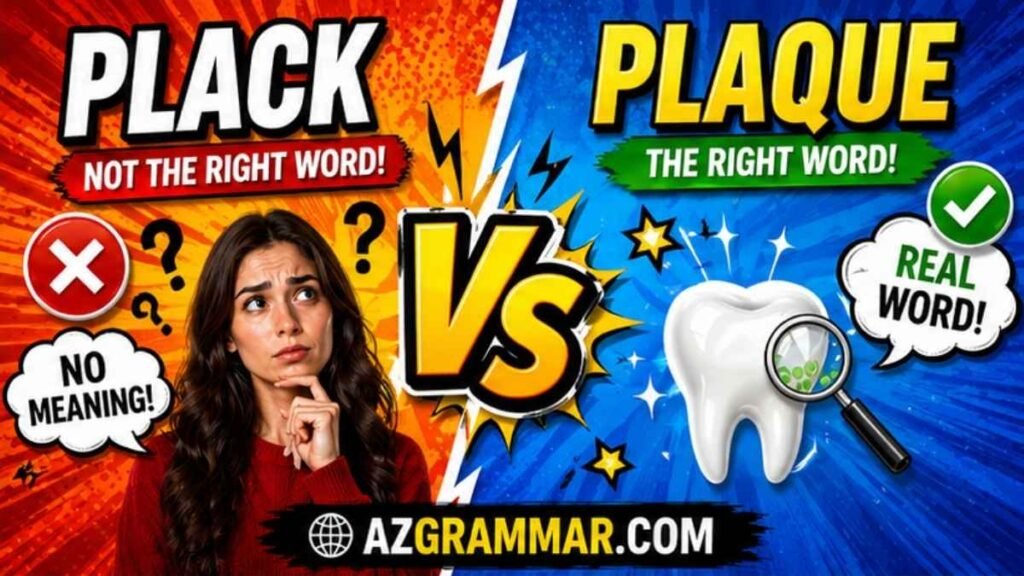
Plack vs Plaque understanding the difference between these two commonly confused words can instantly improve your writing clarity and accuracy. Many people mistakenly type “plack” when they actually mean “plaque,” but only one of these is correct in standard English. A plaque refers to a decorative plate, a dental buildup on teeth, or a commemorative tablet, depending on the context. On the other hand, “plack” is not recognized in modern English usage and is considered a misspelling. This confusion often happens because both words sound similar when spoken. In this guide, you’ll quickly learn the correct usage, meanings, and simple tricks to remember the right spelling every time.
Plack vs Plaque — The Verdict
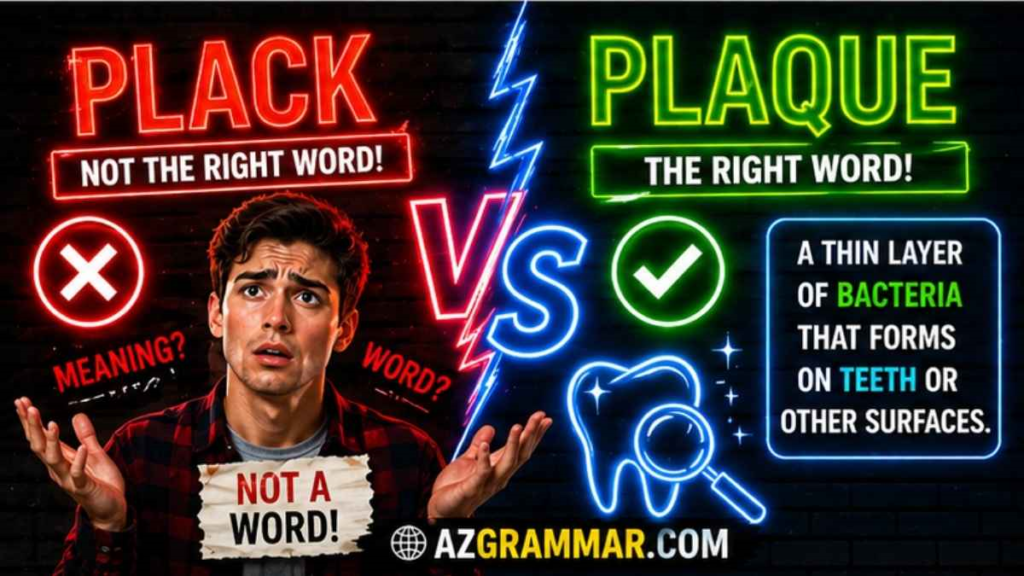
Before anything else, here’s the truth laid out cleanly:
| Spelling | Correct? | Notes |
|---|---|---|
| Plaque | ✅ Yes | The one and only correct spelling |
| Plack | ❌ No | A phonetic misspelling — not in any dictionary |
| Placque | ❌ No | A hybrid error — also not a real word |
| Plaqu | ❌ No | An incomplete typo |
So when it comes to plack vs plaque, the winner isn’t even close. Plaque takes it every time in every context, every sentence, every language style.
Cutesy vs Cutsie: Don’t Make This Spelling Mistake!
What Does “Plaque” Actually Mean?
Here’s something most articles skip: plaque isn’t a one-trick word. It shows up in your dentist’s office, your cardiologist’s report, your neurologist’s notes, and even on the wall of a historic building. That’s a remarkable range for six letters.
Where the Word Comes From
Plaque is a French loanword. It comes from the Old French plaque, meaning “flat plate” or “thin piece of metal.” English borrowed it in the 19th century and as English so often does with French words kept the original spelling while simplifying the pronunciation.
That’s the root of the entire plack vs plaque confusion right there. The word looks French but sounds English. It’s pronounced “plak” rhyming with back, track, and stack yet it’s spelled with a silent u and a -que ending that signals its French origins.
Every Major Definition of Plaque
1. Dental Plaque This is the one most people know. Dental plaque is a soft, sticky, colorless film of bacteria that constantly forms on your teeth and along your gum line. It feeds on the sugars you eat and produces acids that erode tooth enamel. Left unchecked, it hardens into tartar and tartar is a whole different problem that only a dentist can fix.
2. Arterial (Cardiovascular) Plaque This type is far more serious. Arterial plaque is a buildup of fat, cholesterol, calcium, and other substances inside the walls of your arteries. The medical term is atherosclerosis. Over time, this buildup narrows the arteries and restricts blood flow raising the risk of heart attack and stroke significantly.
According to the American Heart Association, cardiovascular disease largely driven by arterial plaque remains the leading cause of death in the United States.
3. Amyloid Plaque (Neurological) This one doesn’t get nearly enough attention. Amyloid plaques are abnormal clusters of protein fragments specifically beta-amyloid that accumulate between nerve cells in the brain. They’re a hallmark feature of Alzheimer’s disease and are actively studied as a target for treatment. The Alzheimer’s Association continues to fund research into how these plaques form and how they might be cleared.
Why Do So Many People Write “Plack”?
Let’s be clear: writing “plack” isn’t a sign of carelessness. It’s actually a sign that your brain is working correctly. Here’s why.
English is a deeply phonetic language at its core we learn to sound words out and spell them the way they sound. So when you hear “plak,” writing “plack” is the perfectly logical, phonetically consistent thing to do.
The problem? French loanwords don’t play by phonetic rules.
The “-que” Pattern You Need to Know
French gave English dozens of words that end in “-que” and every single one of them sounds like “-k” at the end. Look at this pattern:
| Word | Sounds Like | Common Misspelling |
|---|---|---|
| Plaque | plak | plack |
| Antique | an-TEEK | antick |
| Boutique | boo-TEEK | boutick |
| Clique | click | click (same sound!) |
| Oblique | ob-LEEK | obleek |
| Mystique | mis-TEEK | misteek |
| Unique | yoo-NEEK | uneek |
See the pattern? The “-que” ending is silent in terms of its vowel it just hardens the “k” sound. Once you internalize this rule, spelling plaque correctly becomes second nature.
Enrolment or Enrollment: Which One Is Correct?
Autocorrect Won’t Always Save You
Here’s a frustrating reality: some informal platforms, older spellcheck systems, and certain mobile keyboards don’t flag “plack” as an error. So it slips through. Someone sees it uncorrected, assumes it’s fine, and the misspelling spreads across blog posts, social media captions, forum threads, and even some poorly edited websites.
That’s exactly how spelling myths survive in the internet age.
Plaque Used Correctly — Real Sentence Examples
Seeing a word in context is one of the best ways to lock in the correct spelling. Here are natural, real-world examples:
✅ Correct Usage:
- “My dentist told me the plaque along my gum line had started to harden into tartar.”
- “A bronze plaque on the hospital wall honored the surgeon who founded the department in 1947.”
- “Researchers studying plaque buildup in arteries have made significant progress in the last decade.”
- “The plaque on her skin had worsened during winter, a common pattern in psoriasis patients.”
- “Amyloid plaque accumulation in the brain is one of the earliest signs of Alzheimer’s progression.”
❌ Incorrect Usage:
- ~~”She scrubbed the plack off her teeth twice a day.”~~
- ~~”The plack on the building had been there since 1923.”~~
- ~~”His doctor discovered dangerous plack deposits in his coronary arteries.”~~
Every sentence above that uses “plack” is wrong full stop. There’s no context, no dialect, no informal register where “plack” becomes acceptable.
Plaque vs Plague — Don’t Mix These Up
While we’re clearing things up, let’s tackle another confusion that trips people up regularly. Plaque and plague look almost identical — but they couldn’t mean more different things.
| Word | Pronunciation | Core Meaning |
|---|---|---|
| Plaque | “plak” | A film, deposit, or flat decorative plate |
| Plague | “playg” | A widespread epidemic disease; to persistently trouble someone |
Quick examples:
- “The plaque on his teeth needed professional cleaning.” ✅
- “The bubonic plague devastated Europe in the 14th century.” ✅
- “His bad decisions continued to plague him for years.” ✅
One extra letter the g in plague makes a world of difference. One word builds up on your teeth. The other wiped out an estimated 75 to 200 million people in medieval Europe. Mix them up in writing and you’ll confuse your reader badly.
A Closer Look at Dental Plaque
Since dental plaque is the most common reason people search plack vs plaque, it deserves a proper breakdown.
What Is Dental Plaque Made Of?
Dental plaque is a biofilm a complex, organized community of bacteria held together by a sticky matrix of proteins and polysaccharides. It’s not just random bacteria floating around. It’s a structured colony that actively adheres to tooth surfaces.
The bacteria most associated with plaque include:
- Streptococcus mutans — the primary culprit in tooth decay
- Porphyromonas gingivalis — strongly linked to gum disease
- Fusobacterium nucleatum — a bridge species that helps other bacteria colonize
Plaque vs Tartar — What’s the Difference?
A lot of people use these two words interchangeably. They shouldn’t.
| Plaque | Tartar (Calculus) | |
|---|---|---|
| Texture | Soft, sticky | Hard, calcified |
| Color | Colorless/pale yellow | Yellow to brown |
| Removable at home? | Yes — brushing and flossing | No — requires professional scaling |
| Forms from | Bacteria in the mouth | Hardened, untreated plaque |
The key takeaway: plaque becomes tartar if you ignore it. Brush and floss consistently and you break the cycle before it starts.
Recognize vs Recognise Explained: Easy Guide 2026
How to Prevent Dental Plaque
- Brush at least twice daily with a fluoride toothpaste
- Floss once a day especially before bed
- Use an antibacterial mouthwash to hit the spots your brush misses
- Limit sugary foods and drinks bacteria thrive on sugar
- Visit your dentist every six months for a professional clean
According to the American Dental Association, consistent oral hygiene is the single most effective way to control plaque buildup.
How to Remember the Correct Spelling — Memory Tricks That Work
Trick 1: The “-que” Rule
Whenever a word of French origin ends in a “k” sound, it almost always ends in “-que.” Think: antique, boutique, clique, mystique and plaque. Learn the pattern once and it applies everywhere.
Trick 2: The Mnemonic
“It’s not a lack it ends in QUE.”
Or try this one:
“Plaque has a QUEstion mark about its spelling and the answer is always -QUE.”
Trick 3: Break It Down
Spell it out loud: p-l-a-q-u-e. Six letters. No “k.” The “q” and “u” always travel together in English plaque is no exception.
Common Mistakes to Avoid
- Writing “plack” in any formal, medical, or professional context it damages your credibility instantly
- Confusing plaque with tartar — they’re related but distinct
- Mixing up plaque and plague — completely different words with completely different meanings
- Using “placque” — this hybrid error suggests the writer half-knows the correct spelling but hasn’t committed
- Assuming autocorrect caught it — always proofread, especially in health-related content
Trama vs Trauma: Which One Is Correct? (2026)
Reference Cambridge Dictionary Definitions
Here’s a trusted source for clear Grammar:
FAQs — Plack vs Plaque
What Is the Correct Spelling Plack vs Plaque?
The correct spelling is always plaque never plack. “Plack” doesn’t appear in any major English dictionary, including Merriam-Webster, Oxford, or Cambridge. It’s a phonetic misspelling caused by the way the word sounds when spoken aloud. Whenever you’re writing about teeth, arteries, or wall plates, plaque is the only acceptable spelling.
Is “Plack” Ever Correct in Any Context?
No — not in formal English, informal English, medical writing, or casual conversation. “Plack” has no definition, no entry in any dictionary, and no recognized usage in any English-speaking country. Even in creative writing or slang, it holds no meaning. If you’ve seen it used online, it was simply a spelling error that slipped past autocorrect.
Why Do So Many People Spell It “Plack” Instead of “Plaque”?
This confusion happens because plaque is a French loanword and French doesn’t follow English spelling rules. The word is pronounced “plak,” so writing “plack” feels completely logical phonetically. English borrowed the word in the 19th century and kept the original French spelling with its silent -que ending, which is where most people get tripped up.
Why Does Plaque End in “-que” Instead of Just “-k”?
Because English borrowed plaque directly from French, where words like antique, boutique, clique, and mystique all follow the same “-que = k sound” pattern. French loanwords in English often retain their original spelling even when the pronunciation has been simplified. This is one of the most consistent and most confusing patterns in English orthography.
How Do You Use “Plaque” Correctly in a Sentence?
Use plaque any time you’re referring to a sticky bacterial film on teeth, fatty deposits in arteries, a flat commemorative wall plate, or raised skin lesions. For example:
- “The dentist found significant plaque buildup along the gum line.”
- “A bronze plaque marked the building’s founding in 1891.”
- “Arterial plaque increases the risk of heart disease.”
If you’re tempted to write plack, replace it with plaque every single time.
How Is the Word “Plaque” Actually Pronounced?
Plaque is pronounced “plak” it rhymes with back, track, stack, and black. The “-ue” at the end is completely silent. This is standard in both American and British English. The pronunciation never changes regardless of which type of plaque you’re referring to — dental, arterial, decorative, or neurological.
What’s the Difference Between Plaque and Tartar Aren’t They the Same Thing?
They’re related but definitely not the same. Plaque is a soft, colorless bacterial film that forms on teeth daily you can remove it with brushing and flossing. Tartar (also called calculus) is what happens when plaque hardens and mineralizes after being left on the teeth too long. Once plaque becomes tartar, no amount of brushing will remove it you need a professional dental cleaning. Think of plaque as the warning and tartar as the consequence.
What’s the Difference Between “Plaque” and “Plague” They Look Almost Identical
They look similar but mean completely different things. Plaque (pronounced “plak”) refers to a buildup, deposit, or flat commemorative plate. Plague (pronounced “playg”) refers to a widespread infectious disease like the bubonic plague that killed millions in medieval Europe or means to persistently cause trouble. One extra letter changes everything. Don’t mix them up in writing, especially in medical or historical contexts.
What Common Mistakes Do People Make When Writing About Plaque?
The three most common mistakes are:
- Writing “plack” — phonetic but completely wrong
- Writing “placque” — a hybrid error that’s also wrong
- Confusing plaque with plague — similar spelling, opposite meanings
- Treating plaque and tartar as synonyms — they’re different stages of the same problem
The fastest fix? Remember the “-que” rule: if a French-origin word ends in a “k” sound, it almost always ends in -que. Antique, boutique, clique and plaque.
Can “Plaque” Refer to Something Other Than Teeth?
Absolutely and this surprises a lot of people. Plaque is used across multiple fields:
- Dentistry — bacterial film on teeth
- Cardiology — fatty deposits inside arteries (atherosclerosis)
- Neurology — amyloid protein clusters linked to Alzheimer’s disease
- Dermatology — raised, flat-topped skin lesions in psoriasis
- Architecture/History — commemorative or decorative wall plates
The word carries the same core meaning across all these uses: a flat layer or deposit of something. Context tells you which type is being discussed.
The Bottom Line
The debate around plack vs plaque really isn’t much of a debate at all. Plaque is the word. Plack was never a word and never will be. The confusion exists because English borrowed heavily from French and kept spellings that don’t match English phonetic patterns and plaque sits right at the center of that quirk.
Now you know the rule: when a “k” sound comes from a French-origin word, look for the “-que” ending. Antique, boutique, clique, mystique and of course, plaque.
Whether you’re writing about your dental health, discussing cardiovascular disease, honoring someone with a memorial plate, or just trying to win a spelling argument plaque is always the right choice.
Get the spelling right. Your dentist will be proud. Your arteries might even thank you.

James Walker is an English language educator with over 5 years of experience in grammar teaching. He specializes in spelling corrections, confusing word pairs, and grammar rules for everyday use. As the lead author at AZ Grammar, he has helped thousands of students and learners worldwide write English with confidence. His simple, practical approach makes even the most complex grammar rules easy to understand.
Email: azgrammar29@gmail.com
Website: azgrammar.com