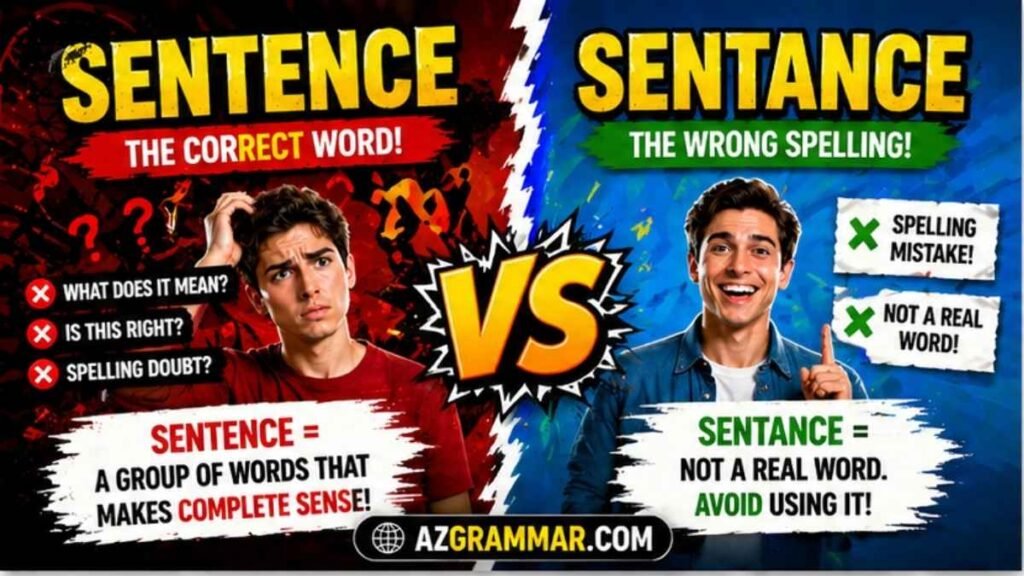
Sentence vs sentance one is real, one is a spelling mistake millions make daily.
You’re typing fast, deadline looming and suddenly you pause. Did you just write sentance? That quiet doubt creeps in. Sound familiar?
You’re not alone. This ranks among the most Googled spelling questions in English worldwide. ESL learners search it. Native speakers search it. Students and professionals too.
The answer is crystal clear.
Only sentence exists in every dictionary Merriam-Webster, Oxford, Cambridge. The other never has. Not historically Or Not regionally. Not ever.
Let’s fix that right now.
Sentence vs Sentance — What’s the Verdict?
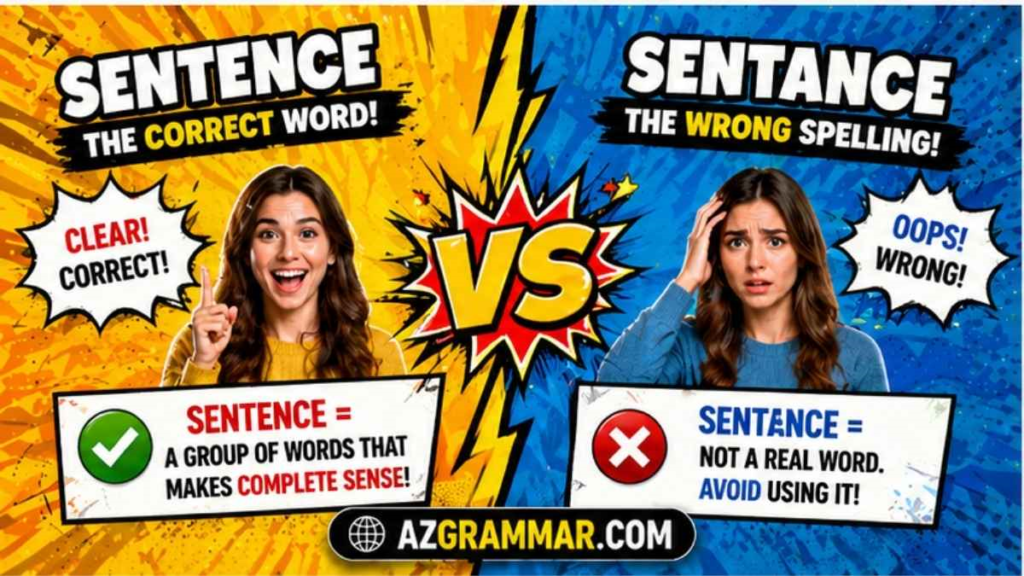
This Sentence is correct. Always.
Sentance is a misspelling. It doesn’t appear in Merriam-Webster, Oxford, or Cambridge. Not historically Or regionally. Not in any dialect, anywhere on Earth.
Here’s the quick comparison:
| Spelling | In Any Dictionary? | Correct? |
|---|---|---|
| ✅ Sentence | Yes | Always |
| ❌ Sentance | No | Never |
The word sentence pulls double duty in English. In grammar, it’s a group of words expressing a complete thought. In law, it’s the punishment a judge hands down after a criminal conviction. Two very different worlds same spelling, zero exceptions.
Spell it wrong in an essay, a job application, or a professional email and your credibility takes a quiet but real hit. Readers notice. Hiring managers notice. Teachers definitely notice.
Cutesy vs Cutsie: Don’t Make This Spelling Mistake!
What Exactly Is a Sentence? Full Definition and Meaning
Think of a sentence as the smallest unit of language that can stand on its own and actually mean something. Strip it down to its bones and you need two things: a subject and a predicate.
“A sentence is a set of words that is complete in itself, typically containing a subject and predicate.” Oxford Dictionary
That’s the grammar definition. But sentence works as both a noun and a verb, which makes it one of those rare, versatile words that shifts roles depending on context.
- As a noun: “Write one sentence summarizing your argument.”
- As a verb: “The judge will sentence the defendant next Thursday.”
Pronunciation matters here too. It’s SEN-tens not SEN-tance, not SEN-tence with a lazy middle vowel. Three syllables, clean and crisp.
The Legal Side of the Word
Step outside the grammar classroom and sentence takes on a weightier meaning. In law, a sentence is the punishment a court assigns following a criminal conviction. You’ve heard the phrases:
- A prison sentence of five years
- A suspended sentence — punishment delayed or avoided under conditions
- A life sentence — confinement for the remainder of someone’s natural life
Same word. Completely different stakes. But spell it sentance in either context and you’ve got a problem.
Why “Sentance” Is Wrong — The Spelling Error Explained
So where does sentance even come from? Nobody invented it deliberately. It sneaks in because of how the word sounds.
Say “sentence” out loud. That middle syllable ten doesn’t sound sharply like an E. It sounds almost neutral, somewhere between an E and an A. Your brain, especially if English isn’t your first language, reaches for the closest familiar pattern. And -ance endings are everywhere in English: distance, performance, dominance, abundance.
That’s the trap. And it catches native speakers too not just ESL learners.
What makes it worse? Autocorrect isn’t reliable here. Some devices flag sentance immediately. Others let it slide right through. You can’t outsource your spelling to technology and call it a day.
The bottom line:
- It’s not a British vs. American spelling difference — both say sentence
- It’s not an archaic form — sentance was never correct at any point in history
- It’s not a texting abbreviation — it’s simply a mistake
“Is It Hopping or Hoping? The Spelling Rule You Need”
The Etymology of “Sentence” — Why It’s Spelled With -ence
Etymology is where spelling suddenly makes sense. Peel back the layers of sentence and you find a Latin word sitting at its core: sententia, meaning opinion, thought, or judgment.
The verb behind it? Sentire — to feel, to perceive. That same Latin root gave English a whole family of related words:
- Sense — to feel or detect
- Sentiment — an emotional feeling
- Sensation — a physical or emotional perception
- Consent — to feel agreement with
- Dissent — to feel opposition
From Latin, sententia passed through Old French almost unchanged still spelled sentence before settling into Middle English. The -ence ending comes directly from the Latin suffix -entia, which forms abstract nouns. Think: existence, patience, silence.
That suffix isn’t random. It’s baked into the word’s DNA. So when you write sentance, you’re not just making a spelling error you’re fighting a thousand years of linguistic history.
The -ence vs -ance Trap: Why English Spelling Trips Everyone Up
Here’s an uncomfortable truth: English has no reliable phonetic rule that separates -ence words from -ance words. Both endings sound almost identical in casual speech. That’s not your fault it’s a genuine structural flaw in English spelling.
Common -ence words:
- Sentence
- Difference
- Confidence
- Existence
- Patience
- Silence
Common -ance words:
- Dominance
- Abundance
- Distance
- Performance
- Endurance
- Relevance
Notice anything? There’s no pattern you can hear. You just have to know or look it up. Even brilliant writers keep a dictionary tab open. There’s no shame in it.
For ESL learners especially, this is one of the trickiest corners of English spelling. The only real fix is memorization, context, and the memory tricks coming up next.
How to Spell “Sentence” Correctly Memory Tricks That Actually Work
Good news: once one of these tricks clicks, it sticks forever.
Trick 1 — Find the Hidden “Ten” Look closely: sen-TEN-ce. The word ten is hiding right in the middle. Find the ten and you’ll never reach for an A again.
Trick 2 — The Sense Connection Sentence and sense share the same Latin root (sentire). If you can spell sense, you’re most of the way there. Just add -tence after the SEN.
Trick 3 — The -ence Family Memorize these four together: sentence, silence, difference, confidence. Group them in your mind. The pattern reinforces itself.
Trick 4 — Say It in Syllables SEN — TEN — CE. Three beats. No A anywhere in there.
Trick 5 — The Legal Anchor A judge hands down a sentence. Serious word, serious spelling. Imagine the courtroom. Imagine the judge. Sentence.
Trama vs Trauma: Which One Is Correct? (2026)
Types of Sentences — The Complete Grammar Breakdown
Now that you know how to spell it, let’s talk about what a sentence actually does. English has seven core sentence types and each one serves a distinct purpose.
Declarative Sentences
The workhorse of writing. A declarative sentence states a fact, an opinion, or an observation and ends with a period.
- She reads three books every month.
- The experiment produced unexpected results.
This is your default sentence type the one you use most without thinking about it.
Interrogative Sentences
Ask a question, get an interrogative sentence. It ends with a question mark and typically inverts the subject-verb order.
- Did you finish the report?
- Where does the river end?
A common ESL error: forgetting to flip the subject and verb. “You did finish the report?” sounds like a statement, not a question.
Imperative Sentences
Commands, instructions, requests that’s the imperative. The subject (you) is implied, invisible, but always present.
- Close the door.
- Add two cups of flour.
- Please submit your application before Friday.
One of the most fascinating things about imperative sentences? They can be a single word. Stop. Run. Listen. All complete sentences.
Exclamatory Sentences
Strong emotion, exclamation mark. Simple enough but easy to overuse.
- That was the most incredible performance I’ve ever seen!
- I can’t believe we won!
Use these sparingly in professional writing. One well-placed exclamatory sentence lands with impact. Ten in a row just looks frantic.
Compound Sentences
Two independent clauses joined by a coordinating conjunction the FANBOYS: For, And, Nor, But, Or, Yet, So.
- She studied all night but she still felt unprepared.
- He wanted to speak yet the words wouldn’t come.
Notice: no comma before the conjunction in those examples. That’s intentional the rule against using commas to separate independent clauses joined by FANBOYS is one writers frequently ignore.
Complex Sentences
One independent clause plus one or more dependent clauses, linked by a subordinating conjunction: because, although, while, since, unless.
- Although the rain was heavy, they continued the match.
- She succeeded because she refused to quit.
Complex sentences add nuance. They show relationships between ideas cause, contrast, condition in ways simple sentences can’t.
Compound-Complex Sentences
The advanced move. Combine a compound sentence with at least one dependent clause and you get a compound-complex sentence.
- Although she was exhausted, she finished the project and her client was thrilled.
These show up constantly in academic and legal writing. Used well, they’re powerful. Overused, they become a maze.
Sentence Structure — The Essential Components
Every sentence regardless of type is built from the same raw materials.
| Component | Definition | Example |
|---|---|---|
| Subject | Who or what the sentence is about | The dog barked. |
| Predicate | What the subject does or is | The dog barked loudly. |
| Object | What receives the action | She threw the ball. |
| Clause | A group with a subject + verb | Because it rained (dependent) |
| Phrase | A group without a subject-verb pair | In the morning |
What Makes a Sentence a Sentence?
Three things must line up:
- A subject
- A predicate
- A complete thought
Miss any one of these and you’ve got a sentence fragment something that looks like a sentence but isn’t.
Fragment: Running through the park every morning. Fixed: She runs through the park every morning.
Fragments aren’t always wrong in creative writing skilled authors use them deliberately for rhythm and punch. But in academic and professional writing, they signal error.
Enrolment or Enrollment: Which One Is Correct?
Sentence vs Sentance Used Correctly Across Real-World Contexts
The word sentence shows up everywhere. Here’s how different fields use it:
Academic Writing Every strong essay relies on a clear topic sentence to open each paragraph and a thesis statement to anchor the whole piece. These aren’t decorative they’re structural.
Legal Writing Courts hand down sentences daily. A criminal conviction can result in anything from a fine to a life sentence. The precision of legal language means spelling matters even more here documents get scrutinized word by word.
Common Mistakes Writers Make With “Sentence”
Even after you’ve nailed the spelling, there are other pitfalls worth knowing:
- Sentence fragments — missing a subject, predicate, or complete thought
- Run-on sentences — two independent clauses crammed together without proper punctuation or a conjunction
- Comma splices — using a comma where a period or conjunction belongs: She was tired, she went home. ❌
- Confusing noun vs. verb usage — sentence functions differently in “Write a sentence” vs. “The court will sentence him”
- Overusing exclamatory sentences — enthusiasm is great but one exclamation mark goes further than ten
Does Any Dialect or Region Use “Sentance”?
Short answer: no.
| Region | Correct Spelling |
|---|---|
| American English | Sentence |
| British English | Sentence |
| Australian English | Sentence |
| Canadian English | Sentence |
| South African English | Sentence |
Sentance isn’t a regional variant. It isn’t a historical form. It isn’t informal digital shorthand. It’s a spelling error full stop wherever you are in the world.
Sentence vs Sentance — The Full Comparison Table
| Feature | Sentence | Sentance |
|---|---|---|
| Correct spelling | ✅ Yes | ❌ No |
| In Merriam-Webster | ✅ Yes | ❌ No |
| In Oxford Dictionary | ✅ Yes | ❌ No |
| In Cambridge Dictionary | ✅ Yes | ❌ No |
| Has a grammar meaning | ✅ Yes | ❌ No |
| Has a legal meaning | ✅ Yes | ❌ No |
| Used in British English | ✅ Yes | ❌ Never |
| Used in American English | ✅ Yes | ❌ Never |
| Recommended | ✅ Always | ❌ Never |
Recognize vs Recognise Explained: Easy Guide 2026
Reference Cambridge Dictionary Definitions
Here’s a trusted source for clear Grammar:
FAQs Sentence vs Sentance
What Is the Correct Spelling Sentence vs Sentance?
Sentence is always correct. Sentance doesn’t exist in any dictionary not Merriam-Webster, Oxford, or Cambridge. It’s not a regional variant, not a British alternative, and not an old-fashioned spelling. It’s simply a misspelling, and there are zero exceptions to this rule.
Why Do So Many People Write “Sentance” Instead of “Sentence”?
The middle syllable is the villain here. When you say sentence out loud, that -ten- sound blurs into something that feels like an A. English also has hundreds of common -ance words distance, performance, dominance so your brain pattern-matches in the wrong direction. It’s a phonetic trap, not a sign of poor intelligence.
What Does “Sentence” Mean in Grammar?
A sentence is a group of words that contains at least a subject and a predicate and expresses a complete thought. It’s the smallest unit of language that can stand entirely on its own. Remove either the subject or the predicate and what’s left is a fragment not a sentence.
What Does “Sentence” Mean in Law Is It the Same Word?
Completely different meaning, identical spelling. In legal contexts, a sentence is the punishment a court assigns after a criminal conviction a prison sentence, a suspended sentence, or a life sentence. Same word, two entirely separate worlds. Both always spell it sentence.
Why Does the -ence vs -ance Difference Confuse Even Native Speakers?
Because English offers no reliable phonetic rule to separate them. Both endings sound nearly identical in everyday speech. Words like confidence and dominance feel similar when spoken yet take opposite suffixes. The only real solution is memorization and even fluent native speakers get this wrong regularly.
How Do You Use “Sentence” as a Verb Correctly?
When a judge delivers punishment, they sentence the defendant. For example: “The court will sentence him to three years in prison.” Most people only know sentence as a noun but its verb form is just as valid — and just as frequently misspelled.
What’s the Fastest Way to Remember the Correct Spelling of Sentence?
Look for the hidden word: SEN-TEN-CE. The number ten sits right in the middle of sentence. Find the ten and you’ll never reach for an A again. Another trick sentence shares its Latin root (sentire) with sense. If you can spell sense, you’re already halfway there.
Is “Sentance” Ever Acceptable in Informal or Digital Writing?
No — not in texting, not in social media captions, not in casual emails. Sentance isn’t informal shorthand. It isn’t an accepted abbreviation. It’s a straightforward misspelling in every context, for every audience, in every English-speaking country worldwide. Informal writing still follows spelling rules.
What’s the Difference Between a Sentence and a Sentence Fragment?
A sentence has a subject, a predicate, and expresses a complete thought. A fragment is missing at least one of those elements. “Running every morning” fragment. “She runs every morning” sentence. Fragments can work in creative writing for stylistic effect but in academic and professional writing they’re considered errors.
Can a Sentence Legally Be Just One Word?
Yes — and it’s more common than most people realize. Imperative sentences often consist of a single word because the subject (you) is implied rather than stated. Stop. Listen. Run. Each one qualifies as a grammatically complete sentence. The subject is invisible but it’s absolutely there.
What Are the Most Common Mistakes People Make With Sentence Structure?
Three mistakes dominate:
- Run-on sentences — cramming two independent clauses together without proper punctuation
- Comma splices — using a comma where a period or conjunction belongs (“She was tired, she went home” ❌)
- Sentence fragments — leaving out the subject or predicate entirely
All three make writing harder to read and weaker to grade or rank.
Conclusion
You started with a simple question sentence vs sentance? — and now you’re walking away with something far more valuable than just the answer.
Here’s what to lock in before you go:
- Sentence is always correct — in grammar, in law, in every English dialect worldwide
- Sentance has never existed in any dictionary — not once, not anywhere
- The confusion is real and totally understandable — English’s -ence vs -ance problem trips up native speakers too
- The fix is simple: find the ten hiding in SEN-TEN-CE and you’ll never forget it
Whether you’re an ESL learner building confidence, a student polishing an essay, or a professional who just wants to stop second-guessing yourself spelling sentence correctly is one small upgrade that quietly improves everything you write.
Good writing starts with getting the basics right. You’ve got this one locked down now. Go write something great.

James Walker is an English language educator with over 5 years of experience in grammar teaching. He specializes in spelling corrections, confusing word pairs, and grammar rules for everyday use. As the lead author at AZ Grammar, he has helped thousands of students and learners worldwide write English with confidence. His simple, practical approach makes even the most complex grammar rules easy to understand.
Email: azgrammar29@gmail.com
Website: azgrammar.com