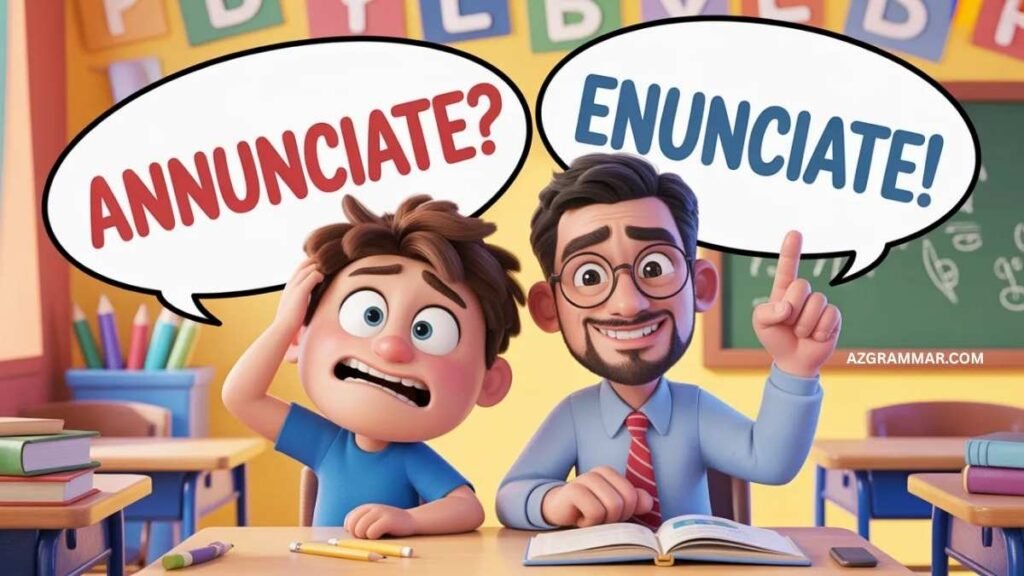
The enunciate vs annunciate debate trips up even confident writers and honestly, it’s easy to see why. Both words look right. Both sound close enough to feel legitimate. Yet only one belongs in your everyday vocabulary.
These two words share similar spelling, nearly identical pronunciation, and a common Latin ancestor. No wonder people freeze mid-sentence and second-guess themselves.
Here’s what most grammar guides won’t tell you upfront: annunciate is real but almost irrelevant in modern English. It exists dictionaries confirm it but the average writer, speaker, or student will go an entire lifetime without ever needing it. Enunciate, on the other hand, is the word you reach for every single day.
So if you’ve been writing annunciate where enunciate belongs, you’re in good company. Thousands of people make the same mistake without realizing it and spell-check won’t save you because both words pass the test.
This guide breaks down enunciate vs annunciate completely. You’ll get clear definitions, real-world examples, the Latin roots behind both words, and a memory trick that makes the right choice automatic. By the end, you won’t hesitate again.
Let’s clear this up once and for all.
What Does Enunciate Mean?
Enunciate is a verb. It has two closely related meanings depending on context.
First meaning speech clarity: To enunciate means to pronounce words clearly, carefully, and distinctly. Think of a drama teacher telling students to “open your mouth and enunciate.” She wants crisp consonants, full vowels, and zero mumbling.
Second meaning formal expression: To enunciate also means to state or express something formally. A politician might enunciate a new policy. A philosopher might enunciate a theory. In this sense, it’s about putting ideas into precise, deliberate language.
Pronunciation: en-UN-see-ayt
Part of speech: Verb (enunciate, enunciates, enunciated, enunciating)
Address vs Adress: Which Spelling Is Correct? [2026]
Example Sentences Using Enunciate
- “Please enunciate your words the audience in the back can’t hear you.”
- “The CEO enunciated the company’s three core values during the town hall.”
- “Speech therapists train clients to enunciate difficult consonant sounds.”
- “She enunciated every syllable slowly so the non-native speakers could follow along.”
Notice how naturally enunciate fits into everyday communication. It covers both physical speech and the act of articulating ideas. That versatility is exactly why it’s the dominant word in this pair.
What Does Annunciate Mean?
Annunciate is also a verb and yes, it is a real English word. Many people assume it’s simply a misspelling of enunciate but that’s not the case. It has its own distinct meaning.
To annunciate means to announce or proclaim something, particularly in a formal or religious context. The word is most strongly associated with The Annunciation the biblical event in which the angel Gabriel announced to Mary that she would bear Jesus. That’s the clearest and most widely recognized use of the word’s root.
Outside of religious and historical texts, annunciate occasionally appears in technical documentation particularly in older engineering and telecommunications contexts where it means to signal or indicate something.
Pronunciation: ah-NUN-see-ayt
Part of speech: Verb (annunciate, annunciates, annunciated, annunciating)
Example Sentences Using Annunciate
- “The angel was sent to annunciate the news to Mary.” (religious/historical context)
- “The system will annunciate an alarm when the pressure exceeds safe limits.” (technical context)
- “Medieval texts often used annunciate to describe royal proclamations.” (archaic usage)
The key takeaway? Annunciate is legitimate but narrow. It belongs in specific, often specialized contexts. In everyday writing and speech, it has no place.
The Core Difference: Enunciate vs Annunciate
People struggle with enunciate vs annunciate because both words look similar and share Latin ancestry. But their meanings don’t overlap the way most people assume.
| Feature | Enunciate | Annunciate |
|---|---|---|
| Primary meaning | Speak clearly / state formally | To announce or proclaim |
| Common in everyday use? | ✅ Yes | ❌ Rarely |
| Part of speech | Verb | Verb |
| Latin root | enuntiare | annuntiare |
| Appears in religious texts? | No | Yes |
| Recommended for general writing? | ✅ Always | ❌ Almost never |
| Accepted by major style guides? | Yes | In narrow contexts only |
The simplest way to think about it: enunciate is about how you say something. Annunciate is about what you’re proclaiming and even then, only in specific historical or technical settings.
Feen vs Fein: Most People Spell It Wrong
Etymology: Where Did These Words Come From?
Understanding where words come from makes it far easier to use them correctly. Both enunciate and annunciate trace back to Latin which is precisely why they cause so much confusion.
The Root of Enunciate
Enunciate comes from the Latin verb enuntiare, which means “to speak out” or “to express clearly.” Break it down further:
- e- (or ex-) = out, outward
- nuntiare = to announce, to report
- nuntius = messenger
So enuntiare literally meant “to send a message out clearly.” Over centuries, it passed through Old French and into Middle English before settling into its modern form. By the 17th century, English writers were using enunciate to describe clear verbal expression and the meaning has held ever since.
The Root of Annunciate
Annunciate comes from annuntiare, also Latin, meaning “to announce” or “to bring news to.” Notice the difference:
- ad- (shortened to an-) = to, toward
- nuntiare = to announce
While enuntiare focuses on the clarity of expression going outward, annuntiare focuses on delivering a message to someone often as a divine or official proclamation.
The English word announce is actually the more natural modern descendant of annuntiare. That’s why annunciate feels archaic because announce already does the job better in modern English.
Key insight: Both words share the Latin root nuntius (messenger). Think of enunciate as “speak out clearly” and annunciate as “deliver a proclamation to.” Same family, very different functions.
American English vs British English: Any Difference?
This is a fair question especially since American and British English diverge on spellings like color/colour or organize/organise. But with enunciate vs annunciate, there’s no such split.
Both American and British English:
- Spell enunciate identically
- Spell annunciate identically
- Prefer enunciate in everyday and formal writing
- Reserve annunciate for the same narrow religious and archaic contexts
The confusion here isn’t regional. It’s simply a matter of word similarity tricking people into reaching for the wrong term. Neither dialect treats these as interchangeable.
How to Use Each Word Correctly
Use Enunciate When:
- Talking about clear speech, pronunciation, or diction
- Describing someone articulating ideas, policies, or beliefs formally
- Writing about public speaking, elocution, or communication skills
- Teaching or learning English as a second language
- Writing in any professional, academic, or creative context
Use Annunciate When:
- Writing about religious history, specifically The Annunciation
- Referencing archaic or historical texts where the word already appears
- Working with older technical documentation in engineering or telecommunications
- Translating or analyzing medieval or early modern literature
Audience-Based Guidance
| Audience | Which Word to Use |
|---|---|
| Students | Always use enunciate |
| ESL learners | Stick with enunciate entirely |
| General writers | Enunciate in every situation |
| Journalists | Enunciate style guides prefer it |
| Theologians / historians | Annunciate may apply in specific cases |
| Technical writers (modern) | Enunciate unless referencing legacy systems |
Focussed or Focused: Which Spelling Is Correct?
Real-World Examples in Context
Seeing both words in realistic scenarios makes the choice much clearer.
Professional Emails
✅ “During tomorrow’s presentation, please enunciate clearly we’ll have attendees calling in remotely.” ❌ “Please annunciate clearly during the call.”Incorrect and jarring to a professional reader.
Academic Writing
✅ “The professor enunciated his thesis in the opening paragraph.” ❌ “The professor annunciated his thesis.” Grammatically odd and contextually wrong.
Public Speaking Coaching
✅ “One of the most powerful tools a speaker has is the ability to enunciate with precision every word lands harder when the audience hears it clearly.”
Religious / Historical Writing
✅ “The painting depicts the moment Gabriel came to annunciate the divine message.” ❌ Using enunciate here would technically work but misses the specific theological weight of annunciate.
News and Journalism
Style guides including AP Style and Chicago Manual of Style consistently favor enunciate in all journalistic contexts. Annunciate would raise red flags in any modern newsroom.
Sweeped vs Swept: Which Word Is Correct?
Common Mistakes and How to Avoid Them
These are the most frequent errors writers make with enunciate vs annunciate and how to fix each one.
Mistake #1: Using annunciate as a synonym for enunciate
❌ “She annunciated her words carefully during the interview.” ✅ “She enunciated her words carefully during the interview.”
Mistake #2: Assuming annunciate sounds more formal or sophisticated
Some writers choose annunciate thinking it sounds more polished. It doesn’t. It sounds wrong. Clarity always beats complexity in good writing.
Mistake #3: Trusting spell-check to catch the error
Most spell-checkers accept annunciate because it is technically a word. Don’t rely on autocorrect to make this distinction for you it won’t.
Mistake #4: Confusing annunciate with announce
These two share roots but aren’t the same. Announce is the modern, everyday word. Annunciate is its archaic cousin. If you mean “to announce,” just say announce.
Mistake #5: Mixing up pronunciation
Both words sound nearly identical in casual speech. That’s part of the problem. Slow down and listen: en-UN-see-ayt vs ah-NUN-see-ayt. The opening syllables are different and so are the meanings.
Memory Trick: Never Confuse These Words Again
Here’s a simple mnemonic that works:
“E” is for Everyday and Enunciate is your Everyday word.
Think of it this way:
- Enunciate → Express → Everyday use ✅
- Annunciate → Archaic → Almost never needed ❌
Another helpful anchor: the word elocution starts with e and elocution is all about speaking clearly. Enunciate and elocution belong in the same mental category. They’re both about voice, clarity, and expression.
If you still find yourself hesitating, just ask: “Am I talking about an angel delivering divine news or an ancient proclamation?” If the answer is no and it almost always will be choose enunciate.
Here are the rewritten sections:
Caliber vs Calibre: Which Spelling Is Correct?
Reference Cambridge Dictionary Definitions
Here’s a trusted source for clear Grammar:
FAQs About Enunciate vs Annunciate
Is Annunciate a Real English Word?
Yes, it is but real doesn’t mean broadly useful. Annunciate has a narrow meaning tied to formal proclamation and religious announcement. Most modern writers will never need it. If you’re not writing about theology or archaic texts, don’t reach for it.
Can I Use Annunciate Instead of Enunciate?
No. These two words aren’t synonyms so they aren’t interchangeable. Using annunciate where enunciate belongs is a grammar error even if your spell-checker doesn’t catch it. The meanings point in different directions entirely.
Why Do People Confuse Enunciate and Annunciate?
Shared Latin ancestry is the biggest culprit. Both words descend from the Latin root nuntiare (to announce) but carry different prefixes that shift their meanings. Add in nearly identical spelling and similar pronunciation and the confusion is almost inevitable.
Which Word Is More Common in Everyday English?
Enunciate and it’s not even close. It dominates across dictionaries, style guides, academic writing, journalism, and casual conversation. Annunciate is a niche term that most fluent English speakers will never use in their lifetime.
Is Annunciate Outdated or Obsolete?
Not fully obsolete but it’s certainly on life support in modern usage. English has largely replaced it with announce for proclamations and enunciate for speech clarity. You’ll mostly find annunciate in older religious texts or 19th-century literature.
What’s the Easiest Way to Remember the Difference?
Remember this: E for Everyday. Enunciate is your everyday word for clear speech and formal expression. Annunciate belongs to angels, ancient proclamations, and archaic texts. If neither of those applies to your sentence, you already know which word to use.
Do Both Words Share the Same Spelling in US and UK English?
Yes completely. There’s no regional spelling difference between American and British English on this one. The confusion here is purely about meaning, not dialect or geography.
What Does It Mean to Enunciate Clearly in Public Speaking?
It means pronouncing each word fully and distinctly no swallowed syllables, no rushed endings, no lazy consonants. Good enunciation gives every sound its proper weight so your audience catches every word without straining. It’s one of the most powerful and underrated tools any speaker can develop.
Conclusion
The enunciate vs annunciate debate has a straightforward winner: choose enunciate almost every time.
It covers clear speech, careful articulation, and the formal expression of ideas. It works in professional emails, academic essays, public speeches, and everyday conversation without ever feeling out of place. Annunciate serves an honest but narrow role in religious and historical contexts and even then, announce often handles the job more cleanly.
So the next time you hesitate between these two words, don’t overthink it. Ask yourself one simple question: Am I describing an angelic proclamation or ancient religious history? If the answer is no use enunciate and move on. Your readers will thank you for it.

James Walker is an English language educator with over 5 years of experience in grammar teaching. He specializes in spelling corrections, confusing word pairs, and grammar rules for everyday use. As the lead author at AZ Grammar, he has helped thousands of students and learners worldwide write English with confidence. His simple, practical approach makes even the most complex grammar rules easy to understand.
Email: azgrammar29@gmail.com
Website: azgrammar.com