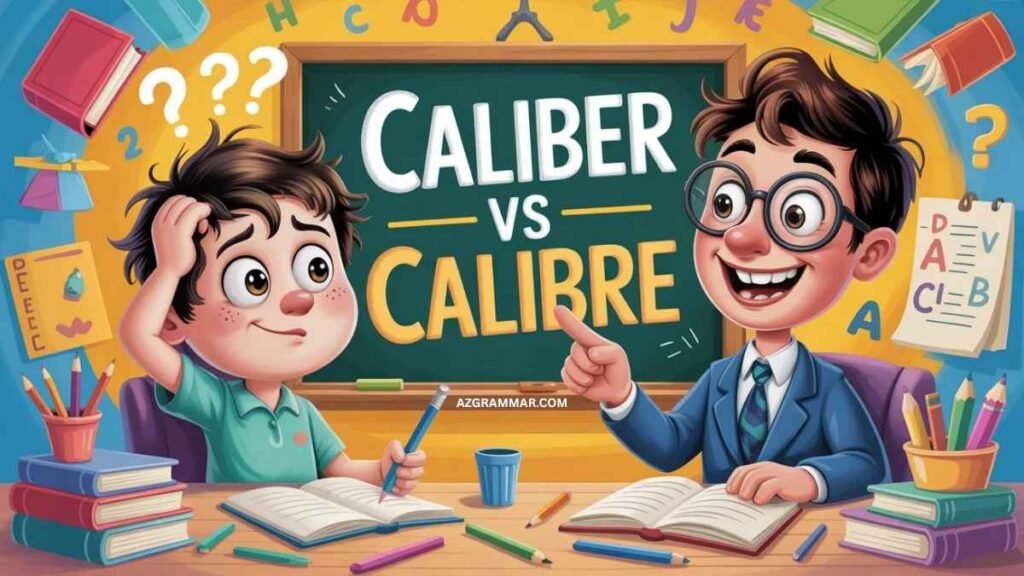
You’ve probably come across both caliber vs calibre and paused for a second. Which one is actually correct? Is one a mistake, or do they mean different things?
This confusion is more common than you might think. English is full of spelling variations, especially when you compare American and British usage. Words like color vs colour or center vs centre follow the same pattern, and caliber vs calibre is no different.
Here’s the good news. You don’t need to memorize complicated grammar rules to get this right. Once you understand how regional spelling works, the choice becomes straightforward.
In this guide, you’ll learn the exact difference, when to use each version, and how to apply it confidently in real-world writing.
Quick Answer (Featured Snippet Target)
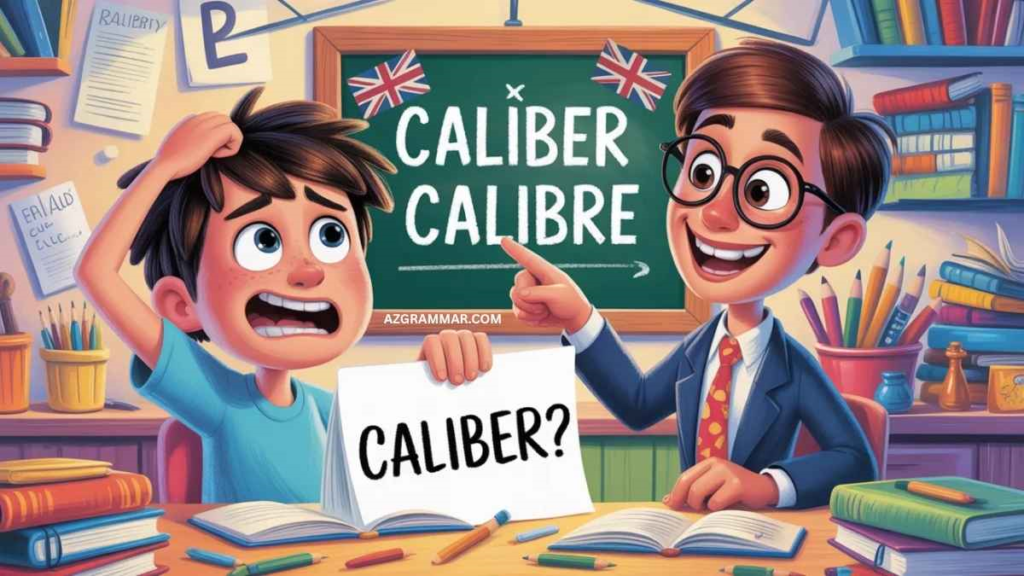
- “Caliber” is the preferred spelling in American English
- “Calibre” is the standard spelling in British English
- Both words have the same meaning. The difference is regional, not grammatical
Feen vs Fein: Most People Spell It Wrong
What Does “Caliber” or “Calibre” Mean?
At its core, caliber (or calibre) has two main meanings. Understanding both helps you use the word correctly in any context.
Meaning 1: Measurement (Technical Use)
In technical or military contexts, caliber refers to:
- The diameter of a bullet
- The internal diameter of a gun barrel
For example:
- A “.22 caliber” firearm uses bullets that are approximately 0.22 inches in diameter
This meaning is widely used in engineering, defense, and manufacturing industries.
Meaning 2: Quality or Standard (Figurative Use)
In everyday language, caliber describes:
- The level of quality
- The standard of someone’s ability
For example:
- “She is a leader of high caliber.”
- “This university attracts top-calibre students.”
👉 Think of it like this:
If something has high caliber, it’s impressive. If it has low caliber, it’s not.
Caliber vs Calibre: The Key Difference
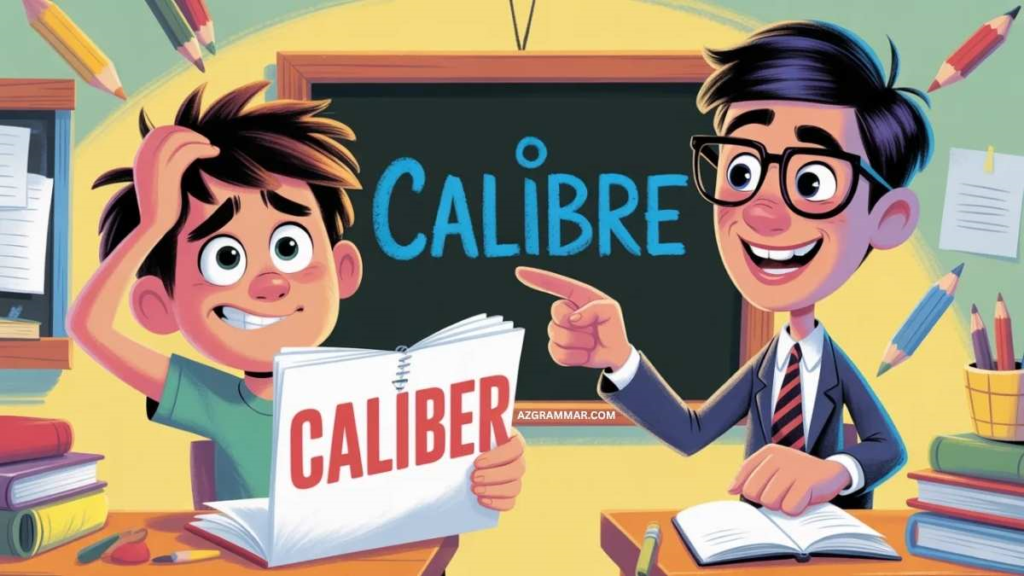
Here’s where most people get confused. The difference isn’t about meaning. It’s about spelling preference based on region.
| Aspect | Caliber | Calibre |
|---|---|---|
| Region | United States | United Kingdom, Commonwealth |
| Meaning | Same | Same |
| Usage | American writing | British writing |
Key Insight
There is no difference in meaning, pronunciation, or correctness. Only spelling changes.
So instead of asking which is correct, the better question is:
👉 Which is correct for your audience?
Nauseous or Nauseated? Which One Should You Use in 2026
American vs British English: Why the Spelling Change
English isn’t a single uniform language. It evolved differently in different regions.
Why “Caliber” and “Calibre” Exist
In the United States, spelling was simplified over time. Meanwhile, British English retained more traditional forms.
This difference was influenced by major dictionaries:
- :contentReference[oaicite:0]{index=0} → favors simplified spellings like caliber
- :contentReference[oaicite:1]{index=1} → preserves traditional forms like calibre
Common Pattern Examples
You’ll notice the same pattern in many words:
| American English | British English |
|---|---|
| color | colour |
| center | centre |
| favor | favour |
| theater | theatre |
Why Consistency Matters
Imagine reading a blog where both spellings are mixed randomly. It feels sloppy and confusing.
👉 Consistency builds trust.
👉 Consistency improves readability.
👉 Consistency helps SEO.
When Should You Use “Caliber” or “Calibre”?
Choosing the right spelling is easier than you think. Just match it to your audience.
Writing for a US Audience
Use caliber if your readers are in the United States.
You’ll see this spelling in:
- Blogs and websites
- Academic papers
- Business communication
- Marketing content
Writing for a UK or International Audience
Use calibre when writing for:
- United Kingdom readers
- Australia, Canada (sometimes mixed usage), and other Commonwealth countries
Writing for Global or SEO Content
This is where strategy matters.
If your website targets:
- US traffic → use caliber
- UK traffic → use calibre
If your audience is mixed:
- Pick one version
- Stay consistent across the entire site
💡 Pro Tip:
Search engines recognize both spellings. However, consistency improves topical authority.
Apologise or Apologize: Which Spelling Is Correct?
Real-World Usage Examples
Let’s bring this into real life so you can see how it actually works.
Everyday Language
- “He is a player of exceptional caliber.”
- “That was a top-calibre performance.”
Notice how both sound natural. Only spelling changes.
Professional and Academic Writing
In formal writing, spelling reflects credibility.
Example:
- US journal → “high caliber research”
- UK journal → “high calibre research”
Small detail. Big impact.
Technical Context (Firearms)
In technical contexts:
- “9mm caliber handgun”
- “.50 calibre rifle”
Both refer to exact measurements, not quality.
👉 Important:
Spelling does NOT change technical meaning.
Common Mistakes to Avoid
Even experienced writers make these mistakes. Let’s fix them.
Mixing Spellings
❌ Wrong:
- “This is a high calibre product with excellent caliber performance.”
✔ Correct:
- Stick to one version only
Assuming Different Meanings
Some people think:
- “caliber = measurement”
- “calibre = quality”
👉 This is incorrect. Both meanings apply to both spellings.
Confusing with “Caliper”
This is a common error.
- Caliber/Calibre → quality or measurement
- Caliper → a measuring tool
Example:
- “Use a caliper to measure diameter”
Using the Wrong Regional Style
If your audience is American, avoid British spelling. And vice versa.
Address vs Adress: Which Spelling Is Correct? [2026]
Caliber vs Calibre vs Caliper
Let’s clear this up once and for all.
| Word | Meaning | Example |
|---|---|---|
| Caliber | Quality or measurement | High caliber work |
| Calibre | Same as caliber (UK spelling) | High calibre work |
| Caliper | Measuring instrument | Use a caliper tool |
Why This Confusion Happens
- Words look similar
- Pronunciation is nearly identical
- Context determines meaning
👉 Tip: If you’re talking about a tool, it’s caliper.
Origin and History of the Word
The word has a fascinating history.
Etymology
- Derived from French: calibre
- Possibly from Arabic qālib (meaning mold or form)
How the Spelling Split Happened
- British English kept the original “calibre”
- American English simplified it to “caliber”
This happened during the 18th and 19th centuries when American English started forming its own identity.
Linguistic Insight
This pattern reflects a broader trend:
- American English → simplified spelling
- British English → traditional spelling
Usage Trends and Popularity
Let’s talk about real-world data behavior.
General Trends
- Caliber dominates in the United States
- Calibre dominates in the UK and Commonwealth countries
Search Behavior Insight
People search based on location:
- US users → “caliber vs calibre”
- UK users → “calibre meaning”
SEO Reality
Google understands both spellings as the same concept.
However:
- Matching user intent improves rankings
- Local spelling improves click-through rate
Style Guide Tips for Writers
If you want polished, professional writing, follow these rules.
Stick to One Standard
Switching between spellings damages credibility.
Match Your Brand Voice
- US-based brand → American English
- UK-based brand → British English
Check Editorial Guidelines
Different publications have strict rules.
For example:
- Academic journals
- News websites
- Corporate blogs
Think About Your Reader
Always ask:
👉 Who is reading this?
Your answer determines your spelling choice.
Focussed or Focused: Which Spelling Is Correct?
Reference Cambridge Dictionary Definitions
Here’s a trusted source for clear Grammar:
FAQs
What is the difference between caliber and calibre?
There is no difference in meaning. Both words refer to the same concepts, including measurement and quality. The only distinction is spelling. “Caliber” is used in American English, while “calibre” appears in British English.
Is caliber American or British spelling?
“Caliber” is the American English spelling. You’ll see it in US-based writing such as blogs, academic papers, and business content.
Is calibre wrong in the United States?
It’s not technically wrong. However, it may look unusual or out of place in American writing. Most US readers expect “caliber,” so using “calibre” can feel inconsistent.
Do caliber and calibre have different meanings?
No. Both spellings carry the same meanings. They can refer to the diameter of a firearm or describe the quality or level of something.
How do you use caliber in a sentence?
You can use it in both technical and figurative ways:
- “She is a leader of high caliber.”
- “The rifle uses .30 caliber ammunition.”
Is this similar to color vs colour?
Yes, it follows the same pattern. American English drops the “u” in words like “color,” “favor,” and “caliber,” while British English keeps it in “colour,” “favour,” and “calibre.”
Does pronunciation change between caliber and calibre?
No. Both are pronounced the same way. The difference exists only in spelling, not in how the word sounds.
Which spelling should students use in assignments?
Students should follow the style required by their school or country. For example, US schools typically expect “caliber,” while UK institutions prefer “calibre.”
Is calibre used outside the UK?
Yes. Many Commonwealth countries such as Australia, Canada, and South Africa commonly use “calibre,” although Canada sometimes mixes both styles.
Which spelling is better for SEO content?
It depends on your target audience. If your content targets US readers, use “caliber.” If your audience is in the UK or similar regions, use “calibre.” Consistency across your content is key for better results.
Conclusion
When it comes to caliber vs calibre, the answer is simple once you understand the context. Both spellings are correct. The only real difference lies in regional preference. American English uses caliber, while British English uses calibre.
What matters most is consistency. If you switch between spellings, your writing can feel unpolished and confusing. Instead, choose the version that matches your audience and stick with it throughout your content.
Think of it like choosing a tone of voice. Once you set it, you stay consistent to build trust and clarity.
In the end, this isn’t about right or wrong. It’s about writing with purpose. Use the spelling your readers expect, keep your style consistent, and your content will feel more natural, professional, and easy to understand.

James Walker is an English language educator with over 5 years of experience in grammar teaching. He specializes in spelling corrections, confusing word pairs, and grammar rules for everyday use. As the lead author at AZ Grammar, he has helped thousands of students and learners worldwide write English with confidence. His simple, practical approach makes even the most complex grammar rules easy to understand.
Email: azgrammar29@gmail.com
Website: azgrammar.com