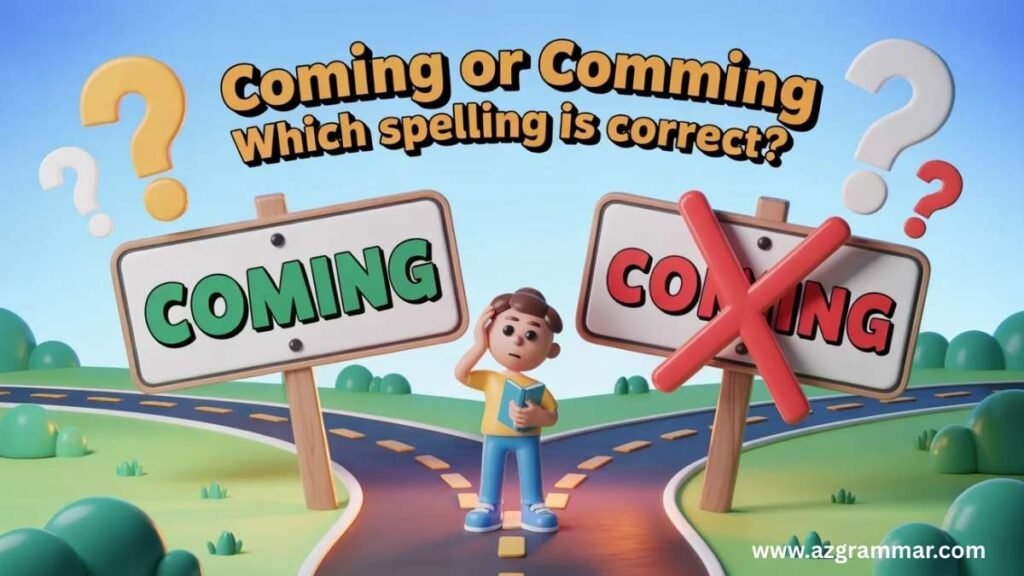
If you have ever paused while typing coming and wondered whether it should be comming, you are not alone. Many writers make this exact mistake. It appears in emails, social media posts, text messages, and even professional documents.
At first glance, comming looks believable. After all, English often doubles consonants before adding -ing. Think about words like running or swimming. Because of that pattern, people naturally assume come should become comming.
However, that assumption is incorrect.
The correct spelling of coming always uses one “m.” The word comming is a spelling mistake in standard English.
This guide explains coming or comming, the grammar rule behind the spelling, why people often get it wrong, and how you can avoid this mistake in your writing. You will also see real examples, grammar explanations, and simple memory tricks that make the rule easy to remember.
Coming or Comming: The Quick Answer
Let’s start with the direct answer many readers search for.
| Word | Correct? | Explanation |
|---|---|---|
| Coming | ✅ Correct | Present participle of the verb come |
| Comming | ❌ Incorrect | A common spelling mistake |
So if you are asking “comming or coming which is correct?”, the answer is simple.
Coming is always correct.
Comming is always incorrect in standard English.
Here are a few correct examples:
- She is coming to the meeting tomorrow.
- The train is coming in five minutes.
- New technology is coming to the market soon.
In contrast, comming does not appear in dictionaries or grammar references. It exists only as a spelling mistake comming from misunderstanding English spelling rules.
Time Flys or Flies: Which One Is Correct?
Understanding the Verb “Come”
To understand why coming vs comming confuses so many writers, it helps to look at the verb itself.
The word come is one of the most common verbs in English. It describes movement toward a place or person. It also appears in many metaphorical expressions.
Basic Verb Conjugation of “Come”
| Verb Form | Example |
|---|---|
| Base verb | come |
| Present tense | come / comes |
| Past tense | came |
| Past participle | come |
| Present participle | coming |
The present participle form uses -ing. This form appears in continuous tenses such as:
- I am coming.
- She is coming home.
- They are coming to the conference.
In grammar terminology, coming is the present participle form created by adding -ing to the base verb come.
Understanding that structure helps explain why comming incorrect spelling appears so often.
Why “Comming” Looks Correct to Many Writers
The confusion around is comming correct usually comes from another English rule.
English often doubles the final consonant before adding “-ing.”
For example:
| Base Verb | -ing Form |
|---|---|
| run | running |
| swim | swimming |
| sit | sitting |
| stop | stopping |
Because of these examples, many writers assume the same pattern applies to come.
They think:
come + ing = comming
However, that logic ignores another important English grammar rule.
The verb come ends with a silent “e.”
When verbs end with silent e, English spelling usually drops the “e” before adding “-ing.”
So the correct transformation becomes:
come → coming
This rule explains why does come become coming instead of comming.
The Grammar Rule Behind the Spelling of Coming
The correct spelling follows the silent e rule, one of the most common patterns in English orthography.
The Silent “E” Rule
When a verb ends with silent e, the e is dropped before adding -ing.
Examples include:
| Base Verb | Correct Form |
|---|---|
| come | coming |
| make | making |
| write | writing |
| drive | driving |
| take | taking |
The rule works because the silent letter e does not affect pronunciation once -ing is added.
For example:
- make → making
- drive → driving
- move → moving
Notice how the e disappears.
This same rule explains the correct form of come + ing.
Centre vs Center: Which One Is Correct?
The Double Consonant Rule (When Letters Actually Double)
The confusion between coming or comming becomes clearer when we compare the silent e rule with the double consonant rule.
English doubles the final consonant before -ing only in specific situations.
The Double Consonant Rule
A consonant doubles when:
- The verb ends with consonant-vowel-consonant (CVC)
- The final syllable is stressed
Examples:
| Base Verb | Correct -ing Form |
|---|---|
| run | running |
| swim | swimming |
| plan | planning |
| stop | stopping |
These verbs do not end with silent e. Therefore, they follow a different spelling rule.
This comparison shows why comming meaning does not exist in proper English spelling.
Real Examples of “Coming” in Sentences
Seeing examples of coming in a sentence helps reinforce the correct spelling.
Everyday Conversation Examples
You will hear coming constantly in spoken English.
Examples:
- I am coming over after work.
- Are you coming to dinner tonight?
- The taxi is coming now.
Professional Writing Examples
The word appears frequently in workplace communication.
Examples:
- The product launch is coming next month.
- New regulations are coming into effect soon.
- A major update is coming to the platform.
News Headlines
Journalists often use the word coming to describe approaching events.
Examples:
- A major storm is coming this weekend.
- Economic changes are coming in the next quarter.
These examples clearly show when to use coming in a sentence.
Literal and Metaphorical Uses of “Coming”
The word coming functions both literally and metaphorically.
Understanding this difference helps English learners use the word naturally.
Literal Meaning (Physical Movement)
In literal usage, coming describes movement toward a place.
Examples:
- She is coming to the office.
- The bus is coming down the street.
- My friend is coming from New York.
Here the verb describes actual movement.
Metaphorical Meaning
English frequently uses movement verbs metaphorically.
Examples:
- Change is coming.
- Winter is coming.
- A new era is coming.
In these cases, coming means approaching or happening soon.
This explains why can coming be used metaphorically. The answer is yes.
Why Do People Spell Coming as Comming?
Many readers search why do people spell coming as comming because the mistake appears surprisingly often.
Several factors cause this error.
Confusion with Other Spelling Patterns
Writers see patterns like:
- run → running
- swim → swimming
They apply the same rule incorrectly.
Fast Typing
Typing quickly increases the chance of accidental double letters.
For example:
coming → comming
This happens frequently in casual messages.
English Language Learners
People learning English may struggle with English spelling rules. Many languages do not use silent letters.
As a result, the silent e rule can feel inconsistent.
Autocorrect Issues
Sometimes predictive text suggests incorrect forms. This problem appears on mobile keyboards.
Common Spelling Mistakes with -ing Verbs
The spelling mistake comming belongs to a larger group of errors involving adding ing to verbs.
Here are similar mistakes:
| Incorrect | Correct |
|---|---|
| writeing | writing |
| makeing | making |
| moveing | moving |
| takeing | taking |
| liveing | living |
All of these errors ignore the silent e rule.
Understanding the rule helps you avoid common English spelling mistakes like these.
Realize or Realise: Which Spelling Is Correct?
Case Study: How Grammar Errors Affect Professional Writing
Even small spelling mistakes can influence how readers perceive your writing.
Consider this simple email example.
Incorrect Version
The new software update is comming tomorrow.
Correct Version
The new software update is coming tomorrow.
The first sentence contains a visible grammar error. Readers may interpret that mistake as carelessness or lack of professionalism.
In contrast, the second sentence looks polished and clear.
This difference matters in:
- professional emails
- academic papers
- business communication
- published articles
For that reason, learning how to spell coming correctly improves the credibility of your writing.
Practical Tips: How to Avoid Spelling “Coming” Wrong
If you often wonder how to avoid spelling coming wrong, a few simple techniques help.
Remember the Base Verb
Think about the base verb:
come
Then apply the silent e rule.
come → coming
Look for Silent E
If the verb ends with silent e, drop it before adding -ing.
Examples:
- write → writing
- move → moving
- drive → driving
Say the Word Slowly
Breaking the word into parts helps.
come + ing
This naturally produces coming, not comming.
Proofread Quickly
Before sending a message or publishing content, scan for common spelling mistakes with ing verbs.
Even a quick review catches many errors.
Facts About English Spelling Rules
English spelling may appear inconsistent. However, many patterns follow logical rules.
Here are a few useful facts:
- The silent e rule appears in thousands of English verbs.
- The double consonant rule depends on stress patterns and syllables.
- Many spelling mistakes occur when writers mix these two rules.
Understanding these patterns improves your grasp of verb morphology and verb inflection in English grammar.
Onsite or On-Site: Which Spelling Is Correct?
Reference Cambridge Dictionary Definitions
Here’s a trusted source for clear Grammar:
FAQs
Is comming correct?
No. Comming is not correct in standard English spelling. The only correct form is coming.
Why is comming wrong?
It breaks the silent e rule. Verbs ending in silent e drop the e before adding -ing.
How do you spell coming?
The correct spelling is:
coming
It uses one “m.”
Is coming spelled with one m or two?
The correct spelling uses one “m.”
coming
Why doesn’t come become comming?
Because the silent letter e is dropped before ing. This rule produces coming instead of comming.
What is the rule for adding ing to verbs?
English generally follows these patterns:
| Situation | Example |
|---|---|
| Silent e ending | make → making |
| Double consonant rule | run → running |
| Standard addition | play → playing |
When do you double consonants before ing?
A consonant doubles when:
- The verb ends with consonant-vowel-consonant
- The final syllable is stressed
Examples include running, swimming, and planning.
Why do we drop the e before ing?
The silent e disappears because it no longer affects pronunciation when -ing is added.
Can coming be used metaphorically?
Yes. For example:
- Opportunity is coming.
- Change is coming.
Is “coming soon” correct grammar?
Yes. The phrase coming soon is widely used in marketing, websites, and announcements.
Final Thoughts:
The debate over coming or comming becomes simple once you understand the grammar rule.
Here is the key takeaway.
- Coming is the correct spelling.
- Comming is always a spelling mistake.
- The word follows the silent e rule.
When the base verb ends with silent e, English drops the e before adding -ing.
So the transformation works like this:
come → coming
Not:
come → comming
Learning this small rule helps you avoid one of the most common writing mistakes in English.
And once you remember it, you will never hesitate again when typing coming.

James Walker is an English language educator with over 5 years of experience in grammar teaching. He specializes in spelling corrections, confusing word pairs, and grammar rules for everyday use. As the lead author at AZ Grammar, he has helped thousands of students and learners worldwide write English with confidence. His simple, practical approach makes even the most complex grammar rules easy to understand.
Email: azgrammar29@gmail.com
Website: azgrammar.com