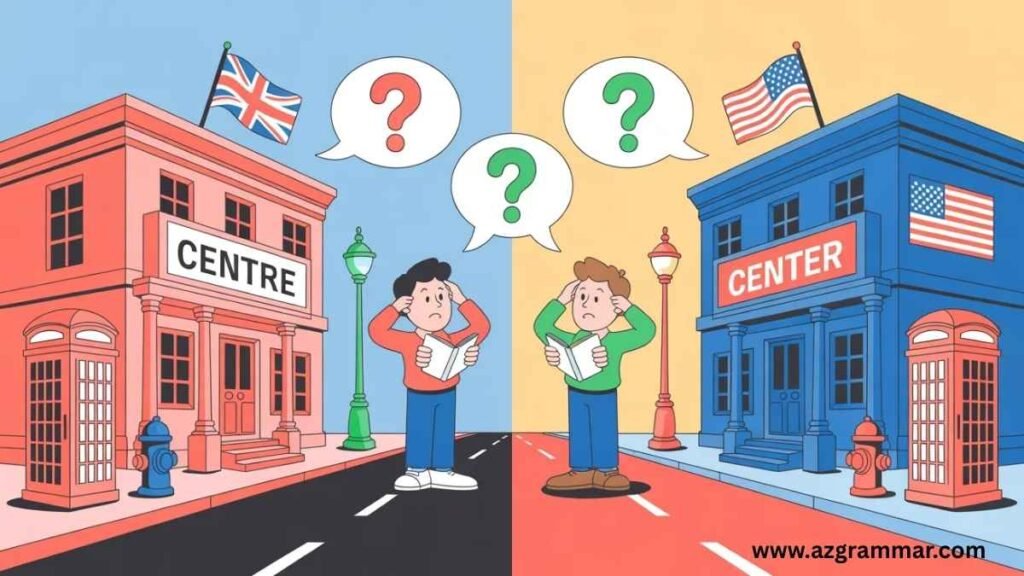
Ever typed a sentence and suddenly paused, wondering if it’s centre or center? You’re not alone. The Centre vs Center debate has confused writers, students, and even seasoned professionals for years. One version looks perfectly right in London, while the other feels completely normal in New York. So which one wins? The truth is a little surprising. Unlike many spelling mistakes, both centre and center are correct. The real difference comes down to geography, language history, and writing style. In this guide, we’ll untangle the Centre vs Center mystery, explain when to use each spelling, and give you simple tricks so your writing always looks polished, no matter where your readers live.
Centre vs Center: Which One Is Correct?
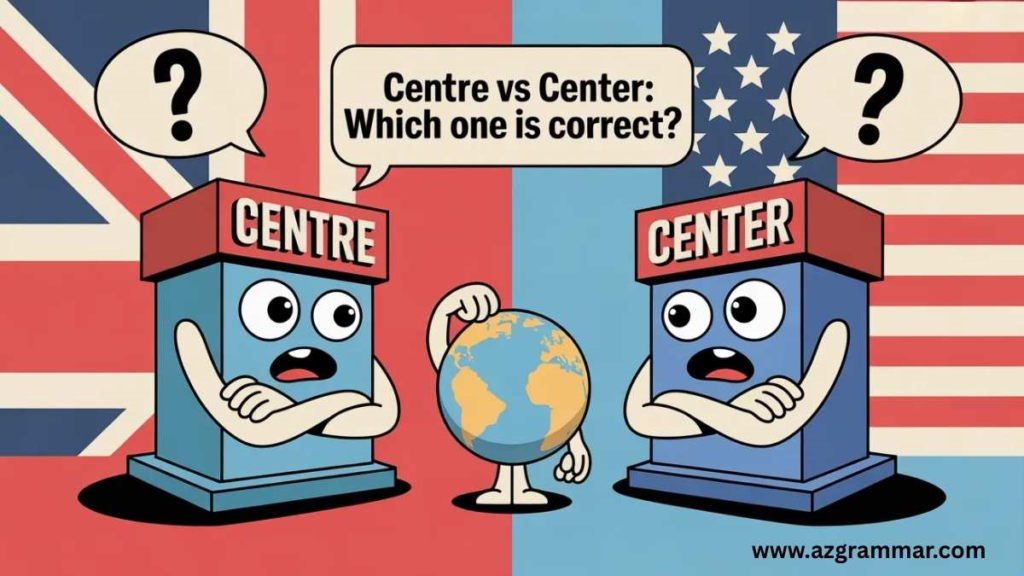
The short answer is simple.
Both “centre” and “center” are correct spellings.
The difference depends on the regional variety of English you are using.
| Word | Region | Correct Usage |
|---|---|---|
| Center | American English | Used in the United States |
| Centre | British English | Used in the UK and many Commonwealth countries |
For example:
- Americans write shopping center
- British writers use shopping centre
Both words carry the same meaning. The difference lies purely in spelling conventions.
Understanding this difference helps writers maintain consistent language style, which is important for professional communication.
Bearing or Baring: How to Use It Correctly
Why the Confusion Exists
The confusion surrounding centre vs center does not happen because one spelling is wrong. Instead, it results from language evolution and regional differences.
English has developed multiple standard forms, including:
- American English
- British English
- Canadian English
- Australian English
Each variety has its own spelling preferences.
Historical Divergence
After the United States gained independence in the late 18th century, American scholars began simplifying English spelling.
One major figure in this movement was Noah Webster, the American lexicographer who created the famous Webster’s Dictionary.
Webster believed English spelling should be simpler and more logical. As a result, many words changed spelling in American English.
Examples include:
| British English | American English |
|---|---|
| colour | color |
| theatre | theater |
| centre | center |
| metre | meter |
These changes helped create a distinct American spelling system.
Influence of Dictionaries
Dictionaries play a major role in shaping spelling standards.
Two influential examples include:
- Oxford English Dictionary (UK)
- Merriam-Webster Dictionary (USA)
These dictionaries reinforce regional spelling conventions.
Global Spread of English
Today, English is spoken by over 1.5 billion people worldwide. Because different countries adopt different spelling traditions, words like centre vs center naturally cause confusion.
Word Origin and Language History
To understand the centre vs center debate fully, it helps to explore the history of the word itself.
Latin and French Origins
The word originates from the Latin term:
centrum
This word referred to the middle point of a circle.
Later, the word entered French as:
centre
Because English borrowed heavily from French during the Middle Ages, the British spelling retained the -re ending.
Development of British English
British English maintained the French-influenced spelling centre.
Examples of similar patterns include:
| Word | British Spelling |
|---|---|
| centre | centre |
| theatre | theatre |
| metre | metre |
These spellings reflect the historical connection between English and French.
American Spelling Reform
In the early 1800s, Noah Webster promoted spelling reforms that simplified many words.
He replaced -re endings with -er endings, resulting in the American spelling center.
The change aimed to create a spelling system that better reflected English pronunciation.
| Period | Spelling |
|---|---|
| Latin | centrum |
| Old French | centre |
| British English | centre |
| American English | center |
Together vs Togather: What’s the Correct Word?
Meaning of “Centre” and “Center”
Despite the spelling difference, centre and center have identical meanings.
Both words refer to a middle point, focus, or central location.
Dictionary Definitions
Major dictionaries define the word as:
The point that is equally distant from every part of something.
Or more broadly:
The main place of activity or attention.
Common Meanings
| Meaning | Example |
|---|---|
| Middle point | The center of the circle |
| Main activity area | The city centre shopping district |
| Focus of attention | She became the center of the discussion |
These meanings appear across many fields, including mathematics, geography, politics, and communication.
Grammar and Word Forms
The spelling difference also affects related word forms.
American English Word Forms
| Word Form | Example |
|---|---|
| center | community center |
| centered | well-centered design |
| centering | centering the image |
British English Word Forms
| Word Form | Example |
|---|---|
| centre | city centre |
| centred | self centred attitude |
| centring | centring the logo |
Notice that the spelling pattern remains consistent within each regional variety.
Regional Usage Around the World
Where you live often determines whether you write centre or center.
| Country | Preferred Spelling |
|---|---|
| United States | center |
| United Kingdom | centre |
| Canada | centre |
| Australia | centre |
| New Zealand | centre |
Canada is an interesting case. Canadian English follows British spelling traditions, though American influence appears in some contexts.
Understanding these regional differences helps writers choose the correct spelling for their audience.
Either or Eather: Which One Is Correct?
Centre vs Center in Different Contexts
The word appears in many contexts, including physical locations and metaphorical meanings.
Physical Location
In everyday language, the word often refers to a place or building.
Examples:
- The shopping center opens at 9 AM.
- The historic city centre attracts tourists.
Both sentences describe a central place or hub of activity.
Metaphorical Meaning
The word can also describe attention or focus.
Examples:
- She became the center of attention at the party.
- The debate moved toward the political centre.
In politics, centre often refers to moderate political positions between left and right ideologies.
Style Guides and Writing Standards
Professional writers rely on style guides to determine which spelling to use.
Three widely recognized style guides include:
- AP Stylebook – used by journalists
- Chicago Manual of Style – used in academic publishing
- Oxford Style Guide – used in British academic writing
Each guide recommends using consistent spelling based on regional language standards.
For example:
- AP Style uses American spelling (center)
- Oxford style prefers British spelling (centre)
Consistency is essential in professional writing.
Centre vs Center in Academic and Professional Writing
Choosing the correct spelling becomes especially important in formal contexts.
Academic Writing
Universities typically follow regional spelling standards.
Examples:
| Location | Preferred Spelling |
|---|---|
| US universities | center |
| UK universities | centre |
Students writing research papers should follow the spelling conventions of their institution.
Corporate Communication
Companies also follow regional spelling rules.
Example:
- An American company writes customer service center
- A British company writes customer service centre
Using the wrong spelling can make writing appear inconsistent or unprofessional.
Real Life Usage Examples
Seeing real examples helps clarify how centre vs center appears in everyday communication.
Everyday Conversation
Examples:
- Let’s meet at the shopping center.
- The restaurant sits in the historic city centre.
Social Media
Examples:
- “The new sports center just opened!”
- “Walking through the beautiful city centre today.”
Workplace Communication
Examples:
- Our office is located in the financial center.
- The company headquarters sits in the business centre.
These examples show how spelling adapts depending on regional English standards.
Common Mistakes Writers Make
Writers sometimes mix the spellings accidentally.
Common mistakes include:
- Switching spellings within the same article
- Using British spelling in American publications
- Mixing related forms like centered and centred
Example corrections:
| Incorrect Usage | Correct Usage |
|---|---|
| city centre in US article | city center |
| shopping center in UK article | shopping centre |
Consistency is the key to professional writing.
Time Flys or Flies: Which One Is Correct?
Related Spelling Differences in English
The centre vs center difference is part of a broader pattern.
Many English words follow similar spelling differences.
| American English | British English |
|---|---|
| center | centre |
| color | colour |
| theater | theatre |
| meter | metre |
These spelling differences developed during the evolution of English across regions.
Usage Trends and Search Insights
Online search data shows that many writers wonder about centre vs center.
Popular search queries include:
- centre vs center difference
- center or centre which is correct
- centre spelling British English
- center spelling American English
This interest reflects the global nature of English communication.
As international communication increases through digital platforms, spelling differences become more noticeable.
Reference Cambridge Dictionary Definitions
Here’s a trusted source for clear Grammar:
FAQs
Is “centre” wrong in American English?
No. It is not incorrect, but it is uncommon in American writing.
Can I use both spellings interchangeably?
Technically yes, but it is best to stay consistent within the same document.
Which spelling should I use for SEO?
Use the spelling that matches your target audience’s regional language.
Is “center” more modern?
Not necessarily. It simply reflects American spelling reform.
Do universities use different spellings?
Yes. Universities follow the regional spelling conventions of their country.
What about “centred” vs “centered”?
The same rule applies:
- centered – American English
- centred – British English
Which spelling should ESL learners choose?
Learners should choose one variety of English and stay consistent.
For example:
- American English learners → center
- British English learners → centre
Final Thoughts:
The Centre vs Center debate isn’t really about right or wrong. It’s about where your English comes from. Both spellings are correct. They simply belong to different varieties of the language.
If you are writing for an American audience, use center. If your readers follow British English, then centre is the correct choice. The key is consistency. Switching between the two spellings in the same article can confuse readers and make your writing look unpolished.
Think of it like driving on different sides of the road. Both systems work perfectly well. You just need to follow the rules of the place you’re in.
Choose the version that matches your audience, stay consistent, and your writing will always stay right at the center or centre of clarity.

James Walker is an English language educator with over 5 years of experience in grammar teaching. He specializes in spelling corrections, confusing word pairs, and grammar rules for everyday use. As the lead author at AZ Grammar, he has helped thousands of students and learners worldwide write English with confidence. His simple, practical approach makes even the most complex grammar rules easy to understand.
Email: azgrammar29@gmail.com
Website: azgrammar.com