
Have you ever typed a sentence, paused for a second, and wondered: “Wait… is it realize or realise?” Congratulations, you’ve just joined one of the internet’s most quietly dramatic spelling debates. The Realize or Realise dilemma has confused students, writers, bloggers, and even professionals who thought they had English completely figured out. One version looks perfectly normal in the United States, while the other feels right at home in the United Kingdom. So which one is actually correct? Are you making a spelling mistake, or is English just being its usual unpredictable self? In this guide, we’ll clear up the Realize or Realise confusion and show you exactly when each spelling belongs.
Quick Answer: Realize or Realise?
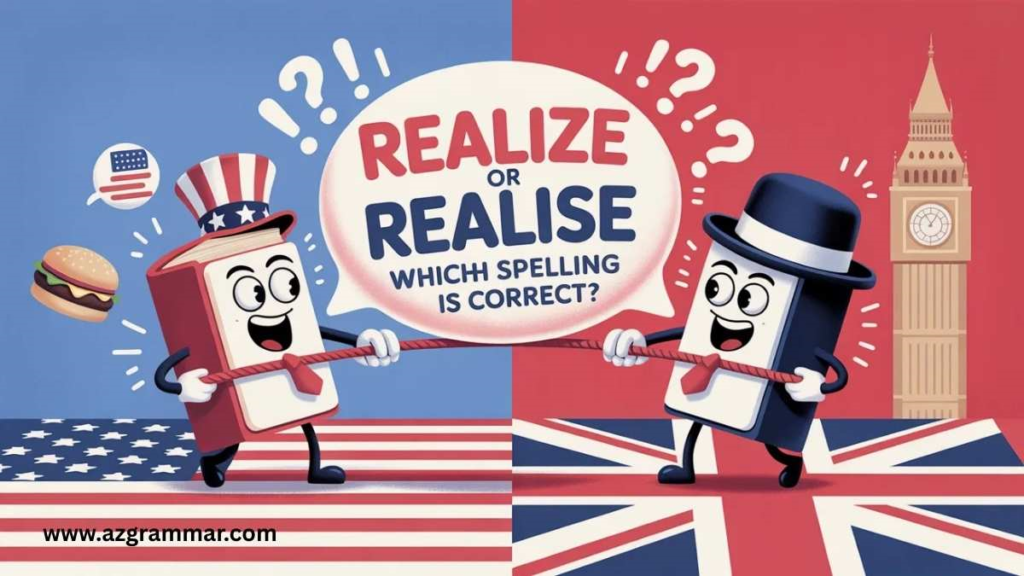
One word. Two spellings. And a surprisingly long debate in English writing.
The short answer is simple:
Both “realize” and “realise” are correct.
The spelling you choose depends mainly on regional English standards.
| Word | Region | Correct Usage |
|---|---|---|
| Realize | American English | Commonly used in the United States |
| Realise | British English | Commonly used in the UK and Commonwealth countries |
For example:
- Americans usually write:
“I suddenly realized the answer.” - British writers often write:
“She realised her mistake.”
Both sentences are grammatically correct. The only difference is spelling style.
Centre vs Center: Which One Is Correct?
Why Writers Confuse Realize and Realise
The confusion surrounding realize vs realise does not come from grammar mistakes. Instead, it results from the global evolution of English.
Several factors contribute to this spelling difference.
American vs British English
English developed into two major standardized forms:
- American English
- British English
Both varieties follow slightly different spelling conventions.
Examples:
| American | British |
|---|---|
| realize | realise |
| organize | organise |
| analyze | analyse |
| recognize | recognise |
These variations reflect historical changes in spelling.
Influence of Style Guides
Publishing houses, universities, and media organizations follow style guides that determine spelling standards.
For example:
- American publications follow AP Stylebook or Chicago Manual of Style.
- British publications often follow Oxford Style Guide.
Each guide promotes consistency within its region.
Global Internet Communication
The internet mixes language varieties more than ever before.
Online writers read content from:
- the United States
- the United Kingdom
- Canada
- Australia
- New Zealand
Because of this global exposure, people frequently encounter both realize and realise.
ESL Learner Challenges
For English learners, seeing two spellings for the same word can feel confusing.
However, understanding that these are simply regional spelling differences makes the situation clearer.
Meaning of “Realize” and “Realise”
Despite the spelling difference, realize and realise have identical meanings.
Both words function as verbs in English and describe moments of awareness, understanding, or achievement.
Dictionary Definition
According to major dictionaries such as Oxford English Dictionary and Merriam-Webster, the word means:
To become aware of something, understand a fact, or make something real or achievable.
Core Meanings
| Meaning | Explanation | Example |
|---|---|---|
| Awareness | Becoming aware of something | I realized I forgot my keys |
| Understanding | Recognizing a truth | She realised the mistake |
| Achievement | Turning something into reality | He realized his dream |
These meanings appear frequently in everyday communication.
Together vs Togather: What’s the Correct Word?
Grammar and Word Usage in Sentences
Understanding how the word works grammatically helps writers apply the correct spelling.
Both realize and realise function as verbs.
They usually describe a moment when someone discovers, understands, or accomplishes something.
Examples include:
- I suddenly realized the answer to the problem.
- She finally realised the truth about the situation.
- The team realized their full potential.
- He realised the project needed major improvements.
In each example, the word describes a moment of understanding or recognition.
The -ize vs -ise Spelling Pattern
The realize vs realise debate reflects a larger pattern in English spelling.
Many words ending in -ize in American English appear as -ise in British English.
Examples include:
| American English | British English |
|---|---|
| realize | realise |
| organize | organise |
| recognize | recognise |
| analyze | analyse |
This pattern appears in hundreds of English words.
Interestingly, some British institutions still accept -ize spelling, particularly in academic writing.
Word Origin and Language History
The history of the word explains why two spellings exist.
Greek Roots
The word originates from the Greek suffix:
-izein
This suffix means:
“to make,” “to transform,” or “to cause something to become.”
Many English verbs use this suffix today.
Examples include:
- modernize
- organize
- recognize
- realize
Latin and French Influence
As the word traveled through languages, it passed into Latin as:
-izare
Later, it entered French before becoming part of English vocabulary.
Historical Spelling Development
| Period | Spelling Influence |
|---|---|
| Ancient Greek | -izein |
| Latin | -izare |
| Early English | realize |
| British variation | realise |
Originally, -ize spelling was historically closer to the Greek root.
However, British English gradually adopted the -ise variant in many publications.
American vs British Spelling Differences
Geography strongly influences whether writers use realize or realise.
| Region | Preferred Spelling |
|---|---|
| United States | realize |
| United Kingdom | realise |
| Canada | realise |
| Australia | realise |
| New Zealand | realise |
Canadian English follows British spelling traditions in many cases.
However, American spelling sometimes appears in Canadian publications due to geographic influence.
Either or Eather: Which One Is Correct?
Style Guide Recommendations
Professional writers rely on style guides to maintain consistent spelling.
Three major guides influence modern English writing.
AP Stylebook
Used widely in journalism and media.
Preferred spelling:
realize
Chicago Manual of Style
Used in academic and publishing environments.
Preferred spelling:
realize
Oxford Style Guide
Common in British academic writing.
Interestingly, Oxford style often recommends:
-ize spelling
Even though realise is widely accepted in British English.
| Style Guide | Preferred Spelling |
|---|---|
| AP Style | realize |
| Chicago Manual | realize |
| Oxford Style | realize (realise accepted) |
This surprises many writers who assume British English always uses -ise endings.
Realize vs Realise in Different Contexts
The spelling stays the same regardless of context, but the meaning can shift slightly.
Awareness or Understanding
Examples:
- I suddenly realized I left my wallet at home.
- She realised the answer during the meeting.
Achievement or Fulfillment
Examples:
- He worked hard to realize his dream of becoming a doctor.
- She realised her ambition of starting a company.
Planning or Action
Examples:
- The company hopes to realize its strategic goals.
- The project finally realised its expected results.
In all cases, the verb describes recognition or accomplishment.
Real Life Usage Examples
Seeing real examples helps clarify the spelling difference.
Everyday Conversation
Examples include:
- I just realized it’s already Friday.
- She realised she forgot the meeting.
Social Media
Common posts include:
- “Just realized how fast this year went.”
- “I realised I’ve been using the wrong password.”
Workplace Communication
Professional messages may say:
- The team realized the importance of collaboration.
- The manager realised additional funding was necessary.
Common Mistakes Writers Make
Even experienced writers sometimes make mistakes with realize vs realise.
Common errors include:
- Mixing American and British spelling in the same article
- Using the wrong spelling for the target audience
- Switching between -ize and -ise forms inconsistently
Example corrections:
| Incorrect Usage | Correct Usage |
|---|---|
| realise in US article | realize |
| realize in UK article | realise |
Consistency matters more than choosing one version over the other.
Time Flys or Flies: Which One Is Correct?
Memory Tricks to Remember the Difference
A simple memory trick can help writers remember the difference instantly.
Z for the USA
Think of Z for the USA.
| Spelling | Region |
|---|---|
| realize | United States |
| realise | United Kingdom |
This rule works surprisingly well for most writers.
Usage Trends and Language Insights
Search data shows that many people wonder about realize or realise.
Popular search queries include:
- realize vs realise difference
- realize or realise which is correct
- realise spelling British English
- realize spelling American English
The reason for this confusion is simple.
English has become a global language, and writers frequently encounter different spelling systems online.
Reference Cambridge Dictionary Definitions
Here’s a trusted source for clear Grammar:
FAQs
Is it realize or realise?
Both are correct.
The spelling depends on whether you are using American or British English.
Why do Americans spell realize with a “z”?
American English follows spelling reforms popularized by Noah Webster in the early 1800s.
Is realise British spelling?
Yes. Realise is widely used in British English and Commonwealth countries.
Can both spellings be used interchangeably?
Technically yes, but you should stay consistent within the same document.
Which spelling should I use in academic writing?
Follow the spelling standard required by your institution or style guide.
Do Australians use realise or realize?
Australian English usually follows British spelling, so realise is common.
Is realize incorrect in British English?
No. Many British academic publications still accept realize.
Are realize and realise interchangeable?
Yes, but only within their regional spelling contexts.
Conclusion:
By now, you probably realize… or perhaps realise something important: this spelling debate isn’t really a battle at all. Both versions are perfectly correct. The only real difference is where your English passport comes from.
If your writing follows American English, go with realize. If you’re using British English, realise will feel right at home. The key rule isn’t choosing one over the other. The real secret is staying consistent throughout your writing.
Think of it like tea and coffee. Both are great. It just depends on your preference and where you are in the world.
So next time you wonder “realize or realise?”, relax. Pick the version that fits your audience, keep it consistent, and your writing will always make perfect sense.

James Walker is an English language educator with over 5 years of experience in grammar teaching. He specializes in spelling corrections, confusing word pairs, and grammar rules for everyday use. As the lead author at AZ Grammar, he has helped thousands of students and learners worldwide write English with confidence. His simple, practical approach makes even the most complex grammar rules easy to understand.
Email: azgrammar29@gmail.com
Website: azgrammar.com