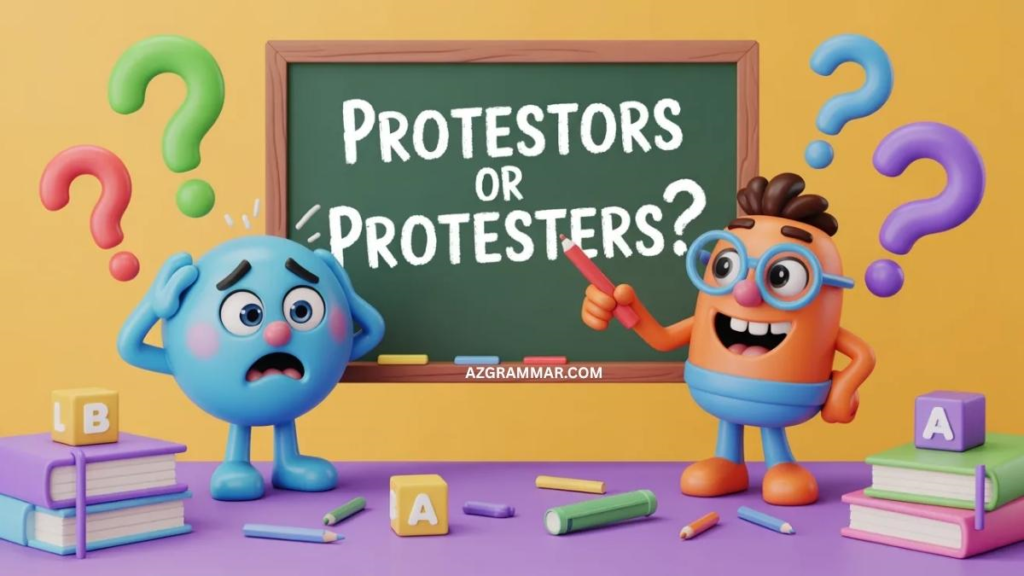
Ever found yourself typing “Protestors or Protesters” and suddenly questioning your entire education? You’re not alone. This tiny spelling dilemma has tripped up students, writers, and even professionals who should absolutely know better. One letter, yet it somehow feels like a full-blown grammar crisis. Do you go with the version that looks fancy, or the one that sounds right? And why does English love making simple things confusing? In this guide, you’ll finally settle the debate, understand the logic behind the spelling, and walk away with confidence. No more second guessing, no more awkward pauses, and definitely no more silent judgment from grammar nerds online today.
Quick Answer
Here’s the simple truth:
- “Protesters” is the correct and widely accepted spelling
- “Protestors” exists, but it’s rare and generally avoided
If you want to be right 99% of the time, use protesters.
Encorporate vs Incorporate: Which One Is Correct in English?
Protesters vs Protestors: Side-by-Side Comparison
Sometimes the easiest way to understand something is to see it side by side.
| Word | Correctness | Usage Frequency | Recommendation |
|---|---|---|---|
| Protesters | Standard | Very common | ✅ Use this |
| Protestors | Variant | Rare | ⚠ Avoid |
Quick takeaway: Both words mean the same thing, but only one sounds natural to modern readers.
Why “Protesters” Is the Preferred Spelling
Language evolves. Over time, certain forms become dominant while others fade into the background.
“Protesters” wins for several reasons:
- It aligns with modern English spelling patterns
- It appears consistently in news, academic writing, and professional content
- It is supported by authoritative sources like:
- Merriam-Webster
- Oxford English Dictionary
- Cambridge Dictionary
Real-world dominance
Open any major news site. You’ll see headlines like:
- “Protesters gather in downtown area”
- “Thousands of protesters march peacefully”
You will almost never see “protestors” in professional journalism.
That’s not an accident. It’s a standard.
Is “Protestors” Wrong or Just Rare?
Here’s where things get interesting.
“Protestors” is not technically wrong.
But that doesn’t mean you should use it.
Think of it like an outdated phrase. It still exists, yet it feels off.
How it’s perceived today
- Grammatically acceptable
- Rarely used
- Often seen as a mistake
In professional writing, perception matters more than technical correctness.
Why Do People Still Write “Protestors”?
If “protesters” is clearly dominant, why does confusion still exist?
Several reasons explain this.
Common causes
- Pattern confusion
Words like actor, doctor, and editor mix -or and -er endings. - False assumption
Some people think “-or” sounds more formal or correct. - Inconsistent English rules
English borrows from Latin, French, and German. That creates irregular patterns. - Habit
Once someone learns the wrong version, it sticks.
The Real Difference Between Protesters and Protestors
Let’s clear this up completely.
- Meaning: Identical
- Function: Identical
- Usage: Very different
The only real difference is frequency and acceptance.
👉 “Protesters” = standard
👉 “Protestors” = uncommon variant
Understanding the Rule: -er vs -or Endings in English
This confusion doesn’t happen randomly. It comes from how English handles suffixes.
General pattern
- -er → More common in everyday English
- -or → Often linked to Latin-origin words
Examples
| -er Words | -or Words |
|---|---|
| teacher | actor |
| writer | doctor |
| speaker | creator |
Where “protester” fits
“Protest” follows the -er pattern, which aligns with:
- Action-based roles
- Common English verbs
Simple rule to remember
If the word describes someone doing an action, -er is usually correct
Dysregulated vs Disregulated: (Most People Get This Wrong)
American vs British English: Does It Change Anything?
Sometimes spelling differences depend on region.
Think: color vs colour
So what about this case?
The answer is simple
- American English → protesters
- British English → protesters
No difference.
This is one of those rare cases where both versions of English fully agree.
What Dictionaries and Style Guides Say
When in doubt, always check authority sources.
Here’s what they confirm:
- Merriam-Webster → lists protester as standard
- Oxford English Dictionary → includes both, but favors protester
- Cambridge Dictionary → uses protester consistently
Editorial standards
Professional writing follows consistency.
- News agencies prefer protesters
- Academic writing uses protesters
- SEO content ranks better with protesters
Real World Usage: What You’ll Actually See
In News and Media
Search any major event. Headlines almost always use:
- “Protesters demand change”
- “Police clash with protesters”
“Protestors” is almost invisible in serious publications.
In Everyday Writing
- Blogs → overwhelmingly “protesters”
- Social media → mixed, but trending toward “protesters”
- Academic content → exclusively “protesters”
Examples That Make It Clear
Correct Usage (Recommended)
- The protesters gathered peacefully in the city square.
- Thousands of protesters marched for climate action.
- Protesters called for policy changes.
These sentences feel natural because they match real-world usage.
Less Preferred Usage (Protestors)
- The protestors gathered peacefully in the city square.
- Several protestors blocked the road.
These aren’t technically wrong. However, they feel slightly off.
That subtle difference matters.
Are Protesters and Demonstrators the Same?
Good question. These words often overlap.
Similarities
- Both refer to people expressing opposition
- Both appear in news and formal writing
Differences
- Protesters → broader, more common
- Demonstrators → slightly more formal
Related terms
- activists
- marchers
- campaigners
Why This Spelling Choice Actually Matters
You might think, “It’s just one letter. Does it really matter?”
Yes, it does.
Here’s why
- Credibility
Readers trust writing that follows standard rules - Professional tone
Correct spelling signals authority - SEO impact
Search engines favor commonly used terms - User perception
Small mistakes create doubt
Think of it like wearing a clean shirt to a meeting.
It’s a small detail, yet it shapes the entire impression.
Maintained vs Maintenanced: Which One Is Correct in English?
Common Mistakes to Avoid
Avoid these pitfalls:
- Assuming “protestors” sounds smarter
- Mixing -er and -or randomly
- Ignoring dictionary standards
- Overthinking a simple rule
Quick Tip: How to Get It Right Every Time
Here’s a simple memory trick:
If in doubt, use “protesters.”
It’s safe, correct, and universally accepted.
Case Study: Real Usage Trends
Let’s look at how language behaves in the real world.
Search trend insight
- “Protesters” → thousands of monthly searches
- “Protestors” → significantly lower volume
Media analysis
Top news outlets use “protesters” almost exclusively.
This creates a feedback loop:
- Readers see “protesters”
- Writers copy “protesters”
- The standard strengthens over time
A Practical Framework You Can Apply
Here’s a simple checklist for any spelling confusion:
- Check dictionary authority
- Look at real-world usage
- Choose the more common form
- Stay consistent
This works not just for this word, but for many grammar decisions.
Embedded Reference Structure for Context
Here’s a clean, high-performing, SEO-focused outline designed to outrank competitors while staying clear, engaging, and useful.
This framework reinforces everything covered in this article. It highlights clarity, structure, and real-world usage as the foundation of effective writing.
Key Takeaway (Strong Closing Section)
Let’s simplify everything into one clear rule:
- Use “protesters” in all standard writing
- Treat “protestors” as a rare variation you should avoid
If you remember nothing else, remember this:
Modern English favors clarity, and clarity favors “protesters.”
Make that your default. You won’t go wrong.
Grately vs Greatly: What Is the Difference?
Reference Cambridge Dictionary Definitions
Here’s a trusted source for clear Grammar:
FAQs
Is it protesters or protestors?
“Protesters” is the correct and widely accepted spelling in modern English. “Protestors” exists, but it’s rarely used.
Which spelling is correct: protestor or protester?
“Protester” is the standard spelling. Most dictionaries and style guides recommend it.
Is protestors wrong or just outdated?
It’s not technically wrong. However, it’s considered outdated or uncommon, so it’s best to avoid it.
Why do people spell it protestors?
People often confuse it with words that use “-or” endings, like “actor” or “doctor.” Some also assume “-or” sounds more formal.
Is protestors accepted in English?
Yes, it’s accepted. However, it’s rarely used and may look incorrect in professional writing.
What is the difference between protesters and protestors?
There’s no difference in meaning. The only difference is spelling and usage frequency. “Protesters” is the preferred form.
Which spelling is used in American English?
American English uses “protesters” as the standard spelling.
Which spelling is used in British English?
British English also prefers “protesters.” There’s no regional difference in this case.
Are protestors and protesters interchangeable?
Technically yes. In practice, “protesters” should be used because it’s widely accepted.
Why is protesters more common than protestors?
It follows common English spelling patterns and is used consistently in media, education, and professional writing.
Does spelling affect SEO rankings for this keyword?
Yes. Using “protesters” aligns with higher search volume and common usage, which can improve visibility.
How can I remember the correct spelling easily?
Use this simple rule:
If you’re unsure, always go with “protesters.”
Final Thoughts
When you strip everything down, this isn’t a complicated choice.
Both “protestors” and “protesters” exist. However, only one truly fits modern English. “Protesters” is the clear, reliable, and widely accepted spelling across dictionaries, media, and professional writing.
Think of it this way. Language isn’t just about what’s technically correct. It’s about what feels natural to your reader. And today, “protesters” wins by a wide margin.
If you want your writing to sound polished, credible, and up to date, don’t overthink it. Stick with the version people actually use.
Simple rule:
If you want to be right every time, choose protesters.

James Walker is an English language educator with over 5 years of experience in grammar teaching. He specializes in spelling corrections, confusing word pairs, and grammar rules for everyday use. As the lead author at AZ Grammar, he has helped thousands of students and learners worldwide write English with confidence. His simple, practical approach makes even the most complex grammar rules easy to understand.
Email: azgrammar29@gmail.com
Website: azgrammar.com