
If you’ve ever stared at your screen wondering whether it’s “encorporate vs incorporate,” congratulations you’ve joined a very large, slightly confused club. It’s one of those sneaky spelling traps that looks right, feels right, and somehow still ends up being completely wrong. English has a talent for doing that. Meanwhile, your brain confidently types “encorporate” like it’s been correct your entire life. Spoiler alert: it hasn’t. But don’t worry, you’re not alone, and you’re definitely not beyond saving. In this guide, you’ll finally settle the encorporate vs incorporate debate, fix the mistake for good, and maybe even impress a few people along the way.
The Quick Answer You Need First
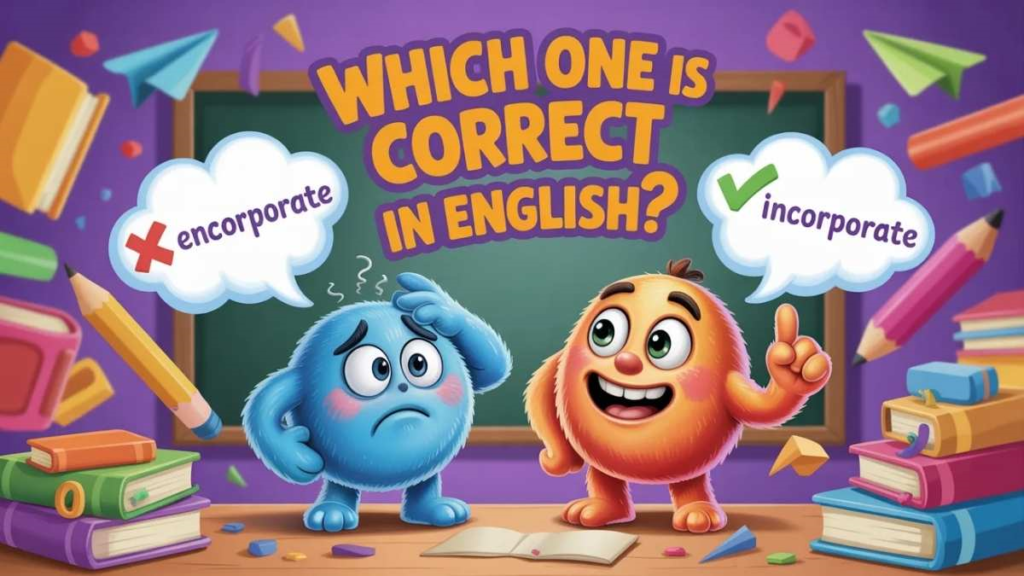
Let’s clear this up immediately:
- “Incorporate” is the correct spelling
- “Encorporate” is incorrect and not a real English word
Simple Definition:
Incorporate means:
- To include something as part of a whole
- To form a company legally
Example:
“We plan to incorporate new ideas into our strategy.”
That’s it. Simple, clear, and correct.
Grately vs Greatly: What Is the Difference?
What Does “Incorporate” Mean? (Simple Explanation)
At its core, “incorporate” is a flexible verb with two main meanings.
Meaning 1: To Include Something
You use it when you want to say that something becomes part of a larger whole.
- Add ideas to a plan
- Blend ingredients into a recipe
- Combine features into a product
Meaning 2: To Form a Company
In business, it means creating a legal company structure.
Think of it this way:
“Incorporate” = bring something into a structure
That structure could be:
- A sentence
- A system
- A company
Incorporate Meaning in Everyday English
You’ll see “incorporate” used often in daily communication. It sounds slightly formal, yet it fits perfectly in professional and academic writing.
Common Real-Life Uses:
- Writing:
“Try to incorporate feedback into your next draft.” - Cooking:
“Slowly incorporate the flour into the mixture.” - Workplace:
“We incorporated customer suggestions into the product.”
Simple Analogy:
Think of incorporate like adding ingredients to a dish. Each element becomes part of the final result.
Incorporate Meaning in Business (Important Context)
Now let’s step into the business world, where this word carries more weight.
What Does It Mean to Incorporate a Business?
When you incorporate a business, you legally create a separate entity from yourself.
Key Concepts:
- Legal entity
- Business registration
- Corporate structure
What Happens When a Business Is Incorporated?
| Step | What It Means |
|---|---|
| Registration | The business is officially recorded with the government |
| Legal Separation | Owners and business become separate entities |
| Liability Protection | Personal assets are protected |
| Tax Structure | Business may have different tax rules |
Example Scenario:
Imagine you start a freelance business.
- Without incorporation → You are personally responsible
- With incorporation → The company becomes a separate legal body
That difference can protect your personal finances.
Is “Encorporate” a Real Word?
Let’s be direct:
No, “encorporate” is not a real word.
You won’t find it in:
- Standard dictionaries
- Academic writing
- Professional communication
Even though it appears online, it is simply a misspelling of “incorporate.”
Why People Confuse “Encorporate” and “Incorporate”
This confusion doesn’t happen randomly. There are clear reasons behind it.
Main Reasons:
- Pronunciation overlap
Both sound similar when spoken quickly - Prefix confusion
“En” and “in” are common prefixes - Typing habits
Muscle memory leads to repeated mistakes
Key Insight:
Your brain often prioritizes familiar patterns over correctness. That’s why “encorporate” feels right, even though it isn’t.
Maintained vs Maintenanced: Which One Is Correct in English?
Encorporate vs Incorporate (Clear Comparison)
Here’s a quick visual breakdown:
| Term | Correct? | Meaning |
|---|---|---|
| Encorporate | ❌ Incorrect | Not a valid English word |
| Incorporate | ✅ Correct | To include or form a corporation |
Quick Takeaway:
If you want to sound professional, always use incorporate.
How to Spell “Incorporate” Correctly (And Never Forget It)
Spelling mistakes happen. However, this one is easy to fix permanently.
Correct Spelling:
I-N-C-O-R-P-O-R-A-T-E
Common Mistakes:
- encorporate ❌
- incorperate ❌
- incorprate ❌
Memory Trick:
Think: “In-corporate” = into a corporation
This simple breakdown makes the spelling stick instantly.
How to Use “Incorporate” in a Sentence
Once you understand the meaning, using it becomes natural.
Everyday Examples:
- “We should incorporate more visuals into the presentation.”
- “The teacher incorporated real-world examples into the lesson.”
Business Examples:
- “They decided to incorporate the company in 2024.”
- “The startup incorporated to protect its founders.”
Professional Writing:
- “This report incorporates recent data and trends.”
Verb Forms and Grammar Rules
To use “incorporate” correctly, you need to understand its forms.
| Form | Example |
|---|---|
| Base | incorporate |
| Past | incorporated |
| Present Participle | incorporating |
| Noun | incorporation |
Grammar Tip:
Use “incorporate” when you want to:
- Show inclusion
- Describe integration
- Explain business formation
Incorporate vs Include vs Integrate (Key Differences)
These words often overlap, but they are not identical.
Simple Breakdown:
- Include → add something
- Integrate → blend smoothly
- Incorporate → include formally or structurally
Dysregulated vs Disregulated: (Most People Get This Wrong)
Comparison Table:
| Word | Meaning Focus | Usage Context |
|---|---|---|
| Include | Add something | General use |
| Integrate | Blend into a whole | Systems/processes |
| Incorporate | Include or form legally | Formal/business use |
Practical Example:
- Include: “Add sugar to the recipe”
- Integrate: “Blend systems together”
- Incorporate: “Include ideas into a framework”
Synonyms of “Incorporate” (Improve Your Writing)
Using the same word repeatedly weakens your writing. Try these alternatives.
Synonyms:
- include
- integrate
- combine
- merge
Example:
Instead of:
“We incorporated feedback…”
Try:
“We integrated feedback…”
Common Mistakes Writers Make
Even experienced writers slip up. Here are the most common issues.
Mistake 1: Using “Encorporate”
- Problem: Incorrect spelling
- Fix: Always use “incorporate”
2: Confusing with “Include”
- Problem: Loss of nuance
- Fix: Use “incorporate” for structured inclusion
3: Misusing Business Meaning
| Scenario | Problem | Correct Version | Impact |
|---|---|---|---|
| Writing | Wrong context | Use proper meaning | Improves clarity |
Related Spelling Mistakes (Learn Faster)
Fixing one mistake often helps you fix others.
Common Errors:
- seperate → separate
- definately → definitely
Why These Happen:
- Phonetic spelling
- Fast typing
- Weak memory patterns
Quick Practice (Make It Stick)
Fill in the Blank:
- We need to __ new ideas into the strategy.
- They decided to __ the company last year.
Fix the Sentence:
- “We will encorporate new features soon.”
Correct version:
“We will incorporate new features soon.”
Passed Away or Past Away : The Complete Guide (2026)
Key Takeaways (Simple and Clear)
- “Incorporate” is correct and widely used
- “Encorporate” is a spelling mistake
- It means:
- To include something
- To form a company legally
Reference Cambridge Dictionary Definitions
Here’s a trusted source for clear Grammar:
FAQs Encorporate vs Incorporate
Is “encorporate” a correct word?
No, “encorporate” is not a correct word in English. It is a common spelling mistake. The correct word is “incorporate.”
What does “incorporate” mean?
“Incorporate” means to include something as part of a whole or to legally form a company as a corporation.
How do you spell “incorporate” correctly?
The correct spelling is: I-N-C-O-R-P-O-R-A-T-E. Remember the prefix “in,” not “en.”
Why do people spell incorporate as encorporate?
People often confuse the spelling due to similar pronunciation and common prefixes like “en” and “in.” Fast typing and habit also contribute to this mistake.
What does it mean to incorporate a business?
To incorporate a business means to register it as a legal entity, separate from its owners. This provides liability protection and a formal structure.
What is the difference between incorporate and integrate?
“Incorporate” means to include something as part of a whole or form a company, while “integrate” means to combine things so they work together smoothly.
How do you use “incorporate” in a sentence?
You can say: “We will incorporate customer feedback into our design.” It shows that something is being included.
Can “encorporate” ever be used in English?
No, “encorporate” should never be used. It is always considered incorrect in standard English.
What is another word for incorporate?
Some alternatives include:
- include
- integrate
- combine
- merge
Is “incorporation” related to “incorporate”?
Yes, “incorporation” is the noun form of “incorporate.” It refers to the process of forming a company or including something into a whole.
Conclusion:
By now, the difference between encorporate vs incorporate should feel completely clear.
“Incorporate” is the only correct spelling. It carries two important meanings. You can use it to describe including something into a whole or forming a business as a legal entity. On the other hand, “encorporate” is simply a mistake. It doesn’t exist in standard English, even though many people still use it by accident.
This confusion happens easily. Similar pronunciation and common prefixes can trick your brain. However, once you understand the structure of the word, it becomes much easier to remember and apply correctly.
If you want a simple rule to keep in mind, use this:
If you’re talking about structure, inclusion, or business, the word is always “incorporate.”
Strong writing depends on small details. Correct spelling builds trust, improves clarity, and makes your communication more professional. So next time you write, you won’t hesitate. You’ll use the right word with confidence.

James Walker is an English language educator with over 5 years of experience in grammar teaching. He specializes in spelling corrections, confusing word pairs, and grammar rules for everyday use. As the lead author at AZ Grammar, he has helped thousands of students and learners worldwide write English with confidence. His simple, practical approach makes even the most complex grammar rules easy to understand.
Email: azgrammar29@gmail.com
Website: azgrammar.com