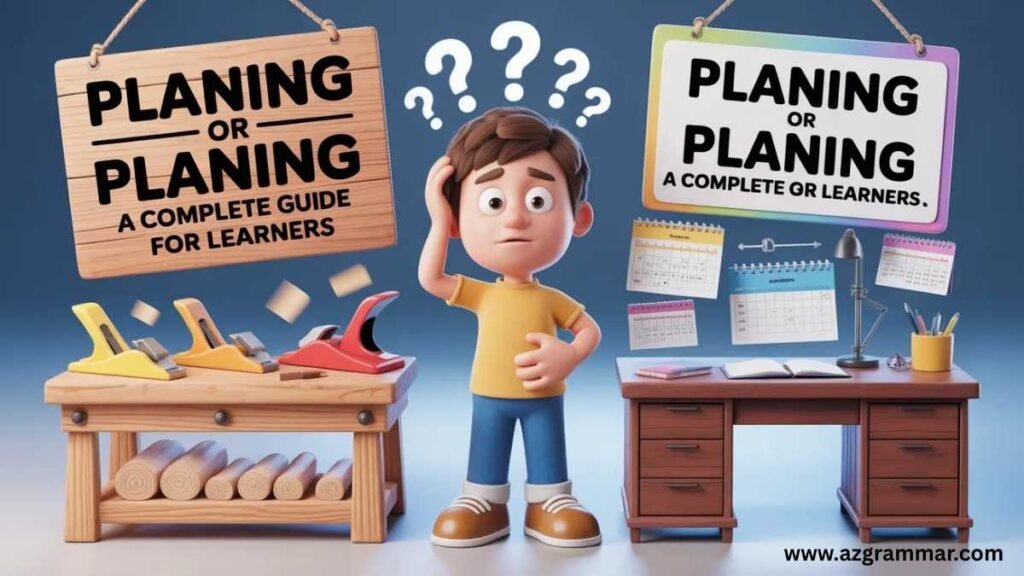
Have you ever typed a sentence like, “I am planing a trip to Italy,” stared at it for five seconds, and suddenly felt suspicious? Something about it looks wrong. Your brain whispers, “Wait… is that right?” Congratulations. You’ve just encountered the classic English dilemma: planing or planning.
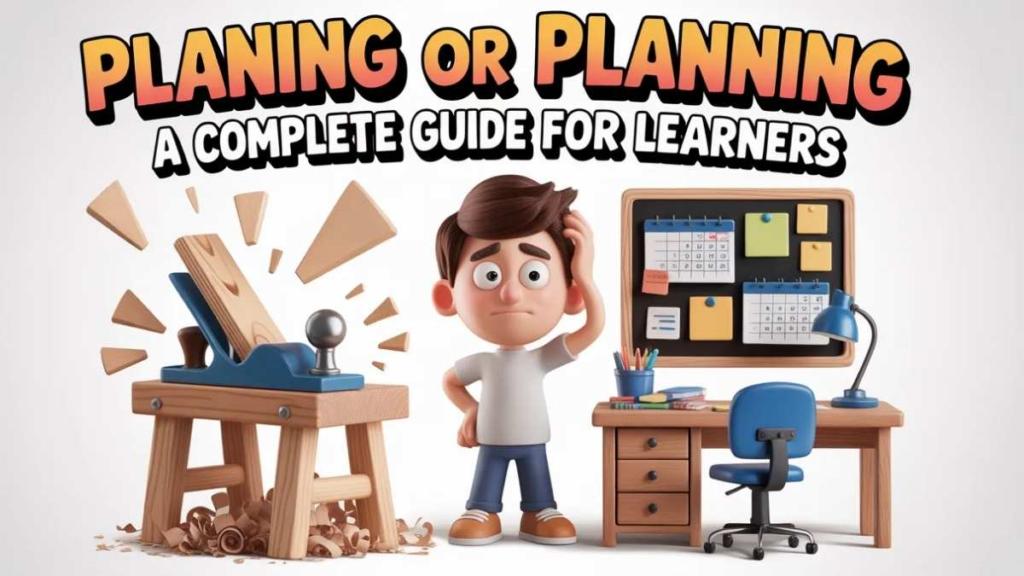
At first glance, the two words seem like identical twins. They differ by just one letter. However, that tiny difference completely changes the meaning. One word is about organizing your future. The other involves shaving thin slices off a piece of wood like a carpenter in a workshop. Not exactly the same situation.
The confusion is surprisingly common. Students write it in essays. Professionals slip it into emails. Even experienced writers occasionally pause and ask themselves whether they meant planing or planning.
In this guide, we’ll clear up the mystery once and for all. You’ll learn the correct spelling, the grammar rule behind the double “N,” and the rare situation where planing is actually the right word. By the end, you’ll know exactly which word to use and you won’t accidentally turn your vacation planning into a woodworking project.
Planing or Planning — The Quick Answer
If you want a fast answer, here it is.
- Planning is the correct spelling when you mean preparing, organizing, or arranging something.
- Planing is a different word. It refers to smoothing wood using a planer.
Most everyday writing uses planning.
Here is a quick comparison.
| Word | Meaning | Example |
|---|---|---|
| Planning | Organizing or preparing something | She is planning a business launch |
| Planing | Smoothing wood using a planer tool | The carpenter is planing the board |
In simple terms:
Planning = organizing your future
Planing = smoothing wood
That one extra N makes a huge difference.
Coming or Comming: Which Spelling Is Correct?
Coming or Comming: Which Spelling Is Correct?
What Does “Planning” Mean in English?
The word planning appears everywhere in modern communication. Businesses rely on it. Students write about it. Travelers do it constantly.
In the English language, planning means preparing or organizing actions before they happen.
The word comes from the verb plan.
When we add -ing to the verb, it becomes planning, which describes an ongoing activity.
Definition
Planning:
The process of organizing tasks, goals, or strategies before taking action.
This concept appears across many areas of life.
Common Areas Where Planning Is Used
Business
Companies plan projects, budgets, and strategies.
Examples:
- marketing planning
- financial planning
- strategic planning
Education
Teachers and students use planning to organize learning.
Examples:
- lesson planning
- academic planning
- study planning
Travel
Travel requires careful organization.
Examples:
- planning a trip
- vacation planning
- itinerary planning
Project Management
Large projects depend on detailed planning.
Examples:
- timeline planning
- resource planning
- risk planning
Example Sentences
- We are planning our marketing strategy for next quarter.
- She is planning a trip to Italy next summer.
- The team is planning the next product launch.
Grammar Note: Present Participle
In grammar, planning is known as the present participle of the verb plan.
Present participles often end in -ing and describe actions happening now.
Examples:
| Verb | Present Participle |
|---|---|
| Plan | Planning |
| Build | Building |
| Write | Writing |
Understanding this grammatical role helps explain the spelling rule behind the word.
Awhile or A While: Which One Should You Use?
What Does “Planing” Mean?
Now let’s look at the second word.
Unlike planning, the word planing belongs to a completely different field.
Planing is used in woodworking and carpentry.
Definition
Planing:
The process of smoothing or flattening wood using a specialized cutting tool called a planer.
Woodworkers use this technique to create smooth surfaces on wooden boards.
Common Tools Used for Planing
| Tool | Purpose |
|---|---|
| Hand planer | Manual wood smoothing tool |
| Electric planer | Power tool for flattening boards |
| Thickness planer | Ensures uniform board thickness |
| Jack plane | Used for rough shaping |
A planer removes thin layers of wood to create an even surface.
Example Sentences
- The carpenter is planing the wooden door.
- He spent the afternoon planing rough boards.
- The furniture maker carefully planed the tabletop.
Why Most People Never Use This Word
Outside carpentry, construction, and furniture making, planing rarely appears in everyday language.
That explains why many writers mistakenly type planing when they actually mean planning.
Why “Planning” Has Two N’s (The Spelling Rule Explained)
One of the biggest sources of confusion is the double N in the word planning.
Why not spell it planing?
The answer comes from a grammar rule known as the double consonant rule.
The Double Consonant Rule
When a one-syllable verb ends with:
consonant – vowel – consonant
the final consonant doubles before adding -ing.
Example Words
| Base Verb | -ing Form |
|---|---|
| Plan | Planning |
| Run | Running |
| Stop | Stopping |
| Sit | Sitting |
The verb plan follows this exact pattern.
P → consonant
L → consonant
A → vowel
N → consonant
Because of this structure, the final N doubles when adding -ing.
Therefore:
plan + ing = planning
This rule keeps pronunciation consistent.
Without doubling the letter, the word might sound awkward or unclear.
The Real Difference Between Planing and Planning
Even though the words look similar, their meanings and usage are very different.
Understanding the distinction helps you avoid embarrassing spelling mistakes.
| Feature | Planning | Planing |
|---|---|---|
| Meaning | Preparing or organizing | Smoothing wood |
| Context | Everyday language, business, travel | Carpentry and woodworking |
| Grammar role | Present participle of “plan” | Verb related to woodworking |
| Usage frequency | Very common | Rare outside woodworking |
Key Insight
Most people searching planing vs planning actually want to know the correct spelling for organizing activities.
In those situations, the correct word is planning.
Freshman or Freshmen: What’s the Difference?
Common Mistakes Writers Make
Because the words look so similar, writers frequently make spelling errors.
These mistakes appear in emails, social media posts, and even professional documents.
Incorrect Examples
- I am planing a vacation next year.
- We are planing our marketing strategy.
- She is planing a birthday party.
Correct Versions
- I am planning a vacation next year.
- We are planning our marketing strategy.
- She is planning a birthday party.
Why These Mistakes Happen
Several factors cause confusion:
- fast typing
- autocorrect errors
- misunderstanding grammar rules
- unfamiliarity with woodworking terms
The solution is simple.
If your sentence refers to organizing something, the correct word is planning.
Real World Examples of Correct Usage
Understanding context makes spelling much easier.
Let’s explore real situations where each word appears.
Everyday Communication
These situations almost always require planning.
- planning a trip
- planning a meeting
- planning a wedding
- planning a business strategy
Example sentence:
We are planning our company conference for September.
Academic or Professional Writing
Students and professionals often discuss planning.
Common examples include:
- project planning
- financial planning
- urban planning
- event planning
Example:
Effective project planning improves productivity and reduces risk.
Woodworking Context
In carpentry, the word planing becomes relevant.
Examples include:
- planing wood boards
- planing a door surface
- planing furniture panels
Example sentence:
The craftsman spent hours planing the wooden table.
Context determines the correct spelling.
British English vs American English: Does the Spelling Change?
Some English words change spelling between British and American English.
For example:
| American | British |
|---|---|
| Color | Colour |
| Organize | Organise |
| Center | Centre |
However, the words planning and planing do not change between regions.
Both American English and British English use the same spellings.
This means the confusion does not come from regional spelling differences.
Instead, the two words simply represent different meanings.
How Dictionaries Define Planing and Planning
Major dictionaries clearly distinguish the two words.
Dictionary Definitions
Planning
The process of deciding in advance how to do something.
Planing
The act of smoothing wood using a plane or planer.
Trusted dictionaries that include these definitions include:
- Oxford English Dictionary
- Merriam-Webster Dictionary
- Cambridge Dictionary
Dictionaries categorize them separately because they belong to different contexts.
Disenroll or Unenroll: Common Mistakes Explained
When Should You Use “Planing” Instead of “Planning”?
Although rare, there are situations where planing is the correct word.
These include industries involving wood shaping.
Situations Where Planing Is Correct
- woodworking tutorials
- carpentry manuals
- furniture building guides
- construction projects involving wood
Example:
The craftsman spent hours planing the wooden table.
Outside these situations, planning is almost always the correct spelling.
Quick Memory Trick to Avoid the Mistake
Remembering the difference becomes easy with a simple trick.
Trick 1
Think of planNing with two N’s as needing extra preparation.
Planning requires more organization. The extra N reflects that.
Trick 2
Associate each word with a mental image.
- Planning → plans for the future
- Planing → planes smooth wood
Once you connect the meaning to the spelling, confusion disappears.
Key Takeaways
Here are the most important points to remember.
- Planning relates to organizing or preparing something.
- Planing refers to smoothing wood with a planer.
- The double N in planning follows a common English spelling rule.
- Most everyday writing requires planning, not planing.
Quick summary table:
| Word | Main Use |
|---|---|
| Planning | Organizing tasks or goals |
| Planing | Woodworking process |
Reference Cambridge Dictionary Definitions
Here’s a trusted source for clear Grammar:
FAQs
Is it planning or planing?
In most situations, planning is correct. It means preparing or organizing something.
What does planing mean?
Planing refers to smoothing wood using a planer tool.
Why does planning have two N’s?
The word follows the double consonant spelling rule when adding -ing to the verb plan.
How do you spell planning a trip?
The correct spelling is planning a trip.
When is planing correct?
Use planing only when referring to woodworking or carpentry.
Final Thoughts
English often contains words that look almost identical yet carry completely different meanings.
The difference between planing and planning is small in spelling but huge in meaning.
Once you remember the context, choosing the correct word becomes simple.
If the sentence involves organizing the future, the correct spelling is planning.
If it involves smoothing wood, the correct word is planing.
Understanding this distinction improves writing accuracy and helps you communicate more clearly.

James Walker is an English language educator and grammar enthusiast dedicated to helping learners improve their writing and communication skills. As an author at AZ Grammar, he simplifies complex grammar rules into clear, practical lessons suitable for students and beginners. With a passion for language learning and education, James focuses on making English grammar easy, understandable, and useful for everyday communication and academic success worldwide.
Email: azgrammar29@gmail.com
Website: azgrammar.com