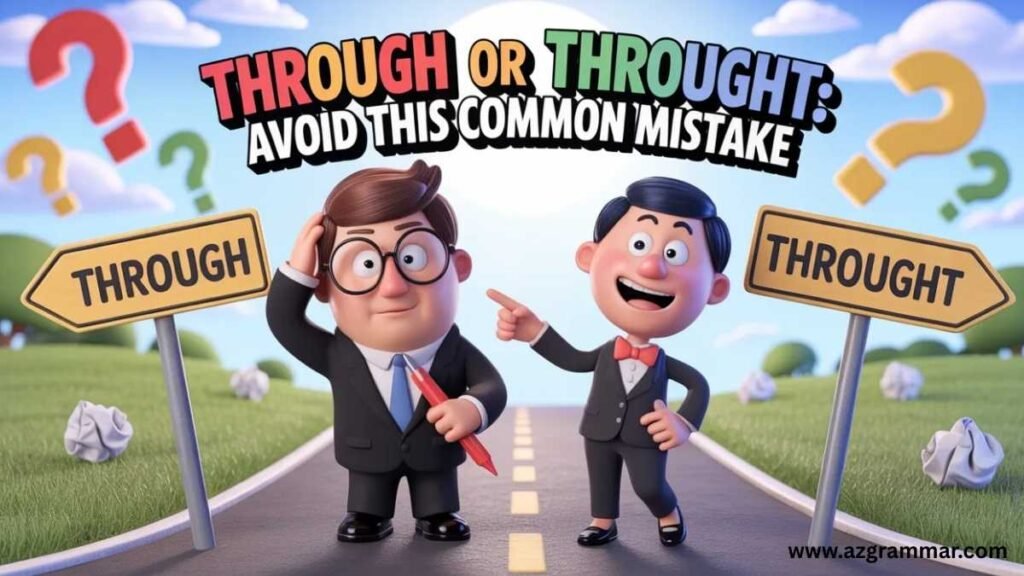
Spelling mistakes happen to everyone. Even experienced writers occasionally pause and wonder whether a word is correct. One mistake that appears surprisingly often online is “throught.”
Many people search for “Through or Throught” because they want to confirm the correct spelling before writing an email, an article, or a social media post.
Here is the simple truth:
“Through” is the correct spelling. “Throught” is not a real English word.
However, the story behind this common mistake goes deeper. English spelling contains unusual patterns, silent letters, and confusing word families. Because of that, writers often mix up similar-looking words.
This guide explains everything you need to know about through vs throught, including meanings, grammar usage, pronunciation, examples, memory tricks, and common spelling mistakes.
Quick Answer: Is It “Through” or “Throught”?
If you need the answer quickly, here it is.
The correct spelling is “through.”
“Throught” is incorrect and considered a spelling mistake.
You will not find “throught” in any major English dictionary, including:
- Oxford English Dictionary
- Merriam-Webster Dictionary
- Cambridge Dictionary
- Collins Dictionary
Instead, these dictionaries only recognize “through.”
Awhile or A While: Which One Should You Use?
Simple Example
Correct sentence:
We walked through the park to reach the museum.
Incorrect sentence:
We walked throught the park to reach the museum.
The difference is simple. One word exists in English grammar. The other is only a misspelling.
Still, thousands of people search this mistake every month because the spelling pattern feels confusing.
Is “Throught” a Real Word?
No. “Throught” is not a real word in English.
It appears frequently online, but it exists only as a spelling error.
Why Dictionaries Reject “Throught”
Standard dictionaries rely on verified language usage. A word must meet several conditions before dictionaries recognize it.
These conditions include:
- Consistent usage in literature
- Documented historical meaning
- Accepted grammatical function
- Widespread usage across speakers
“Throught” fails all of these criteria.
Instead, dictionaries classify it as a common typo for “through.”
Typos vs Real Words
Understanding the difference helps writers improve accuracy.
| Type | Description | Example |
|---|---|---|
| Real word | Recognized by dictionaries | through |
| Typo | Accidental typing mistake | throught |
| Alternative spelling | Accepted variant | color / colour |
“Throught” falls into the typo category.
Why the Error Appears Frequently
Several factors explain the popularity of this mistake.
- People confuse it with “thought.”
- The -ough spelling pattern is unpredictable.
- Autocorrect sometimes fails to detect the typo.
- Fast typing leads to accidental letter additions.
In short, “throught” spreads because English spelling can be tricky.
What Does “Through” Mean in English?
The word through plays an important role in everyday English. It can function as multiple parts of speech depending on context.
Dictionary Definition
Through generally means:
- moving from one side of something to the other
- continuing until completion
- lasting during a period of time
- using something as a medium
Because of its flexibility, through appears in thousands of sentences every day.
Through as a Preposition
The most common function of through is as a preposition.
A preposition connects nouns or pronouns with other words in a sentence.
Examples:
- She walked through the forest.
- The train passed through the tunnel.
- Light entered through the window.
Here, through describes movement from one side to another.
Through as an Adverb
Sometimes through acts as an adverb. In this role, it modifies a verb rather than linking objects.
Examples:
- The rain finally came through.
- The project went through successfully.
- The message came through clearly.
In these cases, through indicates completion or successful transmission.
Through as an Adjective
Less commonly, through functions as an adjective.
Example:
- The train offers a through service from New York to Boston.
In transportation language, through service means uninterrupted travel.
Pronunciation of “Through”
Pronouncing through correctly can challenge many English learners.
Standard Pronunciation
The correct pronunciation is:
/θruː/
You can think of it as sounding like “throo.”
Planing or Planning: A Complete Guide for Learners
Pronunciation Breakdown
| Sound | Explanation |
|---|---|
| th | soft sound made with the tongue between teeth |
| r | light rolling sound |
| oo | long vowel sound |
Why “-ough” Words Cause Confusion
English contains several -ough words that sound completely different.
Consider these examples:
| Word | Pronunciation |
|---|---|
| though | /ðoʊ/ |
| thought | /θɔːt/ |
| tough | /tʌf/ |
| through | /θruː/ |
The spelling looks similar. The pronunciation changes dramatically.
This inconsistency explains why many people struggle with spelling words like through.
Why People Misspell “Through” as “Throught”
Several linguistic and technical factors cause this mistake.
Confusion With Similar Words
The word thought looks extremely similar.
Many writers unconsciously combine the two spellings.
Example confusion:
- thought
- through
- throught
Your brain mixes patterns when typing quickly.
Silent Letters in English
English spelling often includes letters that are not pronounced.
For example:
- k in knife
- b in thumb
- g in gnome
Similarly, the -ough pattern does not always match pronunciation.
This mismatch increases spelling mistakes.
Typing Errors
When typing quickly, the brain may add letters automatically.
Example:
through → throught
The extra t slips in because many words end with -ght.
Examples include:
- thought
- brought
- fought
- sought
Autocorrect Limitations
Modern writing tools detect many spelling errors. However, they are not perfect.
If a program fails to detect throught, the error may remain unnoticed.
Real Example From Online Content
Many beginner writers publish content with this typo.
Example mistake:
We traveled throught several cities before reaching our destination.
Professional editors quickly correct this to:
We traveled through several cities before reaching our destination.
The Origin and History of the Word “Through”
Understanding a word’s history often explains its unusual spelling.
Old English Origins
The word through comes from the Old English word þurh.
This early form appeared in texts more than 1,000 years ago.
Meaning:
- across
- from end to end
- during
Evolution of Spelling
Over centuries, spelling evolved across several forms.
| Historical Form | Time Period |
|---|---|
| þurh | Old English |
| thurgh | Middle English |
| through | Modern English |
During the Middle Ages, English absorbed influences from French, Latin, and Germanic languages. This mixture created many irregular spellings.
Freshman or Freshmen: What’s the Difference?
Why English Spelling Feels Irregular
Unlike some languages, English does not follow strict phonetic rules.
For example:
- rough
- cough
- through
- though
Each word contains -ough, yet they sound completely different.
This historical complexity explains many spelling mistakes.
How to Use “Through” Correctly in a Sentence
Learning real examples helps you understand grammar naturally.
Below are the most common situations where through appears.
Movement From One Side to Another
Example sentences:
- The river flows through the valley.
- The cat ran through the open door.
- The hikers walked through the forest trail.
Completion of a Process
Example sentences:
- She worked through the night.
- The company pushed through the final stage of development.
- He read through the entire report.
Duration Across Time
Example sentences:
- The shop stays open through December.
- The city experienced heavy rain through the weekend.
Communication Via Something
Example sentences:
- The news spread through social media.
- The company received feedback through email surveys.
Common Words Confused with “Through”
Writers often confuse similar-looking words. Understanding these differences prevents mistakes.
Through vs Though
These two words look similar. Their meanings differ completely.
| Word | Meaning | Example |
|---|---|---|
| Through | movement or completion | She walked through the door. |
| Though | contrast or concession | Though it rained, we continued. |
Through vs Threw
Threw is the past tense of throw.
Example:
- He threw the ball across the field.
- She walked through the gate.
Through vs Thought
Thought refers to ideas or mental processes.
Example:
- She had an interesting thought.
- He traveled through Europe last summer.
Because thought ends with -ght, many people mistakenly type throught.
Simple Memory Tricks to Spell “Through” Correctly
Spelling becomes easier when you use memory techniques.
Remember the “-ough” Pattern
Many English words share this pattern:
- though
- although
- through
Seeing them together helps reinforce spelling.
Visual Memory Trick
Imagine a sentence:
Walk through the door.
Picture someone physically passing through a doorway. The mental image helps your brain recall the spelling.
Chunking Technique
Break the word into parts.
th + rough
This makes it easier to remember the structure.
Practice With Phrases
Practice writing phrases such as:
- through the tunnel
- through the city
- through the process
Repetition strengthens memory.
Common English Spelling Mistakes Similar to “Through”
The through or throught confusion belongs to a larger group of spelling mistakes.
Here are several common examples.
| Incorrect | Correct |
|---|---|
| definately | definitely |
| seperate | separate |
| recieve | receive |
| thier | their |
Disenroll or Unenroll: Common Mistakes Explained
Why English Spelling Mistakes Happen
Several factors contribute to spelling errors.
- inconsistent pronunciation rules
- borrowed vocabulary from multiple languages
- silent letters
- irregular historical spelling
Even advanced writers occasionally misspell words.
Examples of “Through” in Everyday Writing
Understanding real-world usage helps reinforce grammar knowledge.
Daily Conversation
Example:
I drove through traffic to reach the office.
Academic Writing
Example:
The researcher analyzed data collected through surveys and interviews.
Business Communication
Example:
Customers can contact support through our website form.
Storytelling
Example:
The hero journeyed through dark forests and ancient ruins.
Tips to Avoid Spelling Errors in English Writing
Strong writing requires careful editing. These strategies help reduce mistakes.
Proofread Your Work
Always reread important writing.
Focus on:
- spelling
- punctuation
- grammar
Reading slowly improves accuracy.
Use Grammar Tools
Several modern tools detect spelling mistakes.
Popular options include:
- Grammarly
- Microsoft Editor
- Hemingway App
These tools highlight errors quickly.
Read Sentences Aloud
When you read aloud, your brain processes words differently. This technique helps identify hidden mistakes.
Build Vocabulary Knowledge
The more words you encounter, the easier spelling becomes.
Helpful activities include:
- reading books
- writing daily
- studying vocabulary lists
Quick Comparison Table: Through vs Throught
| Word | Correct Spelling | Meaning | Example |
|---|---|---|---|
| Through | ✔ Correct | Movement, completion, passage | We walked through the tunnel. |
| Throught | ✘ Incorrect | Not a valid English word | — |
This simple table highlights the key difference.
Reference Cambridge Dictionary Definitions
Here’s a trusted source for clear Grammar:
FAQs
Is “throught” grammatically correct?
No. “Throught” is not grammatically correct. It is simply a spelling mistake for through.
Why do people spell “through” incorrectly?
English spelling patterns create confusion. Words like thought, brought, and fought encourage people to add an extra t.
How do you pronounce “through”?
The correct pronunciation is:
/θruː/
It sounds like “throo.”
Is “through” a preposition or adverb?
It can function as both.
Examples:
- Preposition: We walked through the park.
- Adverb: The signal finally came through.
What are other words spelled with “-ough”?
Here are several examples.
- though
- thought
- rough
- tough
- enough
Each word uses the same spelling pattern but different pronunciation.
Final Thoughts
Spelling mistakes happen to every writer. However, understanding the correct form helps improve clarity and professionalism.
Remember these key points:
- Through is the correct spelling.
- Throught is simply a typo.
- The word through can function as a preposition, adverb, or adjective.
- English spelling patterns often create confusion due to historical influences.
Small grammar details matter. When you master them, your writing becomes clearer, stronger, and more professional.
Next time you wonder “Through or Throught,” you will know the correct answer instantly.

James Walker is an English language educator with over 5 years of experience in grammar teaching. He specializes in spelling corrections, confusing word pairs, and grammar rules for everyday use. As the lead author at AZ Grammar, he has helped thousands of students and learners worldwide write English with confidence. His simple, practical approach makes even the most complex grammar rules easy to understand.
Email: azgrammar29@gmail.com
Website: azgrammar.com