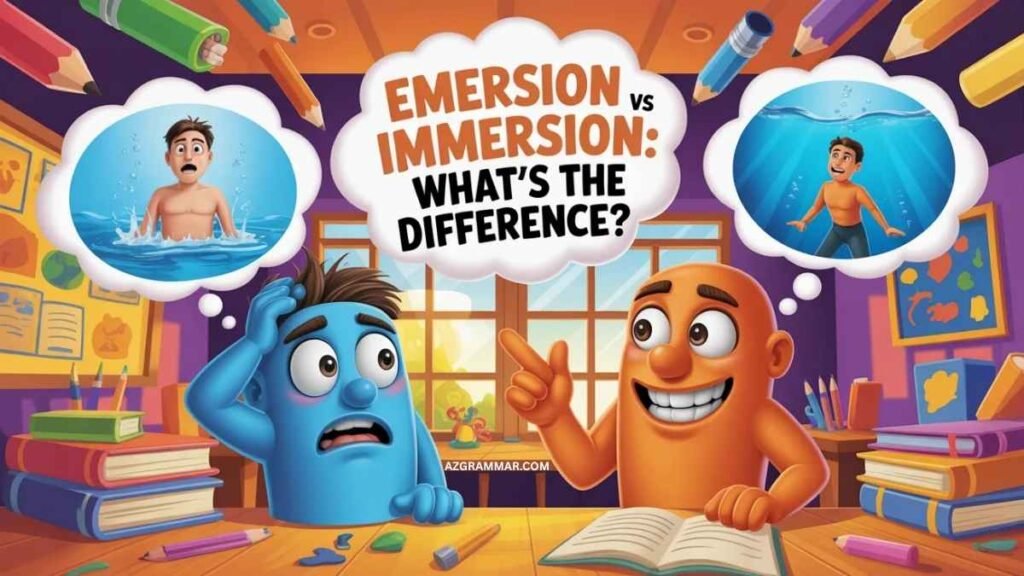
Let’s be honest emersion vs immersion sounds like one of those sneaky English traps designed to embarrass you at the worst possible moment. You confidently write a sentence, pause, and suddenly wonder, “Wait… did I just say the opposite of what I meant?” Don’t worry, you’re not alone. These two words look almost identical, yet they behave like complete opposites. It’s like identical twins where one dives into a pool while the other climbs out. Confusing? Absolutely. But also fixable. In this guide, you’ll finally untangle the mystery of emersion vs immersion and start using both words with confidence, clarity, and maybe even a little swagger.
Quick Answer: Emersion vs Immersion in One Simple Explanation

Let’s simplify everything:
- Immersion = going into something
- Emersion = coming out of something
Simple Analogy
Think about water:
- When you jump into a pool, that’s immersion
- When you come out of the pool, that’s emersion
That’s it. One goes in. The other comes out.
Comprable vs Comparable: The Correct Spelling Explained
Definitions: What Do Emersion and Immersion Mean?
What Is Emersion?
Emersion means the act of emerging or coming out from something, especially from water.
It is commonly used in:
- Biology
- Environmental science
- Technical writing
Example
- “The diver’s emersion was slow and controlled.”
It connects directly to:
- Emerge
- Emergence
These words all relate to the idea of coming out or rising up.
What Is Immersion?
Immersion refers to being deeply involved or submerged in something.
It is widely used in:
- Everyday English
- Education
- Language learning
Example
- “Language immersion helps you learn faster.”
It also relates to:
- Submersion
- Deep involvement
Emersion vs Immersion: Key Differences at a Glance
Here’s a clear comparison:
| Feature | Emersion | Immersion |
|---|---|---|
| Core Meaning | Coming out | Going in |
| Direction | Upward/outward | Downward/inward |
| Usage Level | Rare, technical | Common, everyday |
| Context | Science, biology | Education, experiences |
| Example | Rising from water | Diving into water |
The Core Concept: Direction Matters (In vs Out)
At the heart of emersion vs immersion lies one simple concept:
👉 Direction
- Immersion = inward movement
- Emersion = outward movement
Visual Explanation
Imagine a glass of water:
- Drop a stone inside → immersion
- Pull the stone out → emersion
This contrast becomes easier when you think in pairs:
- Submerge → Immerse
- Emerge → Emersion
Nonresponsive vs Unresponsive: What’s the Real Difference?
Real-Life Examples That Make It Crystal Clear
Everyday Examples
- “She enjoyed full immersion in the culture while traveling.”
- “The turtle’s emersion from the water was slow.”
- “Reading novels creates mental immersion.”
Science and Academic Examples
In scientific contexts, these terms become more precise:
- Emersion is used when something rises above water
- Immersion is used when something is fully submerged
Example
- “Plants showed stress during repeated cycles of immersion and emersion.”
Language Learning Context
This is where immersion dominates.
Immersion Learning
- You learn by surrounding yourself with a language
- You speak, listen, and think in that language
Example
- Living in a foreign country
- Watching content in that language
Important Insight:
You will almost never use emersion in language learning.
How to Use Emersion and Immersion in Sentences
Using “Emersion” Correctly
Use emersion when:
- Something comes out of water
- You describe upward movement
Examples
- “The diver’s emersion was recorded for safety analysis.”
- “The whale’s emersion created a huge splash.”
Using “Immersion” Correctly
Use immersion when:
- Something goes into liquid
- Someone becomes deeply involved
Examples
- “The experiment required full immersion in water.”
- “She improved her English through total immersion.”
Pronunciation and Spelling Differences
These words sound similar, which adds to the confusion.
Pronunciation
- Emersion: ih-MER-zhun
- Immersion: ih-MUR-zhun
Common Mistakes
- ❌ emmersion
- ❌ imersion
- ❌ emmerssion
Quick Tip
Double “m” usually appears in immersion, not emersion.
Transferred or Transfered: Which Is Correct to Use (Updated 2026)
Etymology and Word Origins (Why They Mean Opposites)
Understanding word roots makes everything easier.
Latin Origins
- Immersion → immergere (to dip into)
- Emersion → emergere (to rise out of)
Prefixes Matter
| Prefix | Meaning |
|---|---|
| im- | into |
| e-/ex- | out of |
This explains why the meanings are opposite.
Common Mistakes and Misconceptions
Why People Confuse These Words
- Similar spelling
- Similar pronunciation
- Limited exposure to emersion
Incorrect vs Correct Usage
| Incorrect Sentence | Correct Sentence |
|---|---|
| He enjoyed emersion in the culture | He enjoyed immersion in the culture |
| The diver’s immersion ended the dive | The diver’s emersion ended the dive |
Related Terms You Should Know
Understanding related vocabulary improves clarity:
- Emergence → the process of coming out
- Submersion → the act of going under
- Immersive learning → deep engagement
- Contextual vocabulary → meaning based on usage
When Should You Use Each Word?
Here’s a quick decision guide:
Use Immersion when:
- You mean going into something
- You describe deep involvement
- You talk about learning or experiences
Use Emersion when:
- You mean coming out
- You write in scientific contexts
- You describe upward movement
Emersion vs Immersion in Language Learning
Language learning heavily relies on immersion.
What Is Immersion Learning?
It means learning by:
- Listening constantly
- Speaking regularly
- Thinking in the target language
Why It Works
- Builds natural understanding
- Improves fluency faster
- Mimics real-life communication
Immerse vs Emerse: Stop Confusing These Words Today
Case Study
A student studying English:
- Studying grammar only → slow progress
- Living in English environment → rapid fluency
That’s the power of immersion.
Reference Cambridge Dictionary Definitions
Here’s a trusted source for clear Grammar:
FAQs
What is the difference between emersion and immersion?
Immersion means going into something or being deeply involved, while emersion means coming out of something, especially from water.
Is emersion a real word in English?
Yes, emersion is a real word. However, it is less common and mainly used in scientific or technical contexts.
When should you use emersion in a sentence?
You should use emersion when describing something that is emerging or rising out, such as an object coming out of water.
When should you use immersion in a sentence?
Use immersion when referring to something being submerged or when someone is deeply involved in an activity, such as language learning.
Is emersion the opposite of immersion?
Yes, emersion is the direct opposite of immersion. One means coming out, and the other means going in.
What is immersion learning?
Immersion learning is a method where you learn a language by surrounding yourself with it through speaking, listening, and real-life exposure.
Why is immersion more commonly used than emersion?
Immersion is widely used in everyday language, education, and experiences, while emersion is mostly limited to scientific or technical usage.
Can emersion and emergence be used interchangeably?
Not always. While both relate to coming out, emergence is more common in general English, while emersion is more technical.
What are common mistakes with emersion and immersion?
People often confuse the two due to similar spelling. A common mistake is using emersion when immersion is the correct word.
How can you easily remember emersion vs immersion?
A simple trick:
Emersion = EXIT (out)
Immersion = IN
Conclusion: Emersion vs Immersion Made Simple
Understanding emersion vs immersion doesn’t have to feel complicated. Once you focus on the core idea, everything becomes clear.
At its simplest:
- Immersion means going into something or becoming deeply involved
- Emersion means coming out of something, often in a technical or scientific sense
This small difference can make a big impact on your writing. When you use the correct word, your message becomes clearer, more precise, and more professional.
In everyday English, you’ll use immersion far more often. You’ll see it in language learning, experiences, and even entertainment. On the other hand, emersion appears less frequently and mostly in specialized contexts like biology or environmental science.
If you ever feel unsure, remember this simple rule:
👉 Immersion = IN
👉 Emersion = OUT
Keep practicing with real examples, pay attention to context, and you’ll master these terms quickly. Over time, choosing the right word will become automatic.
Clear writing starts with clear understanding. And now, you have both.

James Walker is an English language educator with over 5 years of experience in grammar teaching. He specializes in spelling corrections, confusing word pairs, and grammar rules for everyday use. As the lead author at AZ Grammar, he has helped thousands of students and learners worldwide write English with confidence. His simple, practical approach makes even the most complex grammar rules easy to understand.
Email: azgrammar29@gmail.com
Website: azgrammar.com