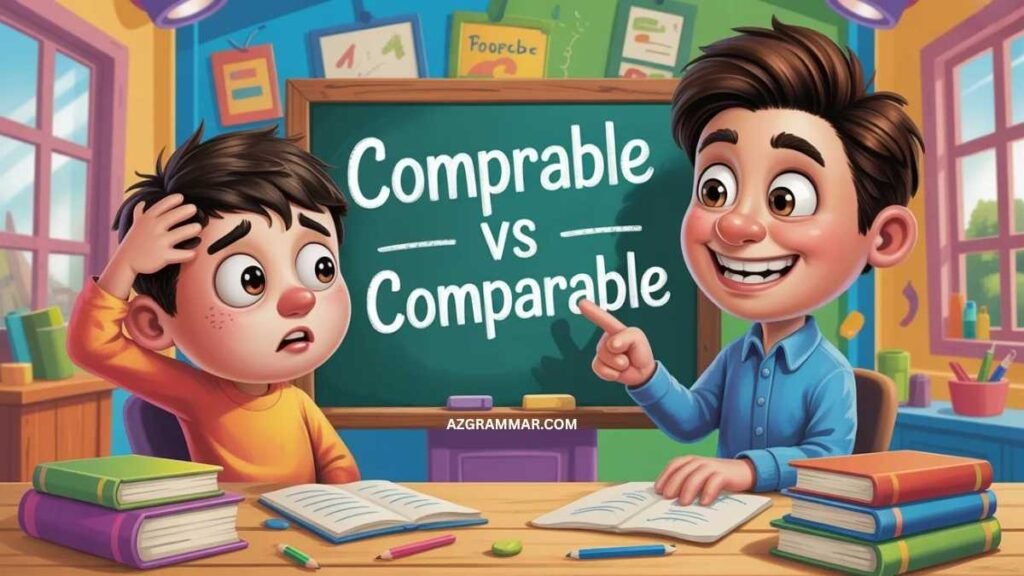
Let’s be honest, the “comprable vs comparable” confusion is one of those small spelling traps that catches even careful writers off guard. You’re typing an email, finishing a report, or working on an assignment. Everything looks perfect. Then suddenly, you pause and stare at one word. Is it “comparable” or “comprable”? It feels like it should be simple, yet that missing “a” creates real doubt.
The problem is that English doesn’t always follow what sounds right. Many people spell words based on pronunciation, not structure. That’s exactly why “comprable” shows up so often, even though it’s incorrect. And here’s the thing tiny spelling mistakes like this don’t just sit quietly on the page. They affect how your writing is perceived. In professional settings, they can make your work look rushed or less polished.
This is why understanding the difference between “comprable vs comparable” matters more than you might think. It’s not just about memorizing a word. It’s about learning a simple pattern that improves your overall writing.
In this guide, you’ll get clear answers, real examples, and easy tricks that actually stick. By the end, you won’t just know the correct spelling you’ll feel confident using it in any situation without second-guessing yourself again.
Quick Answer: Comprable vs Comparable
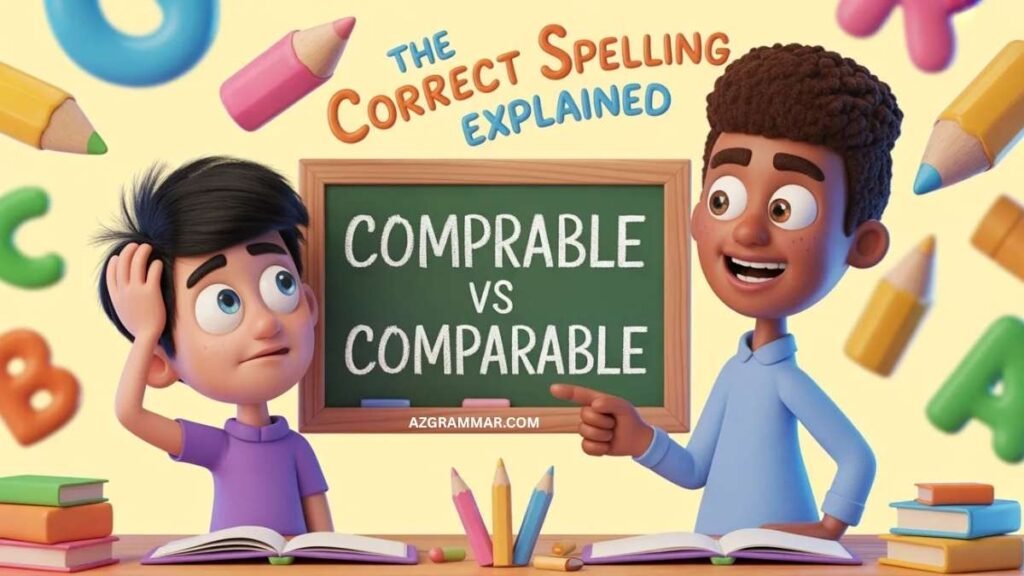
Here’s the clear answer you came for:
- ✅ Comparable = correct
- ❌ Comprable = incorrect
Tweek vs Tweak: Which Is Correct and Why It Matters
Simple explanation
“Comparable” is the standard, dictionary-approved spelling. “Comprable” is a misspelling.
Quick example
- These products are comparable in quality.
That’s it. No exceptions.
Is “Comprable” a Real Word?
Short answer: No.
“Comprable” is not recognized in standard English.
What dictionaries say
Major sources like:
- Merriam-Webster
- Oxford English Dictionary
Only list “comparable.”
Why people still use it
This mistake usually comes from:
- Dropping a vowel while typing fast
- Mishearing pronunciation
- Not connecting the word to its root
Why this matters
In professional settings, spelling errors can:
- Reduce trust in your writing
- Signal lack of attention to detail
- Affect hiring decisions
What Does “Comparable” Mean? (Clear Definition + Context)
Let’s understand the correct word.
Definition
Comparable means:
- Able to be compared
- Similar in important ways
- Equivalent in value, quality, or function
Simple explanation
If two things can be meaningfully compared, they are comparable.
Where You’ll See It Used
This word appears frequently in real life.
Common contexts
- Business pricing
- Financial reports
- Academic research
- Product comparisons
Examples
- The two smartphones are comparable in performance.
- Their salaries are comparable across departments.
- The results are comparable to last year’s data.
Immerse vs Emerse: Stop Confusing These Words Today
Understanding the Spelling: Why “Comparable” Has an ‘A’
This is where most confusion begins.
Word breakdown
- compare → comparable
The root word “compare” stays intact.
Key insight
English often preserves word roots, not pronunciation.
That’s why:
- compare → comparable ✅
- not → comprable ❌
Important takeaway
If you remember the base word, you’ll always spell it correctly.
How to Use “Comparable” Correctly in a Sentence
Let’s move from theory to real usage.
Everyday examples
- These two cars are comparable in price.
- The services offered are comparable across companies.
- Their achievements are comparable in scale.
Professional examples
- The company reported comparable growth this quarter.
- These metrics are comparable across regions.
Key tip
Use “comparable” when comparing similar characteristics or values.
Side-by-Side Comparison Table
| Feature | Comparable | Comprable |
|---|---|---|
| Correct spelling | ✅ Yes | ❌ No |
| Dictionary recognized | ✅ Yes | ❌ No |
| Professional usage | ✅ Recommended | ❌ Avoid |
| Grammar accuracy | ✅ Correct | ❌ Incorrect |
Comparable vs Similar vs Equivalent: What’s the Difference?
Many people confuse these words. They are related but not identical.
Comparable
- Can be compared meaningfully
- Focuses on analysis
Similar
- Shares general resemblance
- Less precise
Equivalent
- Equal in value or function
- Strongest level of similarity
Nonresponsive vs Unresponsive: What’s the Real Difference?
Quick Comparison Table
| Word | Meaning | Example |
|---|---|---|
| Comparable | Can be compared | Prices are comparable |
| Similar | Looks alike | Designs are similar |
| Equivalent | Equal value | Values are equivalent |
Common Mistakes Writers Make
Even experienced writers make these errors.
Top mistakes
- Writing “comprable” instead of comparable
- Confusing spelling with pronunciation
- Using “comparable” in vague contexts
- Mixing with “complementary” (completely different meaning)
Why “Comprable” Happens (And How to Avoid It)
Understanding the cause helps you fix the problem.
Main causes
- Missing vowel “a”
- Fast typing habits
- Weak understanding of root words
Quick Fix Tips
- Always think of compare → comparable
- Slow down when writing important content
- Use proofreading tools
- Read your sentence out loud
Real-Life Usage: Where “Comparable” Matters Most
This word carries weight in professional communication.
Industries where it matters
- Finance → comparable sales
- Marketing → comparable products
- Research → comparable data
- HR → comparable salaries
Examples in action
- Comparable market prices
- Comparable financial results
- Comparable product features
Case Study: Writing Accuracy in Professional Settings
Let’s look at a real-world scenario.
Fact
A study shows:
- 70%+ of employers notice spelling errors instantly
Scenario
Two reports:
- Report A: “Comprable results”
- Report B: “Comparable results”
Outcome
- Report A → appears careless
- Report B → appears professional
Small mistake. Big impact.
Memory Tricks to Get It Right Every Time
You don’t need to memorize complex rules.
Simple trick
“If it comes from compare, keep the ‘a’ there.”
Visual pattern
- compare → comparable
Bonus pattern recognition
- prepare → preparable
- repair → repairable
Is “Comparable” Ever Used Differently? (Context Matters)
Context shapes meaning.
Business usage
- Comparable sales
- Comparable revenue
Academic usage
- Comparable datasets
- Comparable results
Casual usage
- Comparable experiences
- Comparable skills
Transferred or Transfered: Which Is Correct to Use (Updated 2026)
Practice Section: Quick Self-Test
Fill in the blank
These two laptops are __ in performance.
Answer
- Comparable ✅
Multiple choice
Which is correct?
- A) Comprable
- B) Comparable
Answer
- B) Comparable ✅
Reference Cambridge Dictionary Definitions
Here’s a trusted source for clear Grammar:
FAQs
Is it comparable or comprable?
The correct spelling is “comparable.” The word “comprable” is incorrect and should not be used.
Is “comprable” a real word?
No, “comprable” is not a real word in standard English. It does not appear in recognized dictionaries.
What does “comparable” mean?
“Comparable” means something that can be compared or is similar in key aspects like value, quality, or performance.
Why is “comparable” spelled with an “a”?
Because it comes from the root word “compare.” English keeps the original word structure when forming “comparable.”
How do you use “comparable” in a sentence?
Examples:
- These products are comparable in quality.
- The results are comparable to previous studies.
- Their performance is comparable across teams.
Can I use “comprable” in professional writing?
No, you should never use “comprable.” It is considered a spelling mistake and can harm your credibility.
Is “comparable” the same as “similar”?
Not exactly. “Comparable” means things can be compared, while “similar” means they are alike. The meanings overlap but are not identical.
What are synonyms of “comparable”?
Common synonyms include:
- similar
- equivalent
- alike
- parallel
Why do people commonly misspell “comparable”?
Most mistakes happen due to pronunciation confusion or typing quickly and dropping the “a.”
How can I remember the correct spelling of “comparable”?
Think of the base word “compare.” If you remember that, you’ll always spell “comparable” correctly.
Is “comparable” used in business or academic writing?
Yes, it is widely used in both fields. For example:
- comparable sales (business)
- comparable data (academic research)
Final Thoughts
If you remember just one thing, make it this: “comparable” is correct, and “comprable” is always wrong.
That missing “a” might seem small, yet it makes a big difference in how your writing is perceived. Clear, correct spelling shows attention to detail. It builds trust with your reader. It makes your message stronger.
The easiest way to get it right every time is simple. Think of the root word “compare.” Once you see that connection, the correct spelling becomes obvious.
Over time, you won’t even think about it. You’ll just write it correctly without hesitation.
And that’s the goal. Clean, confident, mistake-free writing every time.

James Walker is an English language educator with over 5 years of experience in grammar teaching. He specializes in spelling corrections, confusing word pairs, and grammar rules for everyday use. As the lead author at AZ Grammar, he has helped thousands of students and learners worldwide write English with confidence. His simple, practical approach makes even the most complex grammar rules easy to understand.
Email: azgrammar29@gmail.com
Website: azgrammar.com