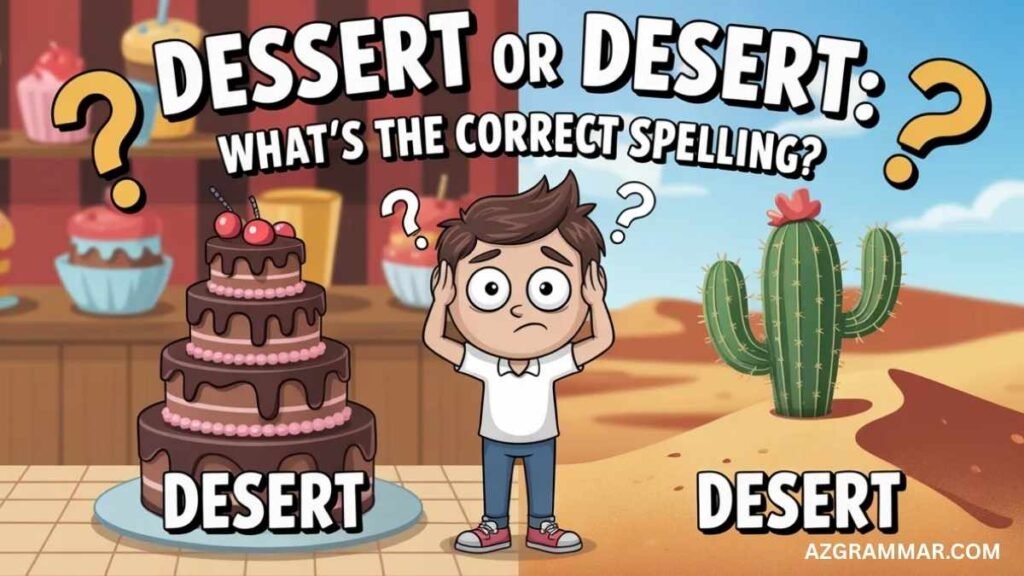
You’re writing a simple sentence about food, feeling confident, maybe even a little proud, and then suddenly boom you freeze. Is it dessert or desert? One gives you chocolate cake. The other gives you sand, heat, and regret. Not exactly the same vibe. It’s one of those sneaky English traps that catches almost everyone at some point. Even good writers pause and think twice. However, once you understand the difference, it becomes ridiculously easy. In this guide, we’ll break down dessert or desert in the simplest way possible, with examples, memory tricks, and a few laughs along the way so you never mix them up again.
Quick Answer: Dessert or Desert?
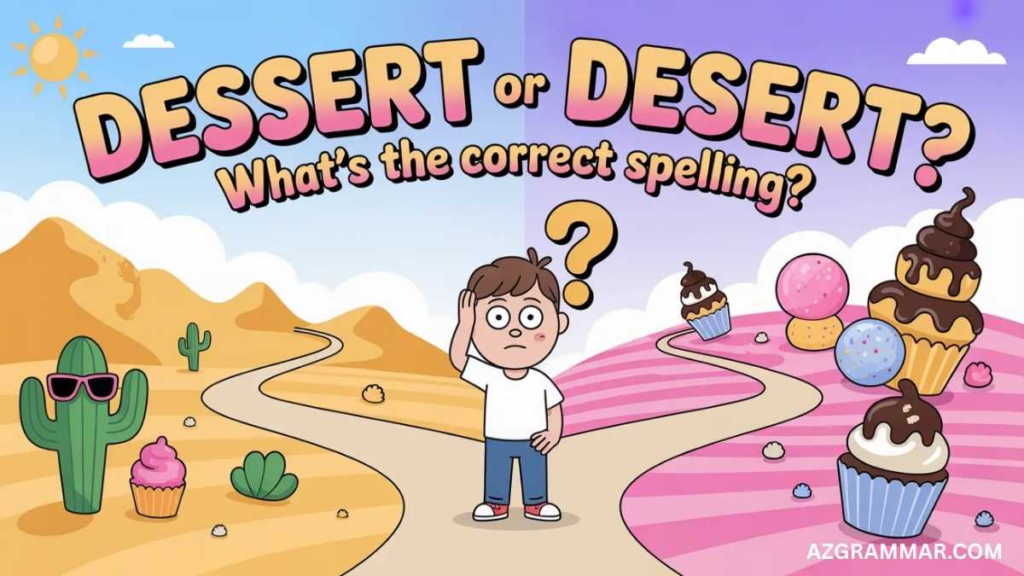
- Dessert = sweet food eaten after a meal
- Desert = dry land OR to abandon
- One-line clarity for featured snippet optimization
- Simple example to instantly remove confusion
Example:
- I ate ice cream for dessert.
- The camel walked through the desert.
That’s it. Simple. However, the real confusion begins when you dig deeper.
Seel or Seal: Which Spelling Is Correct?
Why “Dessert” and “Desert” Confuse So Many People
At first glance, these two words look almost identical. That’s where the trouble starts.
Same letters, different meanings
Both words use the same letters. The only difference is one extra “s.” However, that small detail completely changes the meaning.
Pronunciation similarities
In fast speech, dessert and desert (verb) sound very similar. This makes it harder for learners and even native speakers.
Spelling confusion
- Dessert → double “s”
- Desert → single “s”
Your brain often defaults to the simpler version.
Real-world situations
You might type quickly and write:
- “I love desert after dinner” ❌
Autocorrect might not even catch it. That’s how mistakes slip through.
Fact: Studies in language learning show that commonly confused words are among the top causes of writing errors, even in advanced users.
What Does “Dessert” Mean?
Let’s start with the sweeter word.
Clear definition
Dessert is the sweet course served at the end of a meal.
Common examples
- Cake
- Ice cream
- Brownies
- Cookies
- Pastries
Cultural importance
Desserts are not just food. They’re part of celebrations, traditions, and emotions.
- Birthday cake symbolizes celebration
- Wedding desserts represent joy
- Ice cream often connects to comfort
Everyday usage
Mini examples:
- We had chocolate cake for dessert
- Ice cream is my favorite dessert
Fun fact
In the United States, ice cream is one of the most popular desserts, with the average American consuming around 20 pounds per year.
What Does “Desert” Mean?
Now let’s move from sweetness to dryness.
Desert as a Noun (Geography)
A desert is a dry region with very little rainfall.
Key characteristics
- Less than 250 mm rainfall annually
- Extreme temperatures
- Sparse vegetation
Famous deserts
- Sahara Desert (Africa) – largest hot desert
- Arabian Desert (Middle East)
- Gobi Desert (Asia)
Fact: The Sahara Desert covers about 9.2 million square kilometers, making it almost the size of the United States.
Desert as a Verb (Action)
“Desert” also works as a verb.
Meaning
To leave or abandon someone or something.
Common usage
- Emotional context
- Military or formal situations
Mini examples:
- He deserted his responsibilities
- The soldier deserted his post
Dessert vs Desert: Key Differences Explained
This is where everything becomes crystal clear.
Meaning comparison
- Dessert → food
- Desert → place or action
Spelling difference
- Dessert → double “s”
- Desert → single “s”
Pronunciation difference
Subtle but important.
Supercede or Supersede: What’s the Correct Spelling?
Comparison Table
| Feature | Dessert 🍰 | Desert 🏜️ |
|---|---|---|
| Meaning | Sweet food | Dry land / abandon |
| Spelling | Double “s” | Single “s” |
| Usage | Food context | Geography / action |
| Pronunciation | di-zurt | de-zert |
Dessert or Desert Pronunciation Guide
Pronunciation can make or break understanding.
Correct pronunciation
- Dessert → /dɪˈzɜːrt/ → “di-zurt”
- Desert (noun) → /ˈdez.ərt/ → “dez-ert”
- Desert (verb) → /dɪˈzɜːrt/
Quick tip
- Dessert → stress on second syllable
- Desert (noun) → stress on first syllable
Why Does “Dessert” Have Two S?
This question comes up often.
There’s no strict grammar rule here. However, memory tricks make it easy.
The best explanation
You want more dessert. So it has more “s.”
That’s it.
Why this works
- Simple association
- Easy to remember
- Works instantly in writing
Easy Memory Tricks to Remember Dessert vs Desert
Let’s make this even easier.
Core tricks
- Dessert = two S = sweet stuff
- Desert = one S = sand
Visual memory
Imagine:
- Two scoops of ice cream → dessert
- One dry desert → desert
Quick mental check
Before writing, ask yourself:
“Am I talking about food or sand?”
How to Use Dessert and Desert in Sentences
Understanding theory is good. Practice is better.
Dessert examples
- She ordered dessert after dinner
- We shared a delicious dessert
- Chocolate mousse is a classic dessert
Desert examples (noun)
- Camels survive in the desert
- The desert gets extremely hot
- Plants in the desert conserve water
Desert examples (verb)
- He deserted his responsibilities
- They deserted the project halfway
Common Mistakes with Dessert and Desert
Even experienced writers make these mistakes.
Most common errors
- Writing “desert” instead of “dessert”
- Forgetting the second “s”
- Mispronouncing both words the same
Why mistakes happen
- Speed typing
- Habit-based writing
- Lack of awareness
Quick fixes
- Always double-check context
- Use memory tricks
- Read your sentence aloud
Dessert vs Desert in Real-Life Contexts
Let’s look at real scenarios.
Case study: Restaurant menu
Incorrect: Chocolate lava cake is my favorite desert
Correct: Chocolate lava cake is my favorite dessert
Case study: Travel blog
Incorrect: We explored a beautiful dessert in Dubai
Correct: We explored a beautiful desert in Dubai
Case study: Student essay
Students often mix these words in exams. This leads to lost marks even when the idea is correct.
Curtesy or Courtesy: Correct Usage in Modern English
The Origin and Etymology of Dessert and Desert
Understanding origins helps you remember better.
Dessert origin
- Comes from French desservir
- Meaning: “to clear the table”
- Later evolved into sweet course
Desert origin
- Comes from Latin deserere
- Meaning: “to abandon”
- Also linked to empty land
Are Dessert and Desert Homophones?
Not exactly.
Key point
They are near-homophones, not perfect ones.
Why they sound similar
- Same letters
- Similar syllables
- Fast speech reduces clarity
Dessert vs Desert in British and American English
Good news: no confusion here.
Spelling
- Same in US and UK
Pronunciation
- Slight variation
- Meaning stays identical
Related Commonly Confused Words
Learning similar pairs improves your overall writing.
Examples
- Affect vs Effect
- Then vs Than
- Compliment vs Complement
Why this matters
- Builds vocabulary
- Improves clarity
- Reduces writing errors
Final Takeaway
Let’s simplify everything.
- Dessert = sweet food with two “s”
- Desert = dry land or abandon with one “s”
- Memory tricks make it easy
- Context decides everything
Key insight
Small spelling changes can completely alter meaning. However, once you understand the logic, the confusion disappears.
“Good writing is built on small details.”
Mastering words like dessert or desert makes your writing sharper, clearer, and more professional.
Manuel or Manual: What’s the Real Difference?
Reference Cambridge Dictionary Definitions
Here’s a trusted source for clear Grammar:
FAQs
What is the difference between dessert and desert?
Dessert is sweet food served after a meal, while desert refers to a dry, barren land or the act of abandoning something.
Why does dessert have two “s”?
A simple trick is that you want more dessert, so it has an extra “s” compared to desert.
How do you remember dessert vs desert?
Use this easy rule:
Dessert = sweet → two “s”
Desert = sand → one “s”
Is ice cream a dessert?
Yes, ice cream is one of the most popular desserts and is commonly served after meals.
Can desert ever mean food?
No, desert never refers to food. It only means dry land or the act of leaving something.
How do you pronounce dessert and desert?
Dessert is pronounced “di-zurt,” while desert (noun) is pronounced “dez-ert.”
Are dessert and desert homophones?
They are not exact homophones, but they sound very similar, especially in fast speech.
Are dessert and desert spelled differently in US and UK English?
No, both American and British English use the same spelling for dessert and desert.
What are common mistakes with dessert and desert?
People often write “desert” instead of “dessert,” forget the extra “s,” or confuse their meanings in sentences.
Why are dessert and desert so confusing?
They look almost identical, sound similar, and differ by just one letter, which makes them easy to mix up.
Final Thought
If you’ve ever paused and wondered dessert or desert, you’re not alone. It’s one of those tiny details that can quietly trip up even confident writers. However, once you understand the difference, it becomes surprisingly simple.
Just remember: dessert is sweet and has two “s,” while desert is dry and has one.
That one small distinction can completely change the meaning of your sentence. More importantly, it can change how your writing is perceived. Clear, accurate word choice builds trust and makes your message stronger.
So next time you write, take a second. Choose the right word. And keep your readers enjoying dessert, not wandering through a desert.

James Walker is an English language educator with over 5 years of experience in grammar teaching. He specializes in spelling corrections, confusing word pairs, and grammar rules for everyday use. As the lead author at AZ Grammar, he has helped thousands of students and learners worldwide write English with confidence. His simple, practical approach makes even the most complex grammar rules easy to understand.
Email: azgrammar29@gmail.com
Website: azgrammar.com