You type “user manual,” hit publish, and move on with your day. Later, you notice something strange. It says “user manuel.” Now you’re wondering if you made a typo or accidentally invented a new word. If you’ve ever paused over Manuel or Manual, you’re in good company. This tiny spelling mix-up confuses students, writers, and even professionals. The words look alike, sound similar, and love to cause chaos at the worst possible moment. However, the difference is simple once you see it clearly. In this guide, you’ll finally understand Manuel or Manual without second-guessing yourself again.
Manuel or Manual: Quick Answer (No Confusion)
If you need a fast answer, here it is:
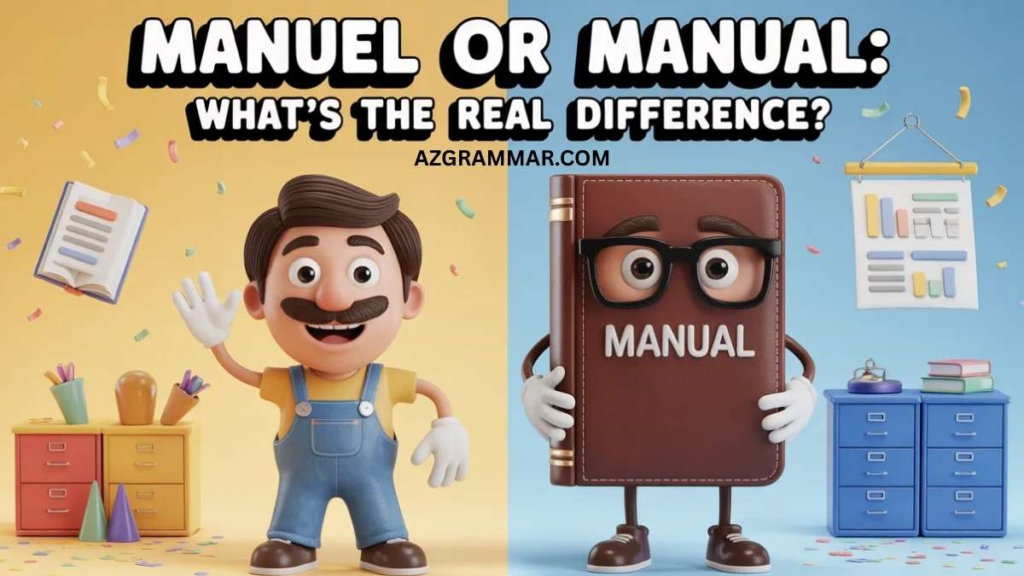
- Manual is the correct English word. It means something done by hand or a book of instructions.
- Manuel is typically a person’s name, not a standard English word used in writing.
If you’re writing about instructions, work, or machines, you almost always want manual.
Presenter or Presentor: Which One Is Correct?
Meaning of “Manual” (Clear and Practical Explanation)
What Does “Manual” Mean?
The word “manual” has two main meanings. Both are widely used in everyday English.
It can refer to something done by hand. It can also refer to a guide or instruction book.
Think of it this way. If you’re using your hands or following instructions, you’re dealing with something “manual.”
Manual as a Noun
As a noun, a manual is a guide that explains how something works.
You’ve likely used one before.
Examples include:
- A user manual for your phone
- A training manual at work
- A repair manual for a car
These documents give step-by-step instructions. They help you understand and use something correctly.
Example sentences:
- I checked the manual before setting up the device.
- The training manual explains every process clearly.
Manual as an Adjective
As an adjective, “manual” describes something done by hand instead of automatically.
This meaning shows up in daily life more often than you might realize.
Examples:
- Manual labor (physical work done by hand)
- Manual transmission (a car you shift yourself)
- Manual process (not automated)
Example sentences:
- The job involves manual work in a warehouse.
- He prefers driving a manual car.
In contrast to automation, manual work requires direct human effort.
Common Uses of “Manual” in Everyday English
You’ll see “manual” across many areas:
- Technology: user manuals, setup guides
- Workplaces: manual tasks, manual handling
- Automotive: manual vs automatic cars
- Education: instruction manuals and training guides
Because it’s so common, using the wrong spelling can stand out immediately.
Meaning of “Manuel” (When It’s Actually Correct)
What Does “Manuel” Mean?
“Manuel” is not a standard English word in most contexts. It’s a given name, often used in Spanish and Portuguese-speaking cultures.
For example:
- Manuel is a common male name in Spain and Latin America.
- It’s similar in usage to names like John or David in English.
Manuel as a Rare Noun (Advanced Usage)
There is a rare, outdated use of “manuel” in historical or religious contexts. However, you almost never see it in modern writing.
For practical purposes, you can ignore this meaning.
Important Note
In modern English writing, “manuel” is almost always incorrect unless you’re referring to a person’s name.
If you write:
- “Please read the user manuel”
That’s a mistake.
Seel or Seal: Which Spelling Is Correct?
Manuel or Manual: Key Differences Explained Clearly
Here’s the difference in plain terms:
| Feature | Manual | Manuel |
|---|---|---|
| Type | Noun / Adjective | Proper noun (name) |
| Meaning | Instructions / done by hand | Person’s name |
| Usage Frequency | Very common | Rare in general writing |
| Context | Work, tech, learning | Names, identity |
A quick way to think about it:
- If it’s about things, use manual
- If it’s about people, use Manuel
Correct Usage of “Manual” in Sentences
Manual as a Noun – Examples
- Always read the manual before installing new software.
- The equipment manual includes safety guidelines.
- She followed the manual step by step.
Each example shows “manual” as a guide or instruction book.
Manual as an Adjective – Examples
- This job requires manual effort.
- The system still relies on manual input.
- He switched from an automatic to a manual vehicle.
In these cases, “manual” describes how something is done.
Correct Usage of “Manuel” in Sentences
Manuel as a Name – Examples
- Manuel is leading the project this week.
- I met Manuel during the conference.
- Manuel lives in Madrid.
Notice something important. It’s always capitalized because it’s a proper noun.
Accidently or Accidentally: Which One Is Correct?
Common Mistakes People Make (And How to Avoid Them)
Let’s look at where things usually go wrong.
❌ Incorrect: Using “Manuel” for Instructions
- Incorrect: Check the user manuel
- Correct: Check the user manual
This is the most common mistake.
❌ Incorrect: “Manuel Labor”
- Incorrect: He does manuel labor
- Correct: He does manual labor
This error often comes from phonetic confusion.
❌ Incorrect: Using “Manuel” in SEO Content
If you’re writing online content, this mistake can hurt you.
Search engines understand user intent. When someone searches “user manual,” they expect relevant results. If your page uses “manuel,” it may look unprofessional or irrelevant.
That can lower trust and reduce rankings.
Spelling Tips to Remember the Difference Easily
Think of “Hand” → Manual
The word “manual” relates to hands. Both start with “man.”
If it involves effort or instructions, think “manual.”
Think of a Person → Manuel
“Manuel” is a name. Picture a person.
That mental image makes it easier to remember.
Check the Context Before You Write
Ask yourself a quick question:
- Am I talking about instructions or work? → manual
- Am I referring to a person? → Manuel
This simple check prevents most mistakes.
Manuel or Manual in British and American English
Here’s something many people wonder about.
Is there a difference between British and American English?
No. Both use “manual” the same way. The spelling does not change.
So if you thought “manuel” might be a regional variation, it isn’t.
Why “Manual” Matters in SEO and Professional Writing
This might seem like a small detail. It isn’t.
Spelling affects credibility. It affects clarity. It even affects search rankings.
For example:
- “User manual” is a high-volume keyword
- “User manuel” is often a misspelling
If your content uses the wrong spelling, readers may lose trust. Search engines may also struggle to match your content with the right queries.
In professional writing, small errors create big impressions.
Manuel or Manual: Which One Should You Use?
Let’s make this simple.
- Use manual when writing about instructions, processes, or anything done by hand
- Use Manuel only when referring to a person’s name
If you’re ever unsure, default to “manual.” That’s the correct choice in almost every writing situation.
Crier or Cryer: Which Spelling Is Correct? (2026)
Reference Cambridge Dictionary Definitions
Here’s a trusted source for clear Grammar:
FAQs
Is “manuel” a correct English word?
“Manuel” is not a standard English word in everyday writing. It is typically used as a proper name, especially in Spanish and Portuguese cultures.
Is it “user manual” or “user manuel”?
The correct phrase is “user manual.” “Manuel” is a misspelling in this context.
Can “manuel” mean an instruction book?
No. An instruction book is always called a manual, not “manuel.”
Why do people confuse “manuel” and “manual”?
The confusion comes from similar spelling and pronunciation. Typing errors and autocorrect issues also play a role.
Is “manual” used as a verb?
No. “Manual” functions as a noun or an adjective, not a verb.
What is manual labor?
Manual labor refers to physical work done by hand rather than by machines or automation.
Is Manuel a common name?
Yes. “Manuel” is a common given name in Spanish and Portuguese-speaking regions.
How can I remember the difference between manual and manuel?
Think of manual = hand (work or instructions). Think of Manuel = a person’s name.
Does “manuel” have any meaning in modern English usage?
In modern English, “manuel” has no common meaning outside of being a name.
Is there a difference between manual in British and American English?
No. Both British and American English use “manual” with the same spelling and meaning.
Final Thoughts
At first glance, “manuel” and “manual” look almost identical. However, that one-letter difference changes everything.
“Manual” is a practical, everyday word. You’ll use it when talking about instructions, processes, or anything done by hand. In contrast, “Manuel” is a name. It belongs to people, not objects or tasks.
This small distinction matters more than you might think. It affects how clearly you communicate. It shapes how professional your writing feels. And it even impacts how search engines understand your content.
The good news is that it’s easy to get right. Just pause for a second and check your context. If you’re describing work or instructions, go with “manual.” If you’re referring to a person, then “Manuel” makes sense.
Once you build this habit, you won’t second guess it again.

James Walker is an English language educator with over 5 years of experience in grammar teaching. He specializes in spelling corrections, confusing word pairs, and grammar rules for everyday use. As the lead author at AZ Grammar, he has helped thousands of students and learners worldwide write English with confidence. His simple, practical approach makes even the most complex grammar rules easy to understand.
Email: azgrammar29@gmail.com
Website: azgrammar.com