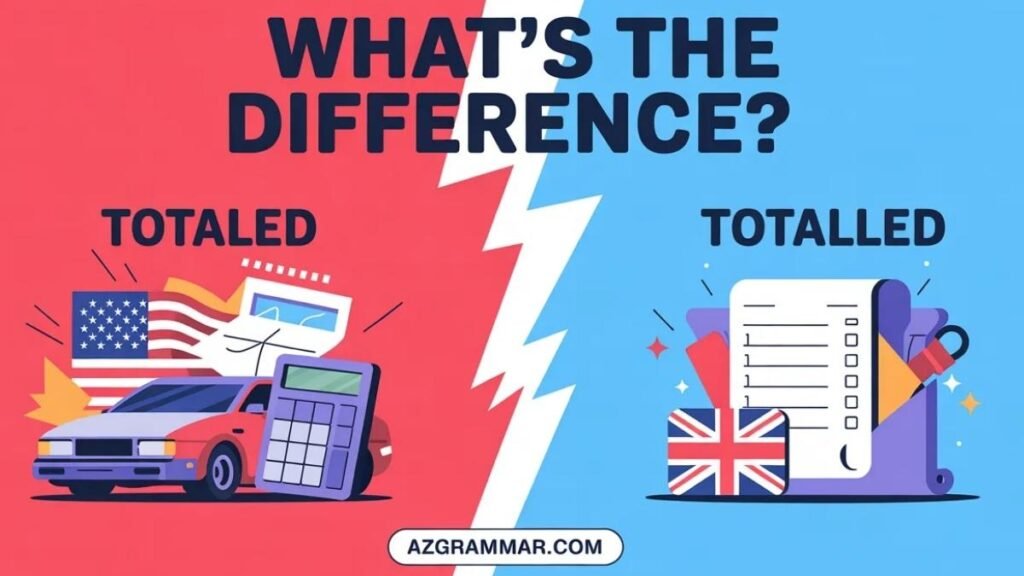
The spelling debate between totaled or totalled confuses many English learners, writers, and even native speakers. You may see both spellings in newspapers, insurance reports, and everyday conversations. That raises an obvious question.
Which spelling is correct — totaled or totalled?
The short answer is simple.
Both spellings are correct. The difference comes from American English spelling and British English spelling conventions.
- Totaled is the standard spelling in American English.
- Totalled is the preferred spelling in British English and many Commonwealth countries.
However, this spelling difference involves more than regional preference. It also relates to English grammar rules, verb past tense formation, and spelling conventions that developed over centuries.
Understanding the totaled or totalled difference helps writers choose the correct form for their audience. It also explains why the word appears frequently in contexts such as car accidents, insurance claims, and financial totals.
This complete guide explains:
- The totaled meaning and totalled meaning
- The grammar rules behind totaled vs totalled
- Why American and British English spell words differently
- The meaning of a totaled car in insurance
- Common mistakes people make when using these spellings
By the end of this article, you will clearly understand when to use totaled and when to use totalled.
Totaled or Totalled — Which Spelling Is Correct?
The spelling totaled or totalled depends entirely on the version of English you are using.
Both spellings represent the past tense of the verb “total.”
Alumnus vs Alumni: What’s the Real Difference?
Quick Comparison
| Spelling | English Variant | Example |
|---|---|---|
| Totaled | American English | The accident totaled the car. |
| Totalled | British English | The crash totalled the vehicle. |
In other words, the two words have identical meanings. The difference lies in regional spelling conventions.
Writers in the United States typically use totaled with one “l”. Writers in the United Kingdom, Australia, Canada, and other Commonwealth regions usually write totalled with two “l” letters.
This pattern appears in many English verbs.
For example:
| American English | British English |
|---|---|
| traveled | travelled |
| canceled | cancelled |
| labeled | labelled |
| totaled | totalled |
These variations reflect long-standing English language differences rather than grammar mistakes.
What Does Totaled or Totalled Mean?
To understand the totaled meaning and totalled meaning, it helps to look at how the verb total works in English.
The word total has several meanings depending on context.
Totaled Definition
Totaled (verb):
The past tense of “total,” meaning:
- To calculate the final amount of something
- To reach a final sum or total
- To completely destroy something, especially a vehicle
Totalled Definition
Totalled (verb):
The British English spelling of the same past tense verb.
The meaning remains identical.
What Does Totaled Mean in Everyday Language?
In everyday conversation, the word totaled usually appears in three main contexts.
Calculating a Final Amount
The verb describes adding numbers to reach a final sum.
Example:
- The accountant totaled the expenses for the quarter.
Reaching a Final Quantity
Sometimes the word describes the final quantity of something.
Example:
- The event attendance totaled 3,500 people.
Destroying Something Completely
In modern usage, the most common meaning relates to vehicle accidents.
Example:
- The crash totaled the car.
This last meaning often appears in insurance reports and automotive damage assessments.
Grammar Rule Behind Totaled vs Totalled
The difference between totaled vs totalled comes from a well-known grammar spelling rule in English.
This rule involves doubling the final consonant when adding suffixes such as -ed or -ing.
The Double Consonant Rule
In British English spelling, verbs that end with a single vowel followed by “l” often double the “l” before adding suffixes.
For example:
| Base Verb | British Past Tense |
|---|---|
| travel | travelled |
| cancel | cancelled |
| signal | signalled |
| total | totalled |
American English usually simplifies this spelling by using a single “l.”
Why American English Uses One “L”
In the early 19th century, American lexicographer Noah Webster introduced spelling reforms.
Webster believed English spelling should be simpler and more phonetic. His dictionaries promoted streamlined forms.
As a result, American English adopted spellings like:
- traveled
- canceled
- totaled
These changes gradually became standard in the United States.
Today, the distinction remains a defining feature of British vs American English spelling.
Lying or Lieing: Which Spelling Is Correct?
British vs American English Spelling
The totaled or totalled difference reflects broader patterns in English spelling.
Understanding these patterns helps explain why certain words differ across regions.
American English Spelling Patterns
American English generally favors simpler spellings.
Characteristics include:
- Fewer doubled consonants
- Simplified vowel patterns
- Shorter word forms
Examples:
| American English | Meaning |
|---|---|
| totaled | past tense of total |
| canceled | past tense of cancel |
| traveled | past tense of travel |
British English Spelling Patterns
British English tends to preserve traditional spellings.
Characteristics include:
- Double consonants before suffixes
- Older historical spelling conventions
- Greater influence from Latin and French
Examples:
| British English | Meaning |
|---|---|
| totalled | past tense of total |
| cancelled | past tense of cancel |
| travelled | past tense of travel |
Both forms follow valid English grammar rules.
Totaled vs Totalled in Car Insurance and Accidents
The word totaled frequently appears in automotive contexts. Many people search for car totaled meaning after an accident.
Understanding the term is important for anyone dealing with vehicle insurance claims.
What Does It Mean When a Car Is Totaled?
A car is considered totaled when the cost to repair the vehicle exceeds its market value.
Insurance companies use this concept during automotive damage assessments.
For example:
If a car is worth $12,000 and repairs cost $10,500, the insurer may decide it is cheaper to replace the vehicle instead of repairing it.
In that situation, the vehicle is declared totaled.
Totaled Car Insurance Meaning
When an insurance company declares a car totaled, it usually means one of the following:
- The repair cost exceeds the vehicle value
- The damage is severe enough that repairs are unsafe
- The cost of parts and labor is too high
The insurer then pays the vehicle’s actual cash value (ACV) rather than repairing it.
When Is a Car Considered Totaled?
Insurance companies use a threshold called the Total Loss Ratio (TLR).
This ratio compares repair cost to vehicle value.
Example Calculation
| Vehicle Value | Repair Cost | Result |
|---|---|---|
| $15,000 | $5,000 | Repairable |
| $15,000 | $12,000 | Likely totaled |
In many U.S. states, insurers declare a car totaled when repair costs reach 70–80% of the vehicle value.
Insurance Write-Off Categories
In many countries, especially the UK, insurers classify damaged vehicles into write-off categories.
| Category | Meaning |
|---|---|
| Category A | Vehicle must be scrapped |
| Category B | Vehicle parts may be salvaged |
| Category S | Structural damage but repairable |
| Category N | Non-structural damage |
When a car is categorized under severe damage classes, it is often described as totalled in British English.
Spicket or Spigot: Usage, and Key Differences Explained
Case Study: Real Example of a Totaled Vehicle
Consider a real-world scenario from an insurance claim.
Accident Situation
- Vehicle: 2019 Toyota Camry
- Market value: $19,000
- Collision repair estimate: $15,200
Insurance Decision
Because the repair cost exceeded 80% of the car’s value, the insurance company declared the vehicle totaled.
Instead of repairing it, the insurer issued a payout close to the car’s market value.
This example shows how the term totaled meaning in car accident contexts relates to economic decisions rather than physical destruction alone.
Common Mistakes When Using Totaled or Totalled
Many writers make small but noticeable errors when using these spellings.
Understanding the most common mistakes helps improve writing accuracy.
Mixing American and British Spellings
One of the most frequent errors occurs when writers combine both forms in the same article.
For example:
- “The accident totaled the car and the damage totalled $8,000.”
This creates inconsistency.
Choose one style and use it consistently.
Misunderstanding the Meaning
Some people think the word totaled always refers to destruction.
However, it can also mean calculating a final amount.
Example:
- The sales figures totaled $45,000.
Incorrect Verb Form Usage
The base verb total changes depending on tense.
| Verb Form | Example |
|---|---|
| Total | They total the numbers |
| Totaling / Totalling | The expenses are totaling $1,000 |
| Totaled / Totalled | The bill totaled $1,000 |
Understanding these verb conjugation forms helps avoid grammatical errors.
Totaled or Totalled in Everyday Writing
The words appear in many types of writing.
Looking at real examples shows how they function in context.
News Writing
Journalists frequently use the term when reporting accidents.
Example:
“The highway collision totaled three vehicles, causing major traffic delays.”
Business Writing
Accountants and analysts often use the verb in financial reports.
Example:
“The company’s annual revenue totaled $2.4 million.”
Social Media Usage
On social platforms, people use the word casually.
Example:
“Someone hit my car in the parking lot and totaled it.”
Academic Writing
In academic contexts, the word usually appears when describing data totals.
Example:
“The survey responses totaled 1,200 participants.”
Quick Comparison Table
The table below summarizes the difference between totaled vs totalled.
| Feature | Totaled | Totalled |
|---|---|---|
| English type | American English | British English |
| Correct spelling | Yes | Yes |
| Meaning | Same | Same |
| Common usage | USA | UK, Australia, Canada |
This comparison highlights that the difference involves spelling conventions rather than meaning.
Bellies vs Bellys: Which One Is Correct in English?
Reference Cambridge Dictionary Definitions
Here’s a trusted source for clear Grammar:
FAQs
Is totaled or totalled correct?
Both spellings are correct.
Totaled is used in American English.
Totalled is used in British English.
What does totaled mean?
The word totaled means either:
- Calculating a final sum, or
- Completely destroying something, usually a vehicle.
Why is totaled spelled with one L?
American English simplified many spellings during the 19th century. These reforms were influenced by Noah Webster’s spelling reform, which promoted shorter spellings.
Why does British English spell totalled with two L?
British English follows traditional double consonant rules when adding suffixes such as -ed.
What does it mean when a car is totaled?
A car is considered totaled when repair costs exceed the vehicle’s market value, making repairs economically impractical.
Is totalled British spelling?
Yes. Totalled is the standard spelling in British English and many Commonwealth countries.
How do you spell totaled?
In American English, the correct spelling is totaled with one “l.”
What is the difference between totaled and totalled?
The difference involves regional spelling conventions.
Both words have the same meaning. The choice depends on whether the writer uses American English or British English.
Final Thoughts:
The spelling debate around totaled or totalled often confuses writers. The truth is straightforward.
Both spellings are correct.
The only difference lies in regional English spelling conventions.
- Totaled is the American English spelling.
- Totalled is the British English spelling.
The meaning remains exactly the same. The word can refer to calculating a final sum or destroying something completely, especially a vehicle in an accident.
When writing, the most important rule is consistency.
Choose the spelling that matches your audience and stick with it throughout your content.
Once you understand the grammar rules, spelling differences, and real-world usage, the confusion between totaled vs totalled disappears completely.

James Walker is an English language educator with over 5 years of experience in grammar teaching. He specializes in spelling corrections, confusing word pairs, and grammar rules for everyday use. As the lead author at AZ Grammar, he has helped thousands of students and learners worldwide write English with confidence. His simple, practical approach makes even the most complex grammar rules easy to understand.
Email: azgrammar29@gmail.com
Website: azgrammar.com