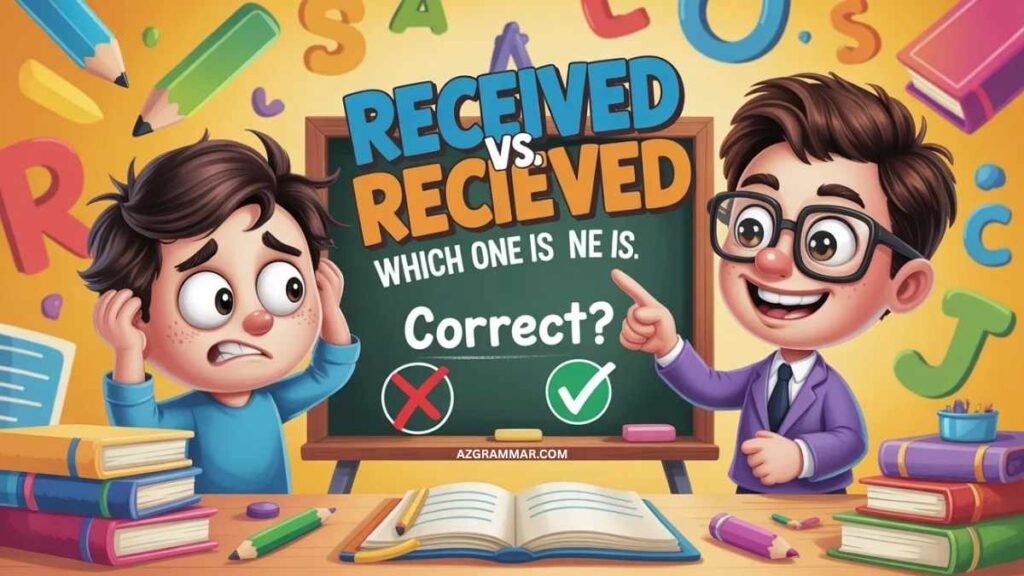
Ever typed “received vs recieved” and suddenly felt like English betrayed you? You’re not alone. This tiny spelling battle has confused students, professionals, and even grammar lovers for years. One version looks right, the other feels suspicious, yet both seem oddly convincing in the moment. Blame tricky rules, fast typing, or autocorrect taking a coffee break. The good news? You can finally settle this once and for all. By the end, you’ll spot the correct spelling instantly and maybe even laugh at past mistakes you made without noticing them before today at all ever again truly confidently now onward forever done here today folks!
Quick Answer: Received vs Recieved
Let’s keep it simple.
- ✅ Correct spelling: Received
- ❌ Incorrect spelling: Recieved
👉 If you’re asking, “is recieved correct?” — the answer is no.
Example:
I received your message yesterday.
That’s the only correct form.
Que or Queue? Which One Is Correct in English?
Recieved vs Received: What’s the Actual Difference?
Here’s where many people get confused.
- Received → a real English word
- Recieved → a misspelling
There’s no difference in meaning because recieved isn’t a valid word at all.
This isn’t like British vs American spelling. It’s simply a mistake.
Received Meaning (Clear and Practical Definition)
The word received comes from the verb receive. It means:
- To get something
- To accept something
- To be given something
- To experience something
Examples of “Received” in Sentences
- I received your email this morning.
- She received an award for her performance.
- We received payment from the client.
- He received good news about his application.
These examples show real-life usage, which helps you understand how the word fits into everyday English.
Why People Misspell “Received”
This mistake happens more often than you think. There’s a pattern behind it.
Main Reasons
- Confusion between “ie” and “ei”
- Misremembering spelling rules
- Typing quickly without checking
- Over-relying on autocorrect
- Learning English as a second language
Here’s the key issue.
English spelling rules aren’t always consistent. That makes words like received tricky.
The Spelling Rule You Need to Know
“I Before E Except After C”
This classic rule explains why received is spelled the way it is.
👉 The rule says:
- Use “ie” (believe, piece)
- Use “ei” after “c” (receive, ceiling)
So in receive:
- The letter c comes before the vowel sound
- That’s why it becomes “ei”, not “ie”
Simple Breakdown
- re + cei + ve + d
- The “cei” part follows the rule
Important Exceptions to the Rule
Here’s where things get interesting.
The rule isn’t perfect.
Common Exceptions
- Weird
- Science
- Foreign
- Height
- Neighbor
👉 That’s why you shouldn’t rely only on the rule. You need memory tricks too.
How to Remember the Correct Spelling (That Actually Works)
Rules help. But memory tricks stick.
Easy Tricks You Can Use
- Think: “C comes before EI”
- Focus on the middle: rec-EI-ve
- Say it slowly: re-ceive-d
- Visualize the word: highlight “cei”
Analogy That Helps
Think of it like a queue.
👉 The letter C stands in line before EI
Once you see it that way, it becomes much easier to remember.
Teepee vs Tipi: Which One Is Correct in English?
Common Spelling Mistakes Related to “Received”
People don’t just write recieved. There are several variations.
Common Errors
- recieved
- receved
- receieved
- recived
- receivd
Why These Happen
- Skipping letters
- Mixing vowel order
- Typing too fast
- Not proofreading
👉 These are classic examples of common spelling mistakes in English received searches.
“I Received” vs “I Have Received” (Grammar Explained Simply)
This is where grammar comes in.
Quick Comparison
| Phrase | Tense | When to Use | Example |
|---|---|---|---|
| I received | Past simple | Completed action | I received your email yesterday |
| I have received | Present perfect | Recent or relevant now | I have received your email |
Key Difference
- I received → finished in the past
- I have received → still relevant now
👉 This is a common confusion in received grammar.
“Was Received” vs “Has Been Received”
These forms appear in formal writing.
Examples
- The package was received yesterday
- Your request has been received
Difference
- Was received → past, completed
- Has been received → recent, ongoing relevance
You’ll often see this in:
- Emails
- Customer support replies
- Business communication
Tare vs Tear: Which One Is Correct in English?
How “Received” Is Used in Everyday English
This word shows up everywhere.
Real-Life Examples
- Email received
- Message received
- Payment received
- Order received
- Package received
Example Sentences
- Your payment has been received successfully.
- I received your message late last night.
- We received the shipment on time.
👉 These examples match real search intent and practical usage.
UK vs US English: Is There Any Difference?
Let’s clear this up.
- Received is correct in both US and UK English
- Recieved is wrong everywhere
There’s no variation here.
Word Forms of “Receive” (Quick Reference Table)
Understanding forms helps avoid mistakes.
| Form | Example |
|---|---|
| Receive | I receive emails daily |
| Received | I received your call |
| Receiving | She is receiving help |
👉 This also helps with searches like received vs receiving spelling.
Origin of the Word “Receive”
Understanding origin can improve memory.
- From Old French: receivre
- From Latin: recipere
- Meaning: “to take back” or “to accept”
👉 That explains why the spelling looks unusual.
How to Use “Received” Correctly (Practical Guide)
Let’s make this actionable.
Do This
- Use received for past actions
- Use correct spelling every time
- Proofread important writing
Avoid This
- Writing recieved
- Guessing spelling
- Ignoring grammar context
Case Study: Real-World Writing Mistake
Scenario
A freelancer sends this email:
“I have recieved your payment.”
Problem
- Looks unprofessional
- Reduces credibility
- Shows lack of attention to detail
Correct Version
“I have received your payment.”
Impact
- Builds trust
- Improves professionalism
- Enhances communication
👉 Small spelling mistakes can have real consequences.
Google Trends Insight: Why This Mistake Still Exists
Search data shows something interesting.
- “recieved vs received” gets thousands of searches
- Many users ask: is recieved a real word
- People struggle with ie vs ei rule
👉 This proves the confusion is ongoing even in 2026.
Chili or Chilli : Which One Is Correct in English?
Quick Recap (Remember This)
- Received = correct
- Recieved = incorrect
- Follow: “i before e except after c”
- Use memory tricks if needed
Reference Cambridge Dictionary Definitions
Here’s a trusted source for clear Grammar:
FAQs
Is “recieved” a correct spelling?
No, “recieved” is incorrect. The correct spelling is “received.” The incorrect version is a common mistake caused by confusion between “ie” and “ei.”
Why is “received” spelled with “ei” instead of “ie”?
Because it follows the rule “i before e except after c.” Since the letter “c” comes before the vowel, the correct spelling becomes “ei” → received.
What is the correct spelling of received?
The correct spelling is:
👉 R-E-C-E-I-V-E-D
What does “received” mean?
“Received” means:
- To get something
- To accept something
- To be given something
Example:
I received your email this morning.
Is “received” used in both US and UK English?
Yes. “Received” is correct in both American and British English. There is no spelling difference between regions.
How do you use “received” in a sentence?
Here are a few examples:
- I received your message yesterday.
- We received the package on time.
- She received an award for her work.
What is the difference between “receive” and “received”?
- Receive → present tense
- Received → past tense
Example:
- I receive emails daily.
- I received your email yesterday.
How do you spell “receiving”?
The correct spelling is:
👉 R-E-C-E-I-V-I-N-G
It follows the same “ei after c” pattern as received.
What is the easiest way to remember the spelling of “received”?
Use this simple trick:
👉 “C comes before EI.”
This helps you remember that after “c,” you should write “ei”, not “ie.”
Why do people commonly misspell “received”?
Most people confuse:
- “ie” and “ei” rules
- Typing habits
- Lack of proofreading
It’s one of the most common spelling mistakes in English.
Is “received” a verb or a noun?
“Received” is a verb. It is the past tense of “receive.”
When should I use “I received” vs “I have received”?
- I received → finished action in the past
- I have received → recent action or still relevant
Example:
- I received your email yesterday.
- I have received your email and will reply soon.
Final Thoughts
Spelling mistakes like recieved vs received might seem small, yet they can quietly affect how your writing is perceived. A single misplaced letter can make a sentence look careless, especially in emails, professional messages, or academic work.
The good news is that this one is easy to fix.
Once you understand the rule “i before e except after c” and use a simple memory trick like “C comes before EI,” the confusion disappears. From that point on, you won’t need to guess. You’ll know.
Think of it this way. Clear writing builds trust. Every correctly spelled word strengthens your message and makes you look more confident and credible.
So the next time you write it, pause for a second.
👉 Received is always correct. Recieved is always wrong.
Lock it in. Use it consistently. Move forward without second guessing.

James Walker is an English language educator with over 5 years of experience in grammar teaching. He specializes in spelling corrections, confusing word pairs, and grammar rules for everyday use. As the lead author at AZ Grammar, he has helped thousands of students and learners worldwide write English with confidence. His simple, practical approach makes even the most complex grammar rules easy to understand.
Email: azgrammar29@gmail.com
Website: azgrammar.com