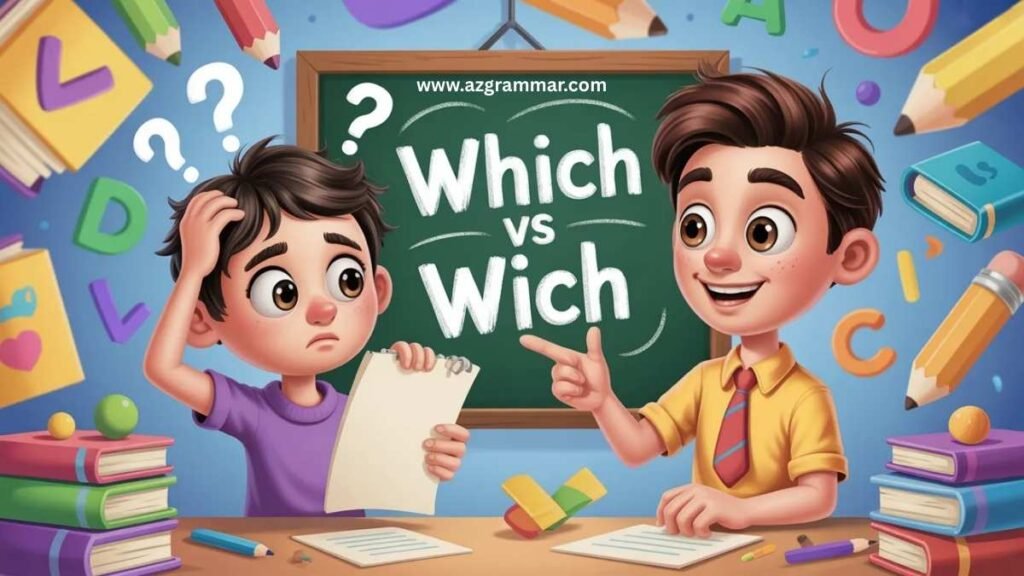
You’re typing fast and suddenly stop. Did you write which or wich? It happens to everyone native speakers, ESL learners, and even seasoned writers. One tiny missing letter causes a surprisingly common spelling mistake that millions of people search for every year.
This guide answers the question once and for all. You’ll learn the correct spelling, why people get it wrong, how to use it properly, and a simple trick so you never mix it up again.
Quick Answer: Which or Wich?
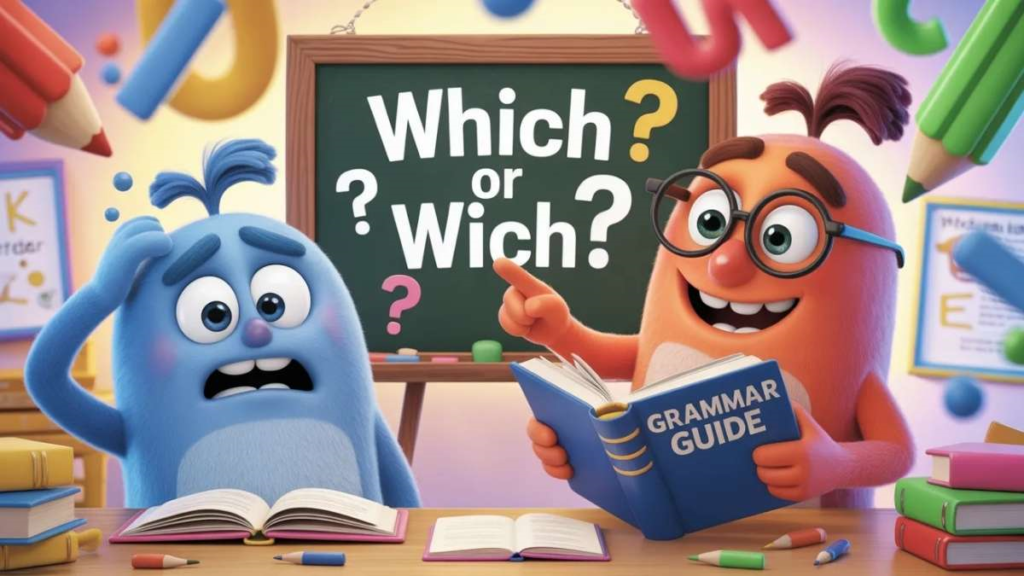
“Which” is the correct spelling. There is no standard English word spelled “wich.” If you’ve been writing wich, you’ve been making a spelling error and you’re definitely not alone.
Correct: Which movie do you want to watch tonight? Incorrect: Wich movie do you want to watch tonight?
The word is always spelled with the letter H after the W: W-H-I-C-H. Keep that in mind and you’re already ahead of thousands of other writers.
Training vs Trainning: Grammar and Usage
What Does “Which” Actually Mean?
Before diving into why people misspell it, it helps to understand what which actually does in a sentence. It’s one of those small words that carries a lot of grammatical weight.
As a Relative Pronoun
When which acts as a relative pronoun, it introduces a clause that adds information about a noun. These are called relative clauses.
- The car, which was parked outside, got a ticket.
- She bought the dress which was on sale.
As an Interrogative Pronoun
As an interrogative pronoun, which asks a question about a choice between specific options.
- Which do you prefer coffee or tea?
- Which of these answers is correct?
a Determiner
Which also works as a determiner when it sits directly before a noun and introduces a question or clause.
- Which book should I read first?
- He couldn’t decide which route to take.
So which is a multi-purpose word. It questions, connects, and specifies all depending on how you use it.
Why So Many People Spell It “Wich”
Millions of people type wich every single day. This isn’t a sign of carelessness. It’s actually a predictable result of how the human brain processes language.
The Phonetic Spelling Trap
English is notoriously difficult because its spelling doesn’t always match its pronunciation. When you say which out loud, you don’t hear a separate H sound. It blends into the “wh” sound or for many speakers, it just sounds like a plain W. So when someone spells by sound, they naturally write wich.
This is called phonetic spelling, and it trips up both native and non-native English speakers alike.
Fast Typing and Autocorrect Habits
Modern typing is fast. When your fingers are moving at speed, small letters drop out. The H in which is easy to skip. And autocorrect doesn’t always catch it because some devices don’t flag wich as an error which only reinforces the habit.
How the Silent H Creates Confusion
The H in which isn’t completely silent but it’s subtle. In many American English accents, wh-words like which, what, where, and when are pronounced with a soft breathy sound at the start, sometimes called the “hw” sound. However, in most modern American speech, that distinction has largely disappeared, and both W and Wh sound the same. The H became invisible to the ear.
Why ESL Learners Are Especially Prone to This Error
For learners of English as a second language, wh-words present a unique challenge. Most languages don’t have this W+H combination. When students learn to write English phonetically, they apply their native language’s spelling logic and the H simply doesn’t make sense to them. It’s one of the most common English spelling mistakes across South Asia, Southeast Asia, and Latin America.
The Origin of “Which” (And Why the H Is There)
Here’s where it gets interesting. The H in which isn’t random. It has a long history that explains exactly why it belongs there.
Old English Roots: hwilc
The word which comes from Old English hwilc, which itself combined two roots: hwa (who) and lic (form or body). So the original meaning was roughly “of what form” or “of what kind.” The H was fully pronounced back then it was a real, audible sound.
How Wh-Words Evolved in English
Over centuries of linguistic change, the hw sound at the start of words gradually shifted. By Middle English, the spelling had flipped to wh instead of hw but the H stayed in the spelling to honor the word’s roots and distinguish it from other words. So what you see today is a spelling fossil a remnant of how the word sounded 1,000 years ago.
Why English Kept the H in Which, What, When, Where, Why
English kept the H in all wh-words for two reasons:
- Etymology — to preserve the link to the Old English and Germanic origins
- Visual distinction — to separate wh-words from other words that might look identical without the H
Think about it: without the H, where becomes were, when becomes wen (a type of cyst), and which becomes wich a meaningless string of letters. The H does real work, even if you can’t always hear it.
Which vs Wich vs Witch: Know the Difference
These three words look and sound similar. Two of them are real English words. One is not. Here’s the full breakdown:
| Word | Correct? | Part of Speech | Meaning | Example |
|---|---|---|---|---|
| Which | ✅ Yes | Pronoun / Determiner | Used to ask about or specify a choice | Which coat do you want? |
| Wich | ❌ No | Not a standard word | Has no meaning in English | — |
| Witch | ✅ Yes | Noun | A person said to practice magic | The witch cast a spell. |
The key differences:
- Which ends in -ch and is a grammar word
- Witch ends in -tch and is a noun referring to a person
- Wich ends in -ch but is simply a misspelling of which
Don’t confuse which with witch either. They sound nearly identical in casual speech but mean completely different things and can’t be swapped.
Niece or Neice: Which One Is Correct in English?
How to Use “Which” Correctly in a Sentence
Knowing the correct spelling is step one. Using it properly in writing is step two. Here’s a practical breakdown.
In Questions (Interrogative Pronoun)
Use which when you’re asking someone to choose from a specific, limited set of options:
- Which flight departs first?
- Which color do you think looks best?
Note: When the options are open-ended or unlimited, use what instead. For example, “What is your name?” works better than “Which is your name?”
In Relative Clauses (Relative Pronoun)
Which introduces nonrestrictive relative clauses clauses that add extra information but aren’t essential to the sentence’s core meaning.
- The report, which took three weeks to write, was approved yesterday.
- Her garden, which faces south, gets plenty of sunlight.
Notice the commas on both sides. That’s a key signal of a nonrestrictive clause.
The Difference Between Restrictive and Nonrestrictive Clauses
This is where many writers get tripped up.
| Clause Type | Word to Use | Commas? | Example |
|---|---|---|---|
| Restrictive | that | No commas | The book that I lost was expensive. |
| Nonrestrictive | which | Use commas | The book, which cost $40, was a gift. |
A restrictive clause limits or defines which specific thing you mean. It’s essential to the sentence. Use that.
A nonrestrictive clause just adds bonus information. Remove it and the sentence still makes complete sense. Use which and add commas.
When to Use “Which” vs “That”
This is one of the most searched grammar questions in English. Here’s the simple rule:
- Use that when the clause is essential to identify what you’re talking about
- Use which when the clause is extra, non essential information
Examples:
- The car that she drives is red. (which car? the one she drives — essential)
- Her car, which she bought last year, is red. (extra info added in — non-essential)
Using a Comma Before “Which”
As a rule of thumb: if you use which in a nonrestrictive clause, put a comma before it. This signals to the reader that what follows is additional, not defining.
- ✅ The meeting, which lasted two hours, was exhausting.
- ❌ The meeting which lasted two hours was exhausting. (should use “that” or add commas)
Prefer vs Perfer: Explained with Easy Examples
Real World Examples of “Which” in Context
Seeing which in real sentences is the fastest way to make the rule stick.
Everyday sentences:
- Which restaurant should we go to?
- I can’t decide which shirt to wear.
- She didn’t know which road to take.
Formal writing examples:
- The committee reviewed all proposals, which were submitted before the deadline.
- The new policy, which takes effect in January, will affect all employees.
Common grammar patterns:
- “…of which…” → The team had three options, none of which seemed ideal.
- “…which means…” → He was late, which means we missed the opening act.
- “Which one…” → Which one is correct?
A Simple Trick to Never Misspell “Which” Again
Here’s the mnemonic that works best especially for ESL learners:
“Which belongs to the Wh-word family.”
Every common question word in English starts with Wh:
- What
- When
- Where
- Why
- Who
- Which
See the pattern? They all start with W-H. If you remember that which belongs to this family, you’ll never drop the H again.
Another memory tip: Think of the phrase “Which witch is which?” a classic English tongue twister. Both which and witch appear side by side. If you remember this phrase, you’ll always know both spellings at once.
“Wich” in Place Names: The One Exception Worth Knowing
Here’s something that genuinely surprises people: -wich does appear in the real world just not as a standalone English word. It shows up in British place names.
- Greenwich
- Sandwich
- Norwich
- Ipswich
- Hardwich
In these cases, -wich comes from the Old English word wīc, meaning a settlement, dwelling place, or trading post. It has nothing to do with the pronoun which. They share letters but have completely separate origins.
Does this make “wich” a real word? No. It’s a place name suffix a historical fragment embedded in British town names. You can’t use wich as a standalone word in a sentence. It simply doesn’t work that way.
So if someone ever argues that wich is valid because of Sandwich or Norwich, they’re mixing up two entirely different etymologies.
Party’s or Parties: Which Spelling Is Correct?
Common Mistakes to Avoid When Using “Which”
Beyond the basic spelling error, writers make a few other recurring mistakes with which. Here’s what to watch out for:
- Confusing which with witch — They sound alike but mean entirely different things. Witch is always a noun referring to a person.
- Dropping the H entirely — Writing wich instead of which is the most common error. Always check for the H.
- Using which when that is correct — If the clause is essential to the sentence’s meaning, use that, not which.
- ❌ The app which you downloaded has a virus.
- ✅ The app that you downloaded has a virus.
- Forgetting the comma before which — In nonrestrictive clauses, the comma is required. Skipping it changes the meaning and breaks grammar rules.
- Overusing which in informal writing — In casual conversation, sentences like “The thing which I told you” sound stiff. “The thing I told you” flows more naturally.
Reference Cambridge Dictionary Definitions
Here’s a trusted source for clear Grammar:
FAQs
Is “wich” a real English word?
No. Wich is not a recognized word in standard English dictionaries. It’s a misspelling of which. The only place you’ll see -wich as a legitimate form is in British place names like Sandwich or Norwich, where it comes from an entirely different Old English root.
Why do people write “wich” instead of “which”?
Mostly because of phonetic spelling habits. The H in which doesn’t produce a clearly separate sound in modern American English, so many people write what they hear and what they hear sounds like wich. Fast typing and autocorrect failures also contribute to the mistake.
What is the difference between “which” and “that”?
Use that to introduce a restrictive (essential) clause one that defines exactly which thing you mean. Use which for a nonrestrictive (extra) clause one that adds information but isn’t required for the sentence to make sense. Nonrestrictive clauses introduced by which always need commas.
Is there a silent H in “which”?
In most modern American English speech, yes the H is essentially silent. The wh combination historically made a distinct “hw” sound (as in Old English hwilc). Some dialects, particularly in parts of Scotland and Ireland, still pronounce the distinction clearly. But in standard American English, which and witch sound nearly identical.
Can “wich” appear in place names?
Yes as a suffix in British place names. Greenwich, Sandwich, Norwich, and Ipswich all end in -wich, derived from the Old English wīc, meaning settlement. But this is a historical place name element, not a usable English word.
How do you pronounce “which” correctly?
In standard American English, which is pronounced “WITCH” identical in sound to the word witch. Some accents pronounce a slight breathy sound before the W, like “HWICH,” but this is rare in everyday American speech.
What part of speech is “which”?
Which can be a relative pronoun, an interrogative pronoun, or a determiner, depending on how it’s used in the sentence. All three uses are correct and common.
Final Thoughts
The answer to which or wich is clear: always write which. The H belongs there it has for over a thousand years and no amount of fast typing or phonetic logic changes that.
The deeper lesson here is that English spelling often preserves history rather than sound. Words like which carry their Old English roots in their spelling even when the pronunciation has moved on. Understanding that makes the spelling make sense.
So the next time your fingers almost skip the H, remember the Wh-word family: What, When, Where, Why, Who and Which. They all belong together, H and all.
Got a grammar question you’ve always wondered about? You’re probably not the only one. The questions that seem too basic to ask are usually the ones worth answering most clearly.

James Walker is an English language educator and grammar enthusiast dedicated to helping learners improve their writing and communication skills. As an author at AZ Grammar, he simplifies complex grammar rules into clear, practical lessons suitable for students and beginners. With a passion for language learning and education, James focuses on making English grammar easy, understandable, and useful for everyday communication and academic success worldwide.
Email: azgrammar29@gmail.com
Website: azgrammar.com