
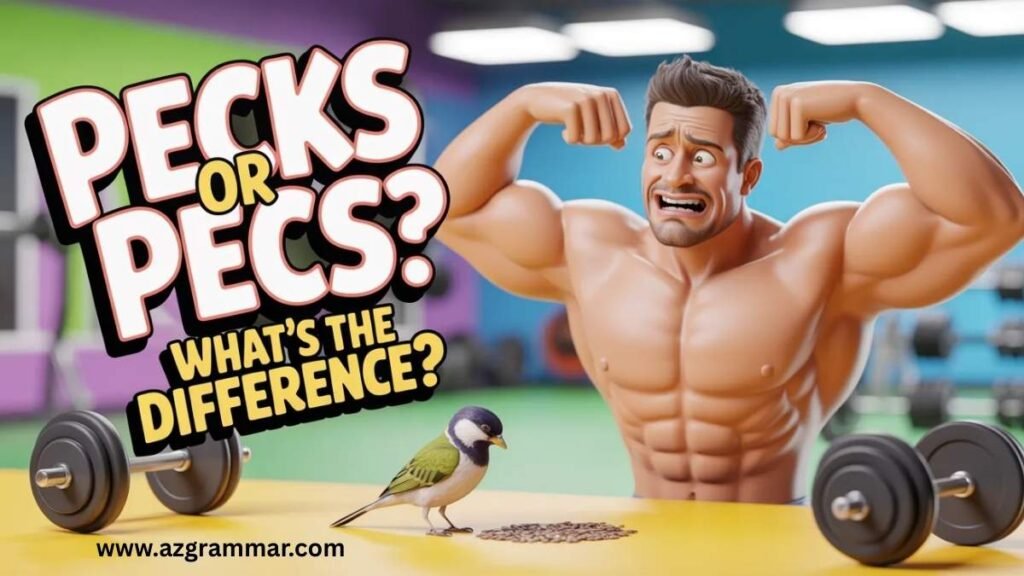
Many people confidently talk about building stronger chest muscles at the gym. Then they write “I trained my pecks today” and unknowingly make a vocabulary mistake. This confusion between pecks and pecs happens more often than you might expect.
Students, bloggers, fitness beginners, and even experienced writers mix up these two words because they sound identical when spoken. English pronunciation does not always reveal correct spelling. As a result, a simple word choice can change meaning completely.
Correct spelling matters. In professional writing, fitness coaching, academic communication, and social media content, clarity builds credibility.
In this complete guide, you’ll learn:
- The true meaning of pecs
- When pecks is actually correct
- Why people confuse the words
- How anatomy and language intersect
- Easy memory tricks to avoid mistakes forever
Let’s clear up the confusion once and for all.
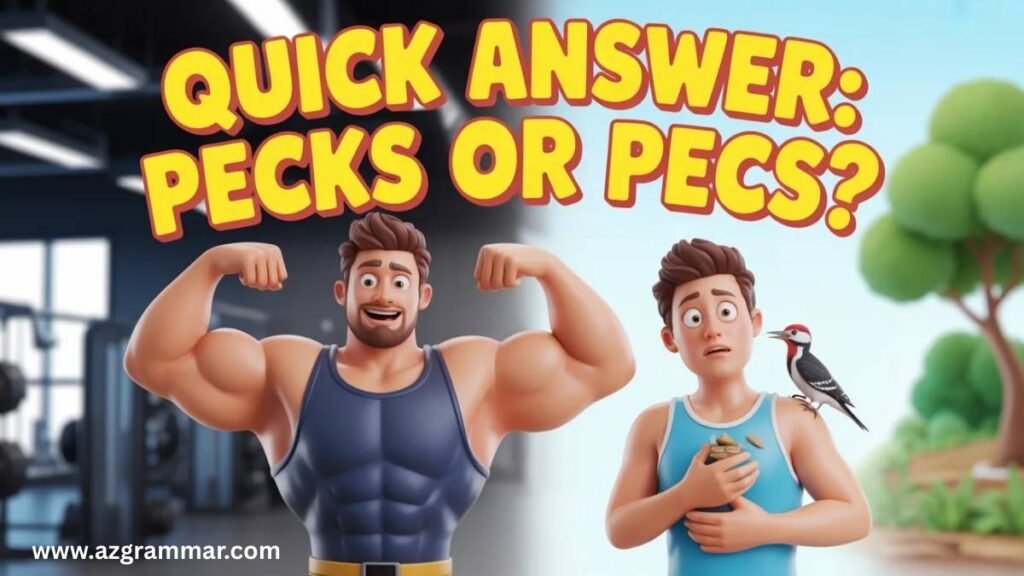
Quick Answer: Pecks or Pecs?
Here is the simple rule most readers want immediately:
Pecs refers to chest muscles.
Pecks refers to a light kiss or tapping motion.
One Sentence Rule
If you’re talking about muscles, use pecs.
If you’re talking about kissing or pecking, use pecks.
Comparison Table
| Word | Meaning | Correct Context |
|---|---|---|
| Pecs | Chest muscles | Fitness, anatomy, workouts |
| Pecks | Light kiss or quick strike | Everyday language |
Knowing this distinction instantly prevents one of the most common fitness spelling errors online.
Oversight vs Oversite: What’s the Difference?
Understanding the Word “Pecs”
Definition and Meaning
Pecs is the shortened form of pectoral muscles, the large muscles located across the chest.
Pronunciation:
/peks/
Although informal, the term is widely accepted in modern English, especially in fitness, bodybuilding, and sports science discussions.
The abbreviation became popular because pectoralis muscles sounds technical. Gym culture favors shorter, conversational terms.
The Anatomy Behind Pecs
Your chest muscles consist primarily of two muscles:
| Muscle | Function |
|---|---|
| Pectoralis Major | Arm pushing, lifting, pressing |
| Pectoralis Minor | Shoulder stabilization |
These muscles play a critical role in:
- pushing movements
- upper-body strength
- posture support
- athletic performance
Fact:
The pectoralis major is one of the strongest upper-body muscles involved in exercises like bench presses, push-ups, and dips.
Bodybuilders began shortening pectorals to pecs during the 1950s bodybuilding boom, when gym terminology evolved into modern fitness slang.
Common Contexts Where “Pecs” Is Used
You’ll encounter pecs in:
- gym conversations
- fitness coaching
- personal training programs
- anatomy education
- sports science research
Examples include:
- “Focus on activating your pecs during bench press.”
- “Chest workouts target upper and lower pecs.”
- “Strong pecs improve pushing power.”
Examples of Correct Usage
Workout Instructions
- Engage your pecs before pressing the barbell.
Fitness Articles
- Developing balanced pecs prevents shoulder injuries.
Everyday Gym Dialogue
- My pecs feel sore after yesterday’s workout.
Understanding the Word “Pecks”
Definition and Meaning
Unlike pecs, pecks comes from the verb to peck.
It means:
- a quick strike with a beak
- a gentle kiss
- repeated small taps
Common Contexts Where “Pecks” Appears
Bird Behavior
- A chicken pecks the ground for food.
Affection
- She gave him a peck on the cheek.
Figurative Writing
- He pecks at the keyboard while thinking.
Examples of Correct Usage
Daily Conversation
- The toddler gave her mother quick pecks.
Storytelling
- The woodpecker pecks loudly against the tree.
Informal Communication
- She pecks away at her laptop all morning.
Notice how none of these examples involve muscles or fitness.
Genius vs Genious: What’s the Correct Spelling?
Pecks vs Pecs: Key Differences Explained Clearly
| Feature | Pecs | Pecks |
|---|---|---|
| Meaning | Chest muscles | Kiss or tapping action |
| Grammar Role | Noun | Verb or plural noun |
| Field | Anatomy & Fitness | Everyday English |
| Example | Train your pecs | Birds peck seeds |
Visual Memory Cue
Pecs → Pectoral muscles
Pecks → Pecking action
Why People Confuse Pecks and Pecs
Several linguistic factors create confusion.
Pronunciation Similarity
Both words sound identical. Spoken English provides no spelling clues.
Spoken Language Influence
People learn vocabulary through hearing before writing. When spelling later, they guess based on sound.
Autocorrect Limitations
Spellcheck tools rarely catch this mistake because both words are valid English words.
Social Media Fitness Trends
Fitness influencers often prioritize speed over accuracy, unintentionally spreading incorrect spelling.
Similar confusion exists in English:
- site vs sight
- complement vs compliment
- muscle vs mussel
English loves homophones.
Word Origins and Linguistic History
Origin of “Pecs”
The term derives from Latin:
pectoralis → meaning “relating to the chest.”
Medical terminology adopted the word centuries ago. Fitness culture shortened it to pecs for everyday use.
Origin of “Pecks”
The word traces back to Old English peccan, meaning to strike or tap repeatedly.
Historical literature frequently used it to describe bird movements or small affectionate gestures.
How Language Evolution Created the Confusion
Language evolves toward efficiency.
- Complex medical words become abbreviations.
- Spoken language influences spelling habits.
- Informal culture spreads faster than formal grammar.
The result: two unrelated words that sound identical.
Contextual Usage: Physical vs Everyday Language
Physical and Fitness Usage
In exercise science, pecs appears constantly.
Examples include:
- bodybuilding training
- strength conditioning
- anatomy textbooks
- rehabilitation therapy
Strong pec muscles improve:
- posture
- athletic power
- shoulder stability
Casual and Metaphorical Usage
Meanwhile, pecks belongs to casual communication.
Examples:
- affectionate gestures
- animal behavior descriptions
- narrative storytelling
Context alone determines correctness.
Fitness Terminology Guide: Understanding Chest Muscle Vocabulary
| Term | Meaning | Usage Context |
|---|---|---|
| Pectorals | Formal chest muscles term | Medical & academic |
| Pecs | Informal abbreviation | Gym & fitness |
| Chest | General muscle group | Everyday speech |
| Upper Chest | Clavicular fibers | Training programs |
| Lower Chest | Sternal fibers | Bodybuilding routines |
Understanding terminology improves communication between trainers, athletes, and writers.
Pecs in Fitness, Health, and Professional Communication
Correct terminology matters in professional environments.
Fitness coaches, physiotherapists, and sports scientists rely on clear anatomical language.
Misusing terms can create confusion in:
- training instructions
- rehabilitation programs
- exercise demonstrations
- educational materials
Quote from strength coach Mark Rippetoe:
“Precise language leads to precise movement.”
Using pecs correctly demonstrates understanding of human anatomy and exercise science.
Common Grammar and Vocabulary Mistakes to Avoid
Common errors include:
- Writing pecks when discussing muscles
- Assuming pronunciation equals spelling
- Confusing informal and formal terminology
- Using abbreviations incorrectly
Proofreading Checklist
Before publishing:
- Ask: Am I discussing muscles?
- Replace pecks with pecs if yes.
- Read sentences aloud.
- Confirm context matches meaning.
Pronunciation Guide: Pecks vs Pecs
Both words share pronunciation:
/peks/
Because sound cannot guide spelling, visual memory becomes essential.
Tip:
Remember that pecs relates to pectoral.
Real Life Examples of Correct Usage
Gym and Fitness Conversations
Trainer:
Keep your elbows steady to activate your pecs.
Athlete:
My pecs are sore after chest day.
Social Media and Online Fitness Content
Correct caption:
- “Chest workout to grow your pecs.”
Incorrect caption:
- “Chest workout to grow your pecks.”
Education and Academic Writing
Textbooks use:
- pectoral muscles
- pec major activation
Academic writing favors clarity.
Everyday Conversation
Correct:
- She gave him a quick peck goodbye.
Incorrect:
- He trained his pecks at the gym.
Usage Trends and Search Behavior
Search interest in Pecks or Pecs has increased alongside global fitness culture.
Reasons include:
- rise of gym memberships worldwide
- growth of online fitness education
- social media workout communities
- increased health awareness
Informational search intent dominates this keyword because users want clarification rather than purchase information.
Memory Tricks to Remember the Difference
Trick One
Pecs = Pectoral muscles
Trick Two
Pecks = Pecking or kissing
Visual Association
Imagine a bird pecking food → pecks
Imagine lifting weights → pecs
Simple mental images create long term recall.
Regional Usage and Informal Language Trends
American English
“Pecs” is extremely common in fitness culture.
British English
Both pectorals and pecs appear frequently.
Informal vs Formal Acceptance
- Academic papers prefer pectoralis major
- Fitness writing commonly uses pecs
Global fitness media has standardized the term across English speaking regions.
Reference Cambridge Dictionary Definitions
Here’s a trusted source for clear Grammar:
FAQs About Pecks or Pecs
Is “pecks” ever correct for muscles?
No. Muscles are always spelled pecs.
Why do people spell pecs as pecks?
Because both words sound identical when spoken.
Is “pecs” considered formal English?
It is informal but widely accepted in fitness and sports communication.
Can I use “pectorals” instead of pecs?
Yes. Pectorals is the formal anatomical term.
Does autocorrect fix this mistake?
Usually not. Both words exist in English dictionaries.
Is “pec” a real word?
Yes. It is the singular abbreviation of pectoral muscle.
What exercises build pecs?
Bench press, push-ups, chest flyes, and dips effectively train pec muscles.
Are pecs only used in bodybuilding language?
No. Physiotherapy, sports science, and fitness education also use the term.
How should beginners use the term correctly?
Use pecs when discussing chest muscles.
Do dictionaries recognize “pecs”?
Yes. Major dictionaries recognize it as an accepted abbreviation.
Key Takeaways: Pecks vs Pecs Made Simple
- Pecs = chest muscles.
- Pecks = kisses or tapping actions.
- Pronunciation is identical.
- Context determines spelling.
- Fitness writing requires anatomical accuracy.
Mastering this difference improves both communication and credibility.
Final Thoughts:
Small language details create big impressions. Understanding Pecks or Pecs: What’s the Difference? helps you communicate clearly whether you’re writing fitness content, studying anatomy, or chatting online.
Language evolves. Fitness culture shapes vocabulary. Yet accuracy still matters.
Now you know the rule.
You won’t hesitate again.
You’ll write with clarity, confidence, and precision.
And that’s a strong foundation both in writing and in training your pecs.

James Walker is an English language educator and grammar enthusiast dedicated to helping learners improve their writing and communication skills. As an author at AZ Grammar, he simplifies complex grammar rules into clear, practical lessons suitable for students and beginners. With a passion for language learning and education, James focuses on making English grammar easy, understandable, and useful for everyday communication and academic success worldwide.