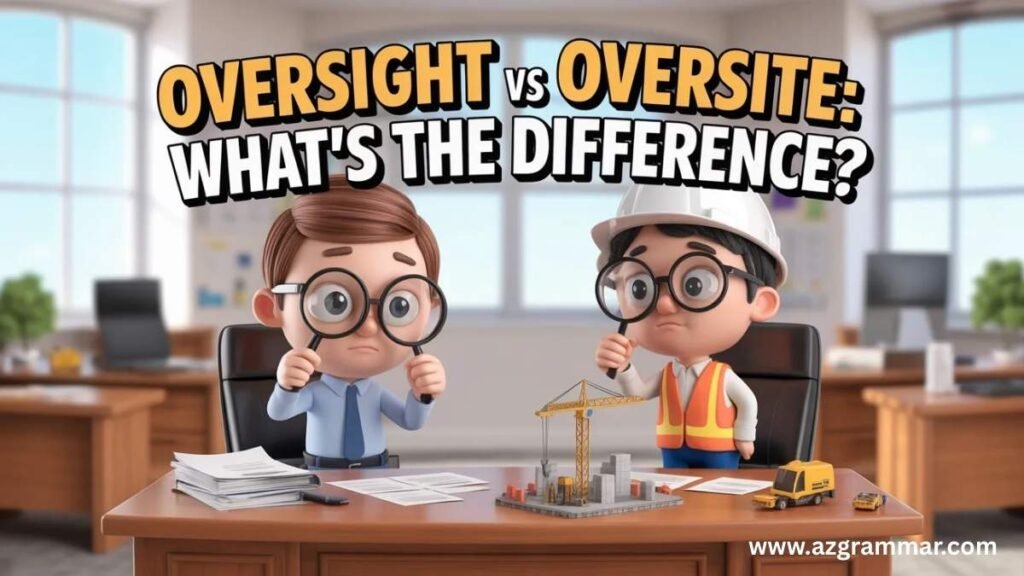
Language mistakes rarely happen because people lack intelligence. More often, English simply sets clever traps. One of the most persistent examples appears in emails, business reports, academic papers, and online writing alike: Oversight vs Oversite.
At first glance, both spellings look reasonable. They sound identical when spoken. Yet only one belongs in standard English. The difference may seem small, though it carries real consequences. A single misplaced letter can weaken credibility, distract readers, or subtly change meaning.
This guide walks you through the distinction clearly and thoroughly. You’ll learn what oversight actually means, why oversite appears so often online, and how professionals use the correct term across business, law, education, and everyday communication.
By the end, you won’t hesitate again.
Quick Answer: Oversight vs Oversite
Let’s begin with the simplest explanation.
Oversight is correct.
Oversite is almost always incorrect.
| Word | Correct Usage | Meaning |
|---|---|---|
| Oversight | ✅ Correct | Supervision or an accidental mistake |
| Oversite | ❌ Incorrect | Usually a spelling error |
Quick rule:
Use oversight whenever you mean supervision, responsibility, monitoring, or an unintended error.
You should avoid oversite in professional writing.
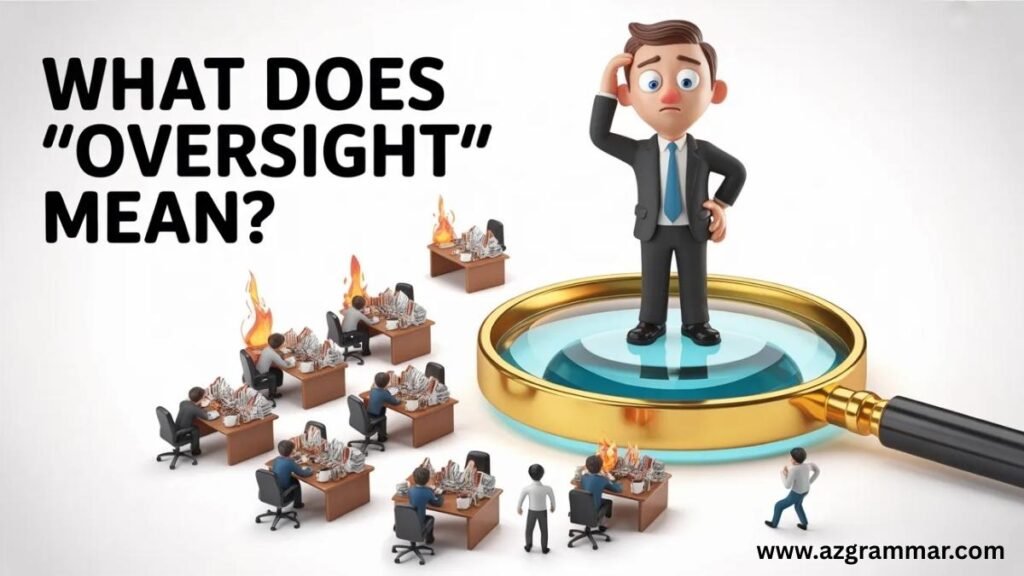
What Does “Oversight” Mean?
Core Definition
The word oversight functions as a noun in modern English.
Pronunciation:
OH-ver-site
Standard dictionary definitions describe oversight as:
Careful supervision or an unintentional failure to notice something.
What makes the word fascinating is its flexibility. One spelling carries two seemingly opposite meanings. Context determines which meaning applies.
Examples:
- The board maintains financial oversight.
- Forgetting that detail was an unfortunate oversight.
Same word. Completely different implication.
The Two Meanings of Oversight
English occasionally preserves historical meanings even when they diverge. Oversight stands as a classic example.
Oversight can mean:
Supervision or Authority
- monitoring operations
- leadership responsibility
- institutional governance
Mistake or Omission
- missing information
- accidental neglect
- human error
Originally, “seeing over” something could imply watching carefully or failing to see entirely. Over centuries, both interpretations remained in use.
Genius vs Genious: What’s the Correct Spelling?
Oversight as Supervision or Authority
In professional environments, the supervisory meaning dominates.
Government Oversight
Modern governments depend on structured oversight systems to ensure accountability.
Examples include:
- congressional oversight committees
- financial regulatory agencies
- judicial review systems
In the United States, congressional oversight allows lawmakers to monitor federal agencies and confirm that policies operate as intended. Without oversight, transparency weakens and public trust declines.
Oversight exists to protect institutions and citizens alike.
Business and Organizational Oversight
Within organizations, oversight supports effective leadership.
Common examples:
- executives reviewing strategic initiatives
- compliance teams monitoring regulations
- boards supervising financial performance
Case Study
A Deloitte governance study reported that organizations with strong executive oversight experienced 28 percent fewer compliance violations compared to those with weaker monitoring structures.
Effective oversight rarely feels restrictive. Instead, it creates clarity and stability.
Legal and Regulatory Contexts
Legal professionals use the term frequently:
- regulatory oversight
- ethical oversight committees
- institutional supervision
These systems reinforce governance, accountability, and responsible leadership.
Key concepts tied to oversight include:
- governance
- leadership
- accountability
- institutional control
Oversight as a Mistake or Omission
The second meaning appears more often in everyday communication.
Example:
“Leaving that information out was an oversight.”
Here, the word signals an error caused by inattention rather than authority.
Writing and Proofreading Oversights
Even experienced writers encounter oversights.
Common examples include:
- missing citations
- incorrect figures
- overlooked formatting errors
- typographical mistakes
Academic journals regularly publish corrections acknowledging editorial oversights. Perfection remains unrealistic even for experts.
Professional Consequences
Small oversights sometimes produce major consequences:
- delayed projects
- misunderstood agreements
- financial reporting errors
- damaged professional credibility
Context determines meaning instantly.
| Sentence | Interpretation |
|---|---|
| Management oversight improved performance | Supervision |
| The delay resulted from an oversight | Mistake |
Readers rely on surrounding information to interpret intent.
Is “Oversite” a Real Word?
In standard English usage, the answer is clear.
Oversite is not a recognized word.
Major dictionaries and style authorities list only oversight.
Why Does Oversite Appear Online?
Several factors explain the confusion:
- identical pronunciation
- familiarity with “website” spelling
- rapid typing habits
- inconsistent spellcheck detection
Because site appears frequently in digital language, writers unconsciously substitute it.
Rarely, Oversite may appear as a brand name or technical label. Outside those exceptions, it remains incorrect in grammar and professional writing.
Why People Confuse Oversight and Oversite
The confusion reflects how human cognition handles language.
Pronunciation vs Spelling
Both words sound identical when spoken. Your ears cannot distinguish them. Only visual recognition resolves the difference.
The “Sight” vs “Site” Pattern
Consider these commonly confused words:
| Word | Meaning |
|---|---|
| sight | vision or perception |
| site | physical location |
| cite | reference or quotation |
Because digital culture emphasizes websites, writers instinctively default to site.
Cognitive Spelling Habits
The brain favors familiar patterns. Repetition reinforces expectation.
Similar spelling traps include:
- affect vs effect
- ensure vs insure
- insight vs incite
Oversight vs oversite belongs to this same family of linguistic misdirection.
Word Origins and Historical Development
Understanding history often clarifies modern confusion.
Etymology
The word derives from Old English roots combining:
- over (above or beyond)
- sight (seeing or observing)
Originally, it described both watching carefully and failing to notice.
Historical Usage
During medieval governance, rulers exercised administrative oversight over territories.
Literary works later used the term to describe missed observations or errors. Over time, both meanings became standard.
Language historians call this process semantic divergence, where one word develops contrasting interpretations without changing spelling.
Contextual Usage: Physical, Abstract, and Professional Meanings
Professional and Business Context
Oversight signals responsibility.
Examples:
- The CEO maintains strategic oversight.
- Finance teams provide operational oversight.
The word suggests awareness, accountability, and leadership.
Legal and Government Usage
Legal documents frequently reference oversight:
- regulatory oversight
- compliance monitoring
- institutional responsibility
Oversight ensures organizations follow established laws and ethical standards.
Everyday Language Usage
Outside formal settings, the word remains common:
- “Sorry, that was an oversight.”
- “We need better oversight on shared tasks.”
Its adaptability explains its longevity.
Oversight in Business, Law, and Professional Writing
Precise language strengthens professional credibility.
Misusing terminology may appear minor, though readers often interpret spelling accuracy as a reflection of attention to detail.
Corporate Communication Examples
Correct:
- “The board exercises financial oversight.”
- “The omission was an oversight.”
Incorrect:
- “The board exercises financial oversite.”
Email and Report Writing
Before sending professional communication:
- verify spelling
- confirm intended meaning
- review context carefully
A Harvard Business Review communication survey identified clear written communication as one of the most valued leadership skills among executives.
Accuracy builds trust.
Oversight vs Similar Words Ending in “Sight” or “Site”
Recognizing related terms reinforces understanding.
| Word | Meaning |
|---|---|
| insight | deep understanding |
| foresight | planning ahead |
| hindsight | understanding after events |
| onsite | physically present |
| website | online location |
Notice the pattern:
Sight → perception or awareness
Site → location
Oversight belongs firmly in the sight category.
Common Grammar Mistakes to Avoid
Frequent errors include:
- writing oversite instead of oversight
- misunderstanding the dual meaning
- misapplying context
Proofreading Checklist
Before publishing:
- Read sentences slowly
- Check context carefully
- Scan visually for spelling patterns
- Confirm meaning fits intention
Good editing prevents avoidable mistakes.
Real Life Examples of Correct Usage
Business & Workplace
- Executive oversight improved operational efficiency.
- Budget issues resulted from planning oversight.
Education & Academic Writing
- Faculty oversight protects research integrity.
- Missing references were an editorial oversight.
Social Media & Digital Communication
Online conversations frequently include phrases such as:
“That typo was an oversight.”
Digital communication keeps the term active in modern language.
Everyday Conversation
Natural spoken examples include:
- “We need better oversight at home.”
- “That was my oversight.”
The word integrates easily into daily speech.
Usage Trends and Search Behavior
Search interest in Oversight vs Oversite continues to grow.
Key drivers include:
- remote work communication
- expansion of digital publishing
- increased professional writing expectations
Autocorrect tools often miss contextual errors. Writers therefore search manually for confirmation.
This behavior reflects a broader trend toward accuracy in online communication.
Memory Tricks to Remember the Difference
Simple associations help retention.
The Vision Rule
Sight relates to seeing.
Oversight involves watching or noticing.
The Location Rule
Site refers to place.
If no physical location exists, avoid site.
Real World Analogy
A supervisor keeps an eye on operations.
Eye → sight → oversight.
Pronunciation and Spelling Guide
Pronunciation:
OH-ver-site
Spelling reminder:
- includes sight
- connects to observation or awareness
Because sound alone cannot guide spelling, visual memory becomes essential.
Reference Cambridge Dictionary Definitions
Here’s a trusted source for clear Grammar:
FAQs
Is oversite ever correct?
No. Standard English recognizes only oversight.
Can oversight mean both supervision and a mistake?
Yes. Context determines which meaning applies.
Why does oversite appear online so often?
Pronunciation similarity and typing habits create confusion.
How do you use oversight in a sentence?
“The committee provides regulatory oversight.”
Is oversight used in legal and business contexts?
Yes. It appears frequently in governance, compliance, and management language.
Can oversight have a positive meaning?
Absolutely. When referring to supervision or leadership responsibility.
Does British English allow oversite?
No. Both British and American English use oversight.
What is the plural form of oversight?
Oversights
How can writers avoid spelling oversights?
Careful proofreading and remembering the sight vs site rule help significantly.
Are oversight and supervision interchangeable?
Often, though oversight usually implies broader responsibility.
Key Takeaways: Oversight vs Oversite Explained Simply
- Oversight is correct.
- Oversite is incorrect.
- Oversight carries two meanings:
- supervision
- accidental mistake
- Context clarifies interpretation.
- Accurate spelling strengthens professional credibility.
Final Thoughts:
Strong writing depends on small details handled well. The difference between oversight and oversite may seem minor, though it reflects broader communication skills.
You now understand the definition, history, professional usage, and practical application of the correct term. That knowledge removes hesitation.
The next time you draft an email, publish an article, or prepare a report, you won’t second-guess yourself. You’ll choose the right word naturally.
Clear language creates confident writers. Confident writers earn trust.

James Walker is an English language educator and grammar enthusiast dedicated to helping learners improve their writing and communication skills. As an author at AZ Grammar, he simplifies complex grammar rules into clear, practical lessons suitable for students and beginners. With a passion for language learning and education, James focuses on making English grammar easy, understandable, and useful for everyday communication and academic success worldwide.