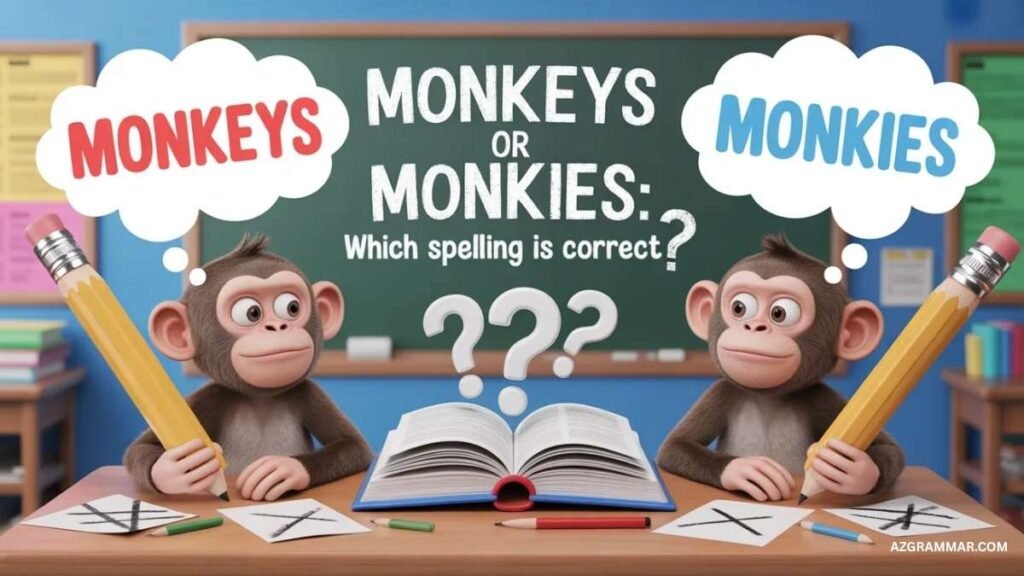
Ever typed “monkies” and felt oddly confident about it… until that red underline showed up like a judgmental teacher? Yeah, English does that. One minute you’re happily pluralizing words, and the next you’re stuck wondering: monkeys or monkies which one is actually correct?
It seems like it should be “monkies,” right? After all, we’ve got babies and cities. But then English throws a banana peel in your path (very on-brand here 🍌), and suddenly the rules aren’t so obvious anymore.
In this guide, we’ll settle the monkeys or monkies debate once and for all with simple rules, clear examples, and just enough humor to make sure you never second-guess this word again.
Monkeys vs Monkies — Quick Answer
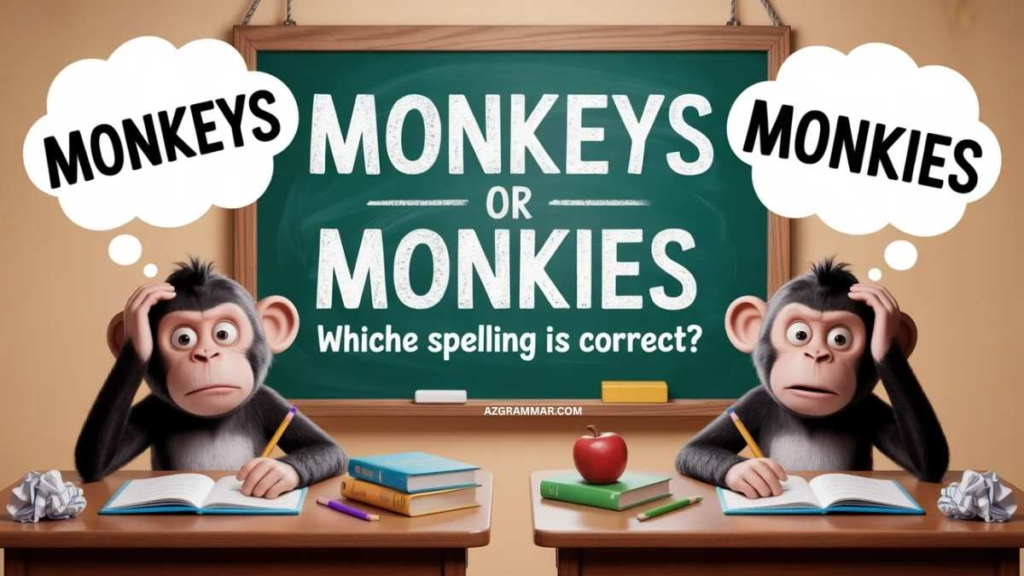
“Monkeys” is the correct plural form. “Monkies” is incorrect and not recognized in standard English.
- ✅ Monkeys → correct
- ❌ Monkies → misspelling
Verified Example
- We observed several monkeys in the forest. ✔️
- We observed several monkies in the forest. ❌
This isn’t a matter of preference or style. It’s a straightforward rule in English grammar.
Calves or Calfs: Which Spelling Is Correct?
Why Correct Spelling Matters
Spelling might seem like a small detail, yet it plays a much larger role than most people realize. It shapes how your writing is perceived and how easily your ideas are understood.
Practical Impact
- Improves readability
- Builds credibility
- Prevents confusion
From a broader perspective, consistent spelling signals attention to detail. Readers are more likely to trust content that feels precise and well-edited.
Content Quality Insight
Search engines can interpret meaning regardless of minor errors. However, readers respond to clarity. Clean, accurate writing keeps them engaged and encourages them to stay longer.
Editorial Standard: Strong writing relies on consistency, accuracy, and adherence to established rules.
What Is the Plural of “Monkey”?
The word “monkey” is a standard noun, and its plural form follows a predictable pattern.
- Singular → monkey
- Plural → monkeys
Correct Usage
- The sanctuary protects several monkeys.
- Monkeys are known for their problem-solving abilities.
There’s nothing irregular about this transformation. It follows a rule you’ll see again and again in English.
Why “Monkies” Is Incorrect
The confusion usually comes from applying a familiar rule in the wrong place.
You’ve likely seen examples like:
- baby → babies
- city → cities
So it feels natural to assume:
- monkey → monkies
That assumption makes sense at first. However, it overlooks one important detail.
Key Point: The plural form depends on the letter before “y,” not just the “y” ending itself.
The Grammar Rule Behind “Monkeys”
Once you understand this rule, the confusion disappears.
Rule Definition
- If a word ends in vowel + “y”, simply add “s”
- If a word ends in consonant + “y”, change “y” to “ies”
Applying the Rule to “Monkey”
Take a closer look:
- monkey → the letter before “y” is “e”, which is a vowel
That means the correct plural is:
- monkey → monkeys
Supporting Examples
Vowel + “Y”
- boy → boys
- key → keys
- toy → toys
Consonant + “Y”
- baby → babies
- city → cities
- lady → ladies
These examples reinforce the pattern. Monkeys follows the rule exactly.
CC’ed or CC’d: Which One Is Right for Professional Emails?
How Pluralization Works in English
To make this even clearer, it helps to step back and look at the bigger picture.
Regular Plurals
- Add “s” → cat → cats
- Add “es” → box → boxes
Words Ending in “Y”
- vowel + y → add “s”
- consonant + y → change to “ies”
Irregular Forms (For Context)
- child → children
- mouse → mice
Understanding this framework gives you a reliable system, not just a one-off answer.
Authoritative Confirmation
If you want to verify this beyond rules, trusted references confirm it clearly:
- Merriam-Webster Dictionary
- Oxford English Dictionary
Both sources list “monkeys” as the correct plural form.
Monkies does not appear as a standard entry.
Best Practice: When in doubt, consult a reliable dictionary rather than guessing.
Quick Reference Comparison
| Feature | Monkies | Monkeys |
|---|---|---|
| Valid English Word | ❌ No | ✅ Yes |
| Grammar Rule | Incorrect | Correct |
| Dictionary Recognition | None | Standard |
| Usage | Misspelling | Accepted |
This quick comparison makes the distinction easy to remember.
Modelling or Modeling: Which Spelling Is Correct?
Recognizing the Pattern Across Words
The real advantage of learning this rule is that it applies far beyond one word.
Comparable Examples
- key → keys
- toy → toys
- boy → boys
Once you recognize the pattern, you’ll find yourself making fewer mistakes overall.
Common Plural Mistakes to Avoid
Many spelling errors come from applying the right rule in the wrong situation.
Frequent Mistakes
- monkies → incorrect
- toies → incorrect
- keies → incorrect
Correct Forms
- monkeys
- toys
- keys
Editing Tip: Before forming a plural, always check the letter that comes before “y.”
Why This Confuses Learners
This rule often causes trouble, especially for learners of English.
Reasons
- Overgeneralizing the “-ies” pattern
- Confusing vowel and consonant rules
- Relying on pronunciation instead of structure
Practical Solution
Shift your focus from sound to structure. The spelling rule provides a more reliable guide than pronunciation.
Real-World Usage
You’ll see the correct form used consistently across all types of writing.
Examples
- Researchers studied monkeys in controlled environments.
- The documentary featured wild monkeys.
- Children enjoy watching monkeys at the zoo.
Using the correct form ensures your writing remains clear and professional.
Vaccum or Vacuum: The Correct Spelling Explained
Quick Practice Check
Fill in the blanks:
- The ______ climbed the trees.
- We saw many ______ in the jungle.
Correct answers:
- monkeys
- monkeys
Reference Cambridge Dictionary Definitions
Here’s a trusted source for clear Grammar:
FAQs
What is the correct plural of monkey?
The correct plural of monkey is monkeys. This follows the standard English rule where words ending in a vowel + y simply take an -s to become plural. For example: The monkeys are swinging from the trees.
Is “monkies” ever correct in English?
No, “monkies” is incorrect and not used in standard English. It may look right because of words like babies or cities, but monkey follows a different rule. You should always use monkeys in both formal and informal writing.
Why is it “monkeys” and not “monkies”?
It’s monkeys because the letter before “y” is a vowel (e). In English grammar, when a word ends in a vowel + y, you simply add -s to form the plural. That’s why we write monkey → monkeys, not monkies.
When do we use “-ies” for plural words?
We use -ies when a word ends in a consonant + y. In such cases, the “y” changes to “ies.”
Examples include:
- baby → babies
- city → cities
- lady → ladies
This rule does not apply to monkey because it has a vowel before “y.”
What are some similar words to monkey?
Here are words that follow the same plural rule as monkey:
- donkey → donkeys
- turkey → turkeys
- key → keys
All of these words end in a vowel + y, so they simply add -s.
How can I remember the rule for monkey vs monkies?
A simple trick is:
👉 If there is a vowel before “y”, just add -s
👉 If there is a consonant before “y”, change y → ies
So:
- monkey → monkeys ✅
- baby → babies ✅
Can “monkeys” be used in both formal and informal writing?
Yes, “monkeys” is correct in all contexts. Whether you are writing an academic paper, a blog post, or a casual message, monkeys is always the proper plural form.
What is a common mistake people make with monkey?
A very common mistake is writing “monkies” because people apply the wrong plural rule. This happens when they confuse it with words that end in consonant + y. Remembering the vowel rule will help you avoid this error.
Final Thought
The confusion between monkeys or monkies comes down to one simple grammar rule but like many things in English, it can feel trickier than it should be. The correct plural is monkeys, because the word ends in a vowel + y, so we just add -s.
While monkies might look right at first glance, it doesn’t follow standard English rules and should always be avoided.
👉 Easy rule to remember:
monkey → monkeys (✔ correct)
monkey → monkies (❌ incorrect)
Once you understand this pattern, you’ll not only get monkeys right every time but also improve your overall grasp of plural forms in English.

James Walker is an English language educator and grammar enthusiast dedicated to helping learners improve their writing and communication skills. As an author at AZ Grammar, he simplifies complex grammar rules into clear, practical lessons suitable for students and beginners. With a passion for language learning and education, James focuses on making English grammar easy, understandable, and useful for everyday communication and academic success worldwide.
Email: azgrammar29@gmail.com
Website: azgrammar.com