Ever found yourself staring at your screen wondering, “Momment or Moment?” You type it once. It looks right. You type it again. Suddenly it looks suspicious. Is there one “m” in the middle or two? Did English secretly change the rules overnight? Relax. You’re not alone. This tiny spelling debate has confused students, professionals, and even confident writers. English loves to play tricks like that. One extra letter can quietly sneak in and cause doubt. The good news? The answer is simple. In the next few minutes, you’ll clear up the Momment or Moment confusion for good and spell it correctly every single time.
Quick Answer: Momment vs Moment
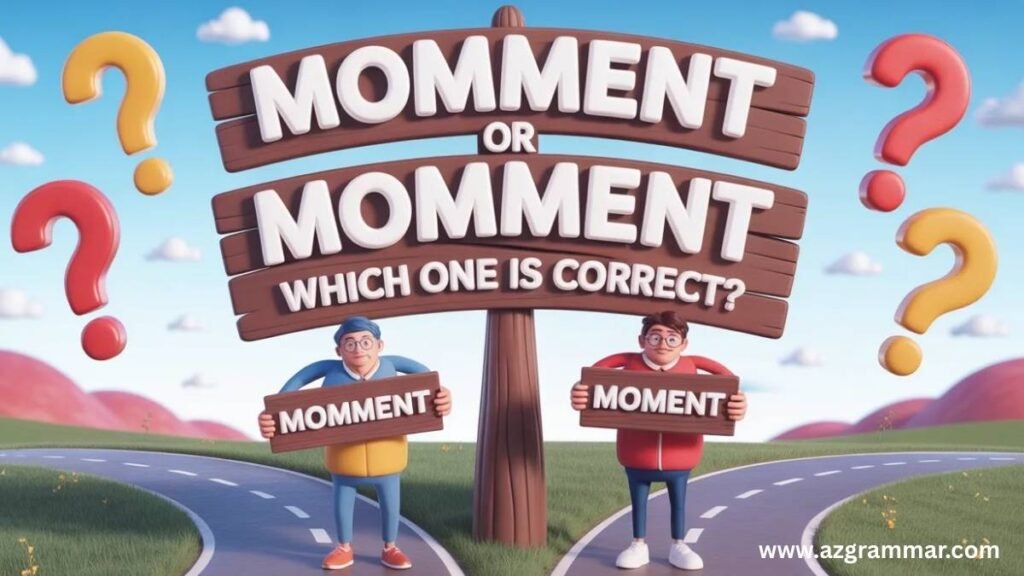
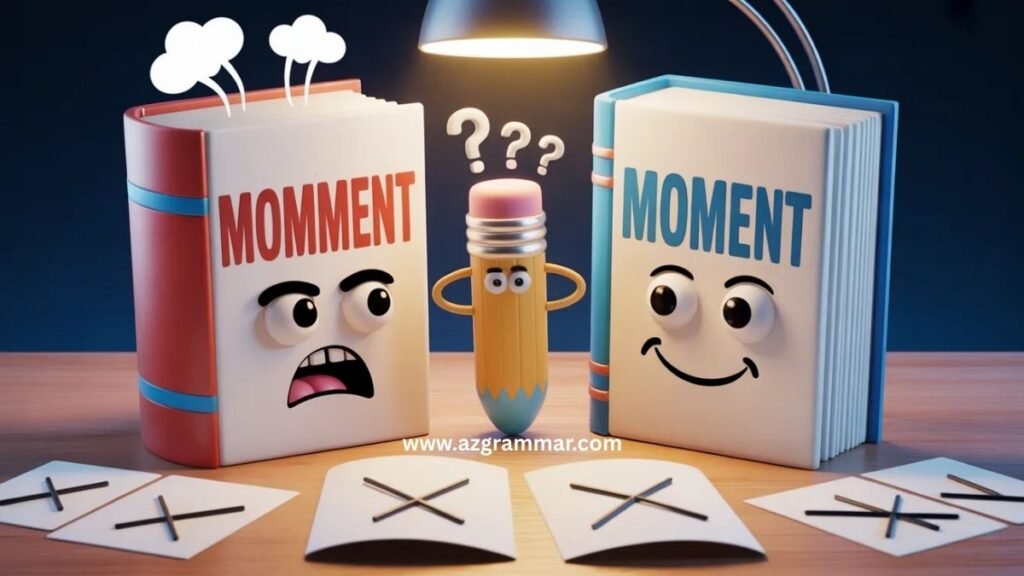
The correct spelling is: Moment.
“Momment” is a spelling mistake and is not a real English word.
People search momment or moment because English spelling does not always match pronunciation. Many words double consonants. Others do not. That inconsistency creates confusion.
Filling vs Filing: What’s the Difference?
Quick Comparison
| Word | Correct? | Usage |
|---|---|---|
| Momment | ❌ Incorrect | Typographical error |
| Moment | ✅ Correct | Proper English word |
Simple rule:
👉 Always write moment with one “m” in the middle.
What Does “Moment” Mean?
The word moment is one of the most versatile words in the English language. You’ll see it in conversations, literature, business communication, and academic writing.
Dictionary Definition
A moment means:
- A very short period of time
- A specific point in time
- An important event or experience
- A critical opportunity or turning point
Pronunciation Guide
Moment is pronounced:
MOH-ment /ˈmoʊ.mənt/
Notice something important:
You hear only one clear m sound in the middle. That’s your first spelling clue.
Core Meanings Explained Simply
Time Reference
A moment can mean a brief duration.
Examples
- “Wait a moment.”
- “I’ll be ready in a moment.”
Think of it as shorter than a minute but longer than a second.
Importance or Significance
Sometimes a moment represents emotional value.
Examples
- Graduation day was a proud moment.
- That conversation changed my life forever.
Here, the word carries emotional weight rather than measuring time.
Everyday Examples You Recognize
- A quiet morning coffee moment
- A career-defining moment
- A moment of silence
- A moment of truth
The word adapts to context easily. That flexibility explains why it appears everywhere in English.
Is “Momment” a Real Word?
No. Momment is not a valid English word.
You will not find it in:
- Merriam-Webster Dictionary
- Oxford English Dictionary
- Cambridge Dictionary
- Collins English Dictionary
So why does it appear online?
Why Momment Shows Up on the Internet
Several factors create this mistake:
- Fast typing
- Muscle memory errors
- Overgeneralizing spelling rules
- Non-native English learning patterns
- Search engine typo behavior
Google indexes misspellings because users frequently search them. However, indexing does not equal correctness.
Important fact:
Search popularity does not validate spelling accuracy.
Why People Confuse Momment and Moment
Spelling confusion rarely happens randomly. There are real linguistic reasons behind it.
Double Consonant Confusion
English contains many doubled letters:
- Summer
- Letter
- Running
- Beginning
Your brain expects similar patterns.
So people instinctively write momment instead of moment.
Pronunciation vs Spelling Mismatch
English spelling evolved from multiple languages. Pronunciation does not always reflect spelling rules.
For example:
| Word | Pronunciation | Double Letter? |
|---|---|---|
| Coming | KUM-ing | No |
| Running | RUN-ing | Yes |
| Moment | MOH-ment | No |
There is no consistent rule learners can rely on. Experience becomes the teacher.
Pecks or Pecs: What’s the Difference?
Typing Habits and Autocorrect
Modern typing creates new mistakes:
- Mobile keyboards duplicate letters accidentally.
- Autocorrect sometimes learns incorrect spelling.
- Predictive typing reinforces errors.
Many people unknowingly train their devices to accept momment.
ESL Learner Challenges
English learners face additional difficulty because:
- Native languages follow consistent spelling rules.
- English blends Latin, Germanic, and French influences.
- Silent letters and irregular patterns appear frequently.
As a result, moment vs momment becomes a common learning obstacle.
Psychology Behind Common Misspellings
Research in cognitive linguistics shows that the brain prefers symmetry.
Two letters feel visually balanced. One letter feels incomplete.
That subconscious preference causes doubling errors like:
- Occured → Occurred
- Untill → Until
- Momment → Moment
Understanding this psychological tendency helps eliminate mistakes permanently.
Origin and History of the Word “Moment”
Knowing where a word comes from makes it easier to remember.
Latin Roots
The word moment comes from the Latin term:
Momentum — meaning movement or importance.
Originally, it referred to physical motion or force.
Journey Through French
During the Middle Ages, the word passed into Old French as moment. English later adopted it during the Norman influence on Britain.
Interestingly, the spelling stayed almost unchanged for centuries.
Expansion of Meaning
Over time, moment gained broader meanings:
| Era | Meaning |
|---|---|
| Ancient Latin | Movement, force |
| Medieval Period | Brief time interval |
| Modern English | Time, significance, opportunity |
This evolution explains why today the word carries emotional and symbolic meaning.
Why History Helps Memory
When you remember momentum, you automatically remember moment.
Neither word doubles the middle letter.
History becomes a memory shortcut.
How to Use “Moment” Correctly in English
Understanding usage removes uncertainty.
Time or Duration Meaning
Use moment when referring to a short period.
Sentence Patterns
- Give me a moment.
- Just a moment, please.
- It happened in a moment.
Daily Examples
- Waiting for food
- Answering a call
- Pausing before speaking
Short. Simple. Natural.
Important Event or Emotional Meaning
Some moments shape memories.
Examples
- The birth of a child
- Winning a championship
- Saying goodbye to a loved one
Writers often use moment to create emotional impact.
Quote Example
“Life is made of moments, not milestones.”
Opportunity or Decision Meaning
In business and leadership contexts, a moment signals timing.
Examples
- This is the perfect moment to invest.
- The company faced a defining moment.
- History remembers decisive moments.
The word communicates urgency and significance simultaneously.
Leaves or Leafs: Which One Is Correct?
Pronunciation and Spelling Guide
Let’s make spelling effortless.
Phonetic Breakdown
MO + MENT
Only one middle m connects both parts.
Why Only One “M”?
The root word momentum contains a single internal consonant sound. English preserved that structure when shortening the word.
No grammatical rule adds a second “m.”
Visual Spelling Trick
Imagine this phrase:
👉 “One Moment Matters.”
Each word contains only one middle consonant pattern.
Your brain links meaning and spelling together.
Quick Memory Rule
If you hear one sound, write one “m.”
Simple. Reliable. Effective.
Real Life Usage Examples
Learning through context works best.
Text Messages and Chat Conversations
✅ Correct:
- “Wait a moment.”
- “Give me a moment to check.”
❌ Incorrect:
- “Give me a momment.”
Social Media Captions
Correct examples:
- “Living in the moment.”
- “Captured the perfect moment today.”
Social media heavily influences spelling habits. Correct usage improves credibility instantly.
Professional and Academic Writing
Professional environments demand accuracy.
Examples:
- “The project reached a critical moment.”
- “This moment marked a shift in policy.”
One spelling mistake can weaken authority.
Casual Spoken English
Conversation examples:
- “Hold on a moment.”
- “That was an awkward moment.”
Natural speakers never pronounce a doubled letter. Let pronunciation guide you.
Common Spelling Mistakes Similar to “Moment”
If you misspell moment, you may also struggle with similar words.
Frequently Confused Words
| Incorrect | Correct |
|---|---|
| Momment | Moment |
| Untill | Until |
| Occured | Occurred |
| Definately | Definitely |
| Recieve | Receive |
Patterns Behind Spelling Errors
Most mistakes happen because:
- English lacks consistent phonetic rules.
- Writers rely on sound rather than structure.
- Speed replaces attention.
Practical Proofreading Tips
Before submitting any document:
- Read sentences aloud.
- Use spell-check tools.
- Pause before sending messages.
- Scan for doubled letters.
Professional writers follow these habits daily.
Moment in Different Contexts and Cultures
English is a global language. The word moment works almost everywhere.
Global Usage
You’ll hear the word used consistently in:
- United States
- United Kingdom
- Canada
- Australia
- India
- International business English
Spelling remains identical worldwide.
Formal vs Informal Communication
Formal
- Academic papers
- Presentations
- Reports
Informal
- Conversations
- Text messages
- Social posts
The word adapts easily without changing spelling.
Cultural Influence
Many languages borrowed moment directly from European roots. That shared history keeps usage consistent across cultures.
Grammar Tips to Improve Writing Accuracy
Correct spelling is part habit, part strategy.
Simple English Spelling Rules
- Learn word roots.
- Avoid guessing based on pronunciation.
- Recognize common patterns.
Vocabulary Learning Habits That Work
Successful learners often:
- Keep a personal word list.
- Notice repeated mistakes.
- Practice writing daily.
- Read high quality content regularly.
Reading improves spelling more than memorization.
Writing and Proofreading Strategies
Professional editors use a process:
- Write freely.
- Step away.
- Review slowly.
- Check spelling intentionally.
Speed creates mistakes. Distance creates clarity.
Helpful Writing Tools
- Grammarly
- Microsoft Editor
- Google Docs spell check
- Hemingway Editor
These tools assist writers but never replace understanding.
Data Insight: Why “Momment” Gets So Many Searches
You might wonder why Google shows results for an incorrect word.
Here’s why.
Typo Search Behavior
Studies show nearly 12–18% of searches contain spelling mistakes. Search engines adapt to user behavior instead of correcting it immediately.
Language Learning Trends
Global English learners now exceed 1.5 billion people worldwide. Many users search spelling questions while writing emails, essays, or social posts.
Why Google Still Indexes Misspellings
Search engines aim to help users, not judge them.
When someone searches momment or moment, Google interprets intent and delivers educational results like this guide.
Quick Comparison Table: Momment vs Moment
| Feature | Momment | Moment |
|---|---|---|
| Correct Spelling | ❌ | ✅ |
| Dictionary Entry | No | Yes |
| Accepted Usage | No | Yes |
| Professional Writing | Incorrect | Correct |
Easy Memory Tricks to Never Misspell “Moment” Again
You don’t need complicated grammar rules. Simple mental shortcuts work better.
Visual Memory Association
Picture a clock showing one tick.
One tick → one moment → one “m”.
Sound Based Recall Technique
Say the word slowly:
MO-MENT
You hear one clear transition. No doubling sound appears.
Practical Writing Habit
Before sending a message, ask:
“Would I pronounce two M sounds here?”
If not, keep only one.
Consistency builds confidence.
Reference Cambridge Dictionary Definitions
Here’s a trusted source for clear Grammar:
FAQs
Which Is Correct, Moment or Moment?
The correct spelling is moment. Writing moment twice may look confusing, but there is only one correct version in English. The word moment refers to a short period of time or an important point in time.
What Is the Spelling of a Moment?
The correct spelling is:
👉 M-O-M-E-N-T
It contains only one “m” in the middle. Any variation like momment is considered a spelling mistake.
How Do You Spell Moment Right?
You spell it correctly as moment.
A simple trick:
If you hear one “m” sound, write one “m.”
Example sentences:
- Please wait a moment.
- That was a beautiful moment.
Is Momento a Real Word?
Yes, momento exists but it is usually a misspelling or confusion with the word memento.
In standard English, momento is not the correct form in formal writing. Most dictionaries recognize memento, not momento, as the proper word.
What Does Momento Mean?
People often use momento when they actually mean memento.
A memento is:
- An object kept as a reminder of a person, place, or event.
Example:
- She kept a photo as a memento of her trip.
When to Use Memento?
Use memento when talking about something that helps you remember a memory or experience.
Examples:
- A souvenir from vacation
- A gift reminding you of someone
- A keepsake from a special event
Moment = time
Memento = memory object
Is It Correct to Say “Give Me a Moment”?
Yes, it is completely correct and very common.
The phrase means:
👉 Please wait for a short time.
Examples:
- Give me a moment to finish this email.
- Just a moment, please.
It works in both casual and professional conversations.
How Do You Say Moment in a Fancy Way?
You can replace moment with more elegant or formal alternatives depending on context:
Formal or Fancy Alternatives
- Instant
- Occasion
- Juncture
- Interval
- Point in time
- Turning point
- Fleeting instant
- Defining moment
Example:
This was a defining moment in history.
Final Thoughts
Spelling mistakes happen to everyone. Even experienced writers sometimes pause and wonder, “Momment or Moment?” The important thing is knowing the correct form and understanding why it’s correct.
Remember this simple takeaway: moment is the only correct spelling. Momment is just a common typing error caused by English’s unpredictable spelling patterns.
Once you understand the meaning, pronunciation, and usage, the confusion disappears. Writing becomes smoother. Your confidence grows.
Language mastery isn’t about perfection. It’s about learning from small mistakes and improving one word at a time. And sometimes, getting one moment right makes all the difference.

James Walker is an English language educator and grammar enthusiast dedicated to helping learners improve their writing and communication skills. As an author at AZ Grammar, he simplifies complex grammar rules into clear, practical lessons suitable for students and beginners. With a passion for language learning and education, James focuses on making English grammar easy, understandable, and useful for everyday communication and academic success worldwide.