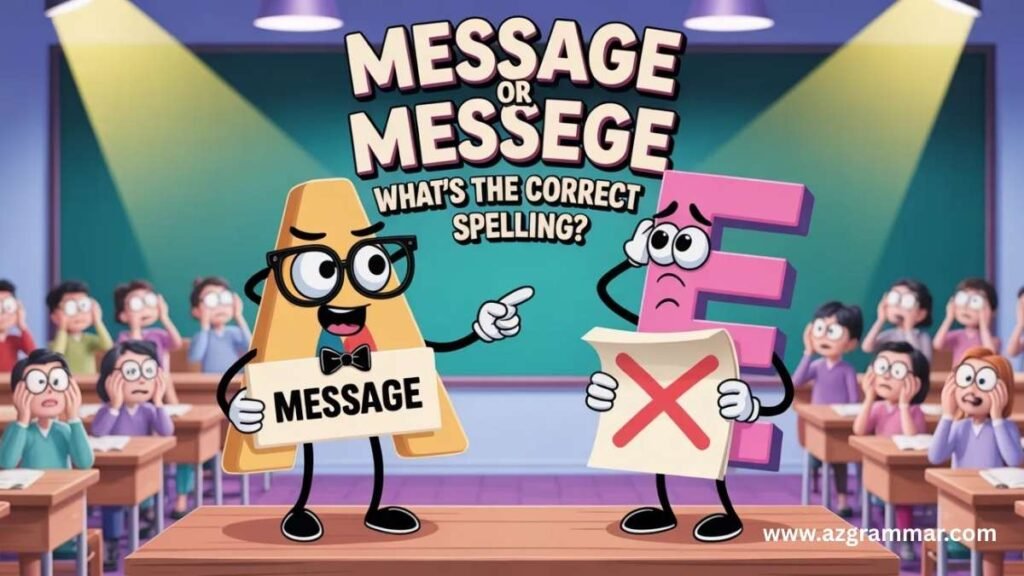
You’re typing fast. The email sounds sharp. Your point is clear. Then your brain freezes over one tiny word: Messege or Message: What’s the Correct Spelling? Suddenly you’re staring at the screen like it personally offended you. You know this word. You’ve used it a thousand times. Yet here you are, questioning vowels like they’re suspects in a lineup. Is it the “a”? Is it the “e”? Why does English do this to us? Don’t worry. You’re not alone in this spelling spiral. In the next few minutes, we’ll clear the confusion, settle the debate, and make sure you never doubt this word again.
Quick Answer: Message Is the Correct Spelling
Here is the direct answer:
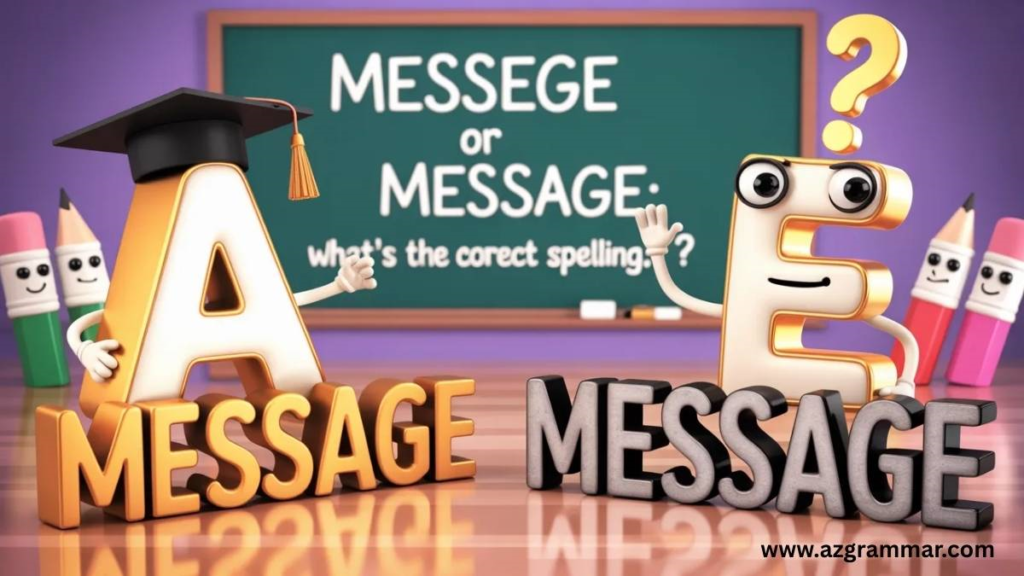
The correct spelling is message. “Messege” is a common misspelling in English.
Simple. Clear. Final.
Here’s a side-by-side comparison:
| Word | Correct in English? | Meaning |
|---|---|---|
| Message | Yes | A communication or piece of information |
| Messege | No | Misspelling |
If you are writing in English, always use message.
Now let’s go deeper and understand why the mistake happens.
Signer or Signor What’s the Real Difference?
What Does “Message” Mean in English?
Before correcting spelling, you should understand the word itself.
According to:
- Merriam-Webster
- Oxford English Dictionary
- Cambridge Dictionary
A message means:
- A written or spoken communication
- Information sent from one person to another
- An idea conveyed indirectly
Let’s break that down in simple terms.
Written or Spoken Communication
- “I left you a message.”
- “She delivered an important message to the team.”
Digital Communication
In today’s world, this is the most common meaning.
- Text message
- Voice message
- Email message
- Direct message
Digital communication has made the word even more common than it was 30 years ago.
Symbolic or Deeper Meaning
A message can also be symbolic.
- “The movie had a strong environmental message.”
- “His speech carried a powerful message of hope.”
In this sense, a message is the underlying idea behind something.
How to Pronounce Message Correctly
Correct pronunciation reduces spelling confusion.
The standard pronunciation is:
MESS-ij
- Two syllables
- Stress on the first syllable
- Soft “j” sound at the end
Say it slowly:
MESS + ij
The second syllable sounds like “age,” not “edge.”
This matters because many people accidentally write messege due to how they hear the word in fast speech. The middle vowel sound is subtle, and English vowels often blur together.
However, the correct spelling always includes “a” in the second syllable.
Why People Confuse “Messege” and “Message”
Spelling mistakes follow patterns. They rarely happen randomly.
Here are the most common reasons.
Vowel Confusion
English contains five vowel letters but dozens of vowel sounds.
The second syllable in “message” sounds soft and short. Many people instinctively replace the “a” with “e” because it feels visually balanced.
However, English does not rely on symmetry. It relies on history.
Fast Typing Errors
In digital communication, speed often wins over precision.
When typing quickly:
- Fingers reverse vowels
- The brain predicts patterns incorrectly
- Autocorrect does not always intervene immediately
Speed creates errors.
Double Consonant Confusion
“Message” contains double “s.”
Writers sometimes struggle with:
- When to double consonants
- When to keep single consonants
- How vowel length affects spelling
Because the first syllable sounds strong, people sometimes overthink the second.
Lack of Spelling Rule Awareness
Many English spelling patterns are inherited from Old French and Latin.
They do not always follow modern phonetic logic.
Understanding origin helps eliminate doubt.
Unphased or Unfazed Which One Is Correct?
Word Origin: Where Does “Message” Come From?
Language history explains spelling better than memorization.
The word message comes from the Old French word message. That word traces back to the Latin term “missus,” meaning “to send.”
Here’s the path:
- Latin: missus (to send)
- Old French: message
- Middle English: message
- Modern English: message
The double “s” reflects the Latin root. The “age” ending reflects French influence.
English absorbed the word without changing its structure significantly.
This explains why it does not follow simple phonetic rules.
The Double “S” Rule Explained
Why does “message” keep double “s”?
Because it belongs to a family of words with similar structure.
Consider these:
- passage
- package
- massage
Notice the pattern?
All follow:
Double consonant + age
This pattern comes from French spelling conventions.
When you recognize this pattern, the word becomes easier to remember.
Think of “message” as part of a spelling family.
Message vs Messege: Side-by-Side Comparison
Let’s reinforce it visually.
| Feature | Message | Messege |
|---|---|---|
| Correct spelling | Yes | No |
| Found in dictionaries | Yes | No |
| Meaning | Communication | None |
| Acceptable in formal writing | Yes | No |
“Messege” does not appear in standard dictionaries. It has no recognized definition in English.
Spicey or Spicy What’s the Correct Spelling?
Real-World Usage of “Message”
Understanding usage builds confidence.
Digital Communication
- “Send me a message.”
- “I missed your voice message.”
- “She replied to my direct message.”
In today’s world, digital messaging drives daily communication.
Workplace Writing
In professional settings:
- “Please review the message below.”
- “The CEO shared an important message with employees.”
- “Our marketing message needs clarity.”
Clear spelling builds trust in business communication.
Education and Academic Context
In literature classes:
- “What is the author’s message?”
- “The central message of the speech focuses on equality.”
Students encounter this word frequently.
Social Media Context
Brands talk about:
- Brand messaging
- Clear message delivery
- Audience messaging strategy
Influencers shape their message intentionally.
The word carries weight in modern communication theory.
Message vs Massage: Another Common Confusion
Here’s a classic mistake.
| Word | Meaning |
|---|---|
| Message | Communication |
| Massage | Body therapy technique |
Pronunciation difference:
- Message: MESS-ij
- Massage: muh-SAHZH
One wrong vowel can completely change meaning.
Imagine writing:
“I need a massage from my manager.”
That changes the situation entirely.
Common Spelling Mistakes to Avoid
Here are frequent errors:
- messege
- mesage
- messsage
- messege
Why do they happen?
- Vowel reversal
- Missing double consonant
- Over-typing letters
Here’s a simple memory trick:
“Message ends in ‘age’ like package and passage.”
Group it with similar words. Patterns reduce mistakes.
Is “Messege” Ever Correct?
No.
“Messege” does not appear in:
- Merriam-Webster
- Oxford English Dictionary
- Cambridge Dictionary
It is not recognized in standard English.
Spellcheck flags it because it has no dictionary entry.
Is “Message” a Noun or a Verb?
Primarily, message is a noun.
Example:
- “I received your message.”
However, modern English uses it as a verb in digital contexts.
Example:
- “I’ll message you later.”
- “She messaged him about the meeting.”
Language evolves. Digital culture expands word functions.
US vs UK Spelling: Any Difference?
No difference.
Both American and British English use message.
Unlike words such as “color” and “colour,” this word remains consistent across regions.
Consistency makes this one easier than many English words.
Can “Message” Be Plural?
Yes.
Plural form: messages
Example sentences:
- “I received three messages.”
- “Her messages were clear and thoughtful.”
Pronunciation slightly shifts:
MESS-ij-iz
The added syllable is subtle but clear.
Naive or Nieve: Which One Is Correct?
Why Autocorrect Sometimes Misses “Messege”
Autocorrect systems rely on:
- Context recognition
- Frequency patterns
- Software databases
Sometimes fast typing produces near-correct structures that software delays flagging.
However, most modern tools catch “messege.”
Do not rely fully on technology. Build internal spelling confidence.
How to Remember the Correct Spelling of Message
Use simple mental tools.
Memory Techniques
- “Message ends with AGE like package.”
- Break it into syllables: MESS + AGE
- Think of “mess” + “age” as two clear parts.
Visual grouping works well.
When you link it to passage and package, your brain forms a pattern cluster.
Patterns reduce cognitive effort.
Usage Trends and Why This Search Is Popular
Spelling-related searches remain highly popular.
Why?
- High digital communication volume
- Increased professional writing
- Non-native English speakers verifying spelling
- Fear of looking careless in business emails
Search engines see consistent queries for “messege or message.”
It reflects a broader desire for writing accuracy.
Clear spelling builds authority.
Reference Cambridge Dictionary Definitions
Here’s a trusted source for clear Grammar:
FAQs Messege or Message
Is “messege” a real word in English?
No. “Messege” is not a recognized English word. It is a common misspelling of message, which is the correct spelling found in all major dictionaries.
What is the correct spelling: messege or message?
The correct spelling is message. If you are writing in English, always use “message.” “Messege” is incorrect.
Why do people spell message as messege?
Most mistakes happen because of vowel confusion. The second syllable sounds soft, so people replace the “a” with “e.” Fast typing and habit also cause the error.
How do you pronounce message correctly?
Message is pronounced MESS-ij. It has two syllables, and the stress falls on the first syllable.
What does message mean?
A message is a piece of communication sent from one person to another. It can be spoken, written, digital, or symbolic.
Is message a noun or a verb?
Message is primarily a noun. However, in modern English, it can also be used as a verb, especially in digital contexts. For example, “I’ll message you later.”
Does British English spell message differently?
No. Both American and British English use the same spelling: message.
Can message be plural?
Yes. The plural form is messages. For example, “I received several messages this morning.”
Why does message have double “s”?
The double “s” comes from the word’s Latin and Old French origins. It follows the same pattern as words like “passage” and “package.”
How can I remember the correct spelling of message?
Use this simple trick:
Message ends in “age,” just like package and passage.
Grouping it with similar words makes it easier to remember.
Conclusion:
Here’s the bottom line.
The correct spelling is message.
“Messege” is simply a misspelling.
It doesn’t appear in dictionaries. It doesn’t belong in professional emails. And it doesn’t belong in academic writing. If you’re communicating in English, the word you need is message.
You’ve now learned:
- The correct spelling
- The proper pronunciation
- The word’s origin
- The reason the mistake happens
- An easy way to remember it
English can feel tricky at times. However, this one is settled.
Next time you type it, you won’t pause.
You won’t second guess.
You’ll write message confidently and move on.

James Walker is an English language educator and grammar enthusiast dedicated to helping learners improve their writing and communication skills. As an author at AZ Grammar, he simplifies complex grammar rules into clear, practical lessons suitable for students and beginners. With a passion for language learning and education, James focuses on making English grammar easy, understandable, and useful for everyday communication and academic success worldwide.