You’ve probably paused mid sentence wondering about Genius vs Genious, questioning whether your keyboard betrayed you again. You’re not alone, because this tiny spelling dilemma quietly confuses writers everywhere. Maybe you typed a brilliant compliment, reread it, and suddenly lost confidence in a single word. English has a talent for doing that. One extra letter can turn a smart sentence into a suspicious one. The good news is you’re about to clear up the confusion once and for all. By the end of this guide, you’ll know exactly which spelling works, why the mistake happens, and how to avoid second guessing yourself ever again.
Quick Answer: Genius or Genious?
Let’s keep it simple.
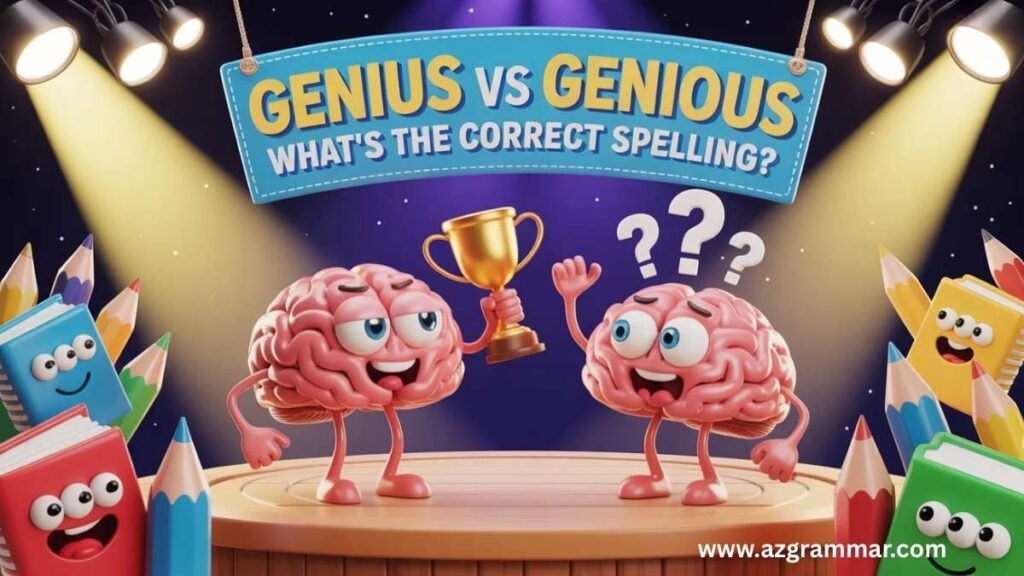
Genius is the only correct spelling in American English, British English, and standard international usage.
Examples:
- She is a mathematical genius.
- That solution was pure genius.
- Mozart demonstrated musical genius at an early age.
No reputable dictionary recognizes genious as an alternative form. If accuracy matters, and it usually does, genius is always the right choice.
What Does “Genius” Mean?
In modern English, genius describes exceptional intellectual or creative ability. The word applies to individuals or ideas that stand noticeably above ordinary standards.
A genius does more than perform well. A genius introduces insight, originality, or innovation that changes outcomes.
Consider figures such as Albert Einstein, Marie Curie, or Leonardo da Vinci. Each transformed an entire field through uncommon thinking. Their work illustrates why the word carries such weight.
Outside academic discussion, the meaning expands. We often use genius to praise clever solutions, inspired creativity, or remarkable problem solving.
Literal Meaning
Historically, the word carried a very different sense.
In ancient Rome, a genius referred to a guiding spirit believed to shape a person’s character and destiny. Over time, English speakers gradually shifted the meaning from supernatural influence to human capability.
Today, the literal definition centers on:
- extraordinary intellectual ability
- exceptional creativity
- rare natural talent
While psychologists sometimes associate genius with extremely high IQ scores, modern research recognizes that creativity, innovation, and applied intelligence matter just as much as measurable intelligence.
Genius, in its truest sense, reflects how ability is used rather than simply how it is measured.
Modern and Informal Meaning
Language evolves alongside culture, and the word genius has become more flexible in everyday use.
You no longer need world changing discoveries to earn the label. A clever shortcut, efficient system, or surprisingly simple solution often qualifies.
For example:
- Automating repetitive tasks feels genius.
- Preparing meals ahead of time is genius during busy weeks.
- A smart design improvement may be described as genius.
In these situations, the word expresses admiration rather than formal evaluation. It celebrates effective thinking in action.
How to Pronounce “Genius” Correctly
Correct pronunciation often prevents spelling mistakes before they happen.
Genius is pronounced:
JEE-nee-uhs
/ˈdʒiː.ni.əs/
Notice what you do not hear. There is no “oh” sound in the middle of the word. The pronunciation flows smoothly across two syllables.
Many spelling errors occur when writers rely on imagined sounds instead of established spelling conventions. When you internalize the pronunciation, the correct spelling becomes intuitive.
Oversight vs Oversite: What’s the Difference?
Why People Spell It “Genious”
Linguists describe this type of error as pattern interference. The brain favors familiar structures and applies them automatically.
Because English contains many -ious endings, writers subconsciously adjust genius to match that pattern.
Digital communication amplifies the problem. When typing quickly, attention stays focused on ideas rather than individual letters. The incorrect spelling slips through because it looks believable.
Recognizing the psychological reason behind the mistake helps eliminate it permanently.
Word Origins: The History Behind “Genius”
The spelling becomes clearer once you look at its history.
The word entered English directly from the Latin genius and remained largely unchanged. Unlike many English words shaped through French or Middle English evolution, this term preserved its original structure.
Its development followed a clear path:
- Ancient Rome: a protective or guiding spirit
- Renaissance thought: natural creative power
- Modern English: exceptional intellectual or creative ability
Because the spelling stayed stable throughout centuries of use, the -ious ending never emerged.
The difference lies in origin, not exception.
Genius vs Ingenious: A Common Source of Confusion
Another frequent source of confusion involves the word ingenious.
Although related historically, the two words serve distinct grammatical purposes.
| Word | Function | Meaning |
|---|---|---|
| Genius | Noun | Exceptionally intelligent person |
| Ingenious | Adjective | Clever or inventive |
A helpful comparison:
A genius develops ingenious solutions.
Because ingenious includes -ious, writers sometimes merge the two visually and create genious. Separating their roles immediately resolves the confusion.
When and How to Use “Genius” Correctly
The word adapts naturally to different contexts.
Describing Exceptional Individuals
Used formally to recognize remarkable ability.
- Newton displayed mathematical genius.
- She is widely regarded as a research genius.
Praising Ideas
Common in modern conversation.
- The workflow improvement was genius.
- Your strategy sounds genius.
Expressing Natural Talent
Often appears in the phrase “genius for.”
- He has a genius for negotiation.
- She shows a genius for storytelling.
Choosing the right context preserves credibility while keeping language expressive.
Academic and Professional Usage
In academic and professional writing, genius carries significant weight. Writers use it carefully and typically support the claim with evidence.
The term appears most appropriately when describing measurable achievement, lasting influence, or transformative innovation.
Precision matters here. Overuse weakens impact. Thoughtful usage strengthens authority.
Everyday Conversation
In everyday speech, the word becomes more relaxed.
People often use genius to acknowledge clever decisions or efficient solutions. The tone shifts from evaluation to appreciation.
Calling a small improvement “genius” signals enthusiasm rather than intellectual judgment. Context makes the intention clear.
Real Life Examples of Correct Usage
Examples help turn rules into instinct.
People
- Einstein’s scientific genius reshaped physics.
- The composer demonstrated musical genius.
Ideas
- Automating backups was genius.
- The redesign proved genius.
Professional Settings
- Her analysis showed strategic genius.
Consistent exposure reinforces correct usage naturally.
Common Spelling Mistakes Related to “Genius”
Several predictable errors appear alongside this word.
| Incorrect | Correct |
|---|---|
| genious | genius |
| geniouses | geniuses |
| genious idea | genius idea |
Most mistakes arise from analogy with -ious adjectives or confusion with ingenious. Careful proofreading quickly resolves them.
Memory Tricks to Never Misspell “Genius” Again
Simple strategies work best.
Rule 1: A genius needs no extra “O.”
No 2: gen + ius = genius.
No 3: If you don’t hear an “oh” sound, don’t add an “o.”
Repeated use in real sentences builds automatic recall over time.
Regional Usage: American vs British English
Unlike many English words, genius shows no regional spelling differences.
American English, British English, Canadian English, and Australian English all use the same form.
The idea that genious represents a British variation is a myth. The spelling remains consistent worldwide.
Usage Trends and Search Behavior
Online search behavior reveals how common this confusion is. Thousands of writers search for confirmation before publishing content.
Interestingly, this trend reflects good writing practice. Skilled writers verify uncertain details rather than relying on assumption.
Correct spelling strengthens professionalism, reader trust, and clarity of communication.
Genius in Context: Meaning Beyond Intelligence
Modern understanding recognizes multiple forms of genius.
Creative genius appears in art and design. Practical genius emerges in engineering or business strategy. Emotional genius shows itself in leadership, teaching, and communication.
The concept now extends beyond raw intelligence. It describes impactful thinking that improves outcomes or reshapes understanding.
Reference Cambridge Dictionary Definitions
Here’s a trusted source for clear Grammar:
FAQs About Genius vs Genious
Is “genious” ever a correct spelling?
No. Genious is always incorrect. Standard English recognizes only genius as the proper spelling.
Why do people commonly misspell genius as genious?
Many writers assume the word follows the -ious pattern found in words like curious or serious. This familiar pattern leads people to add an unnecessary “o.”
How do you spell genius correctly?
The correct spelling is G-E-N-I-U-S six letters with no extra vowel.
What does the word genius mean?
A genius refers to a person with exceptional intelligence, creativity, or natural talent. It can also describe a brilliant idea or solution.
Is genius a noun or an adjective?
Traditionally, genius is a noun. In modern informal English, it is often used like an adjective to praise an idea, such as “That solution is genius.”
What is the plural form of genius?
The correct plural form is geniuses.
How do you pronounce genius?
Genius is pronounced JEE-nee-uhs (/ˈdʒiː.ni.əs/). There is no “oh” sound in the pronunciation.
Is there a difference between genius and ingenious?
Yes. A genius is an exceptionally intelligent person, while ingenious describes something clever or inventive.
Can an idea be called genius?
Yes. Modern English frequently uses genius to praise clever ideas, smart solutions, or creative thinking.
Is genius spelled differently in British and American English?
No. Both American and British English use the same spelling: genius.
Why does spellcheck sometimes miss the word genious?
Autocorrect systems rely on context and frequency. If the word appears in informal writing often enough, some tools may not immediately flag it, even though it remains incorrect.
Is calling someone a genius a compliment?
Yes. Calling someone a genius is generally considered a strong compliment that recognizes intelligence, creativity, or impressive problem solving ability.
Key Takeaways: Genius vs Genious Explained Simply
- Genius is the correct spelling.
- Genious is incorrect.
- The word comes from Latin and never followed the ious pattern.
- A genius creates ingenious ideas.
Understanding these points removes hesitation permanently.
Final Thoughts Genius vs Genious:
And just like that, the mystery of genius vs genious is officially solved. No more staring at your screen, tilting your head, or whispering the word out loud as if pronunciation might magically reveal the answer. From now on, you know the rule: genius gets the spotlight, and genious quietly exits the stage.
The next time you compliment someone’s brilliant idea, you won’t hesitate or rely on luck and autocorrect. You’ll type confidently, hit send, and move on with the calm satisfaction of a writer who knows exactly what they’re doing.
Look at you spelling smarter already. Honestly, that’s kind of genius.

James Walker is an English language educator and grammar enthusiast dedicated to helping learners improve their writing and communication skills. As an author at AZ Grammar, he simplifies complex grammar rules into clear, practical lessons suitable for students and beginners. With a passion for language learning and education, James focuses on making English grammar easy, understandable, and useful for everyday communication and academic success worldwide.