Ever stared at your screen wondering, “Is it calves or calfs?” and suddenly questioned everything you thought you knew about English? You’re not alone. The language that gave us knife → knives and leaf → leaves clearly enjoys keeping things interesting—and occasionally confusing.
At first glance, calfs seems perfectly logical. Just add an “s,” right? Simple. Except… English decided to take a different route (because of course it did). That’s where calves or calfs becomes a surprisingly tricky grammar puzzle.
In this guide, we’ll clear up the confusion once and for all with simple rules, real examples, and a few “aha” moments along the way. By the end, you’ll not only know the correct answer but also understand why it’s correct so you won’t second-guess yourself again.
Quick Answer (Featured Snippet Optimized)
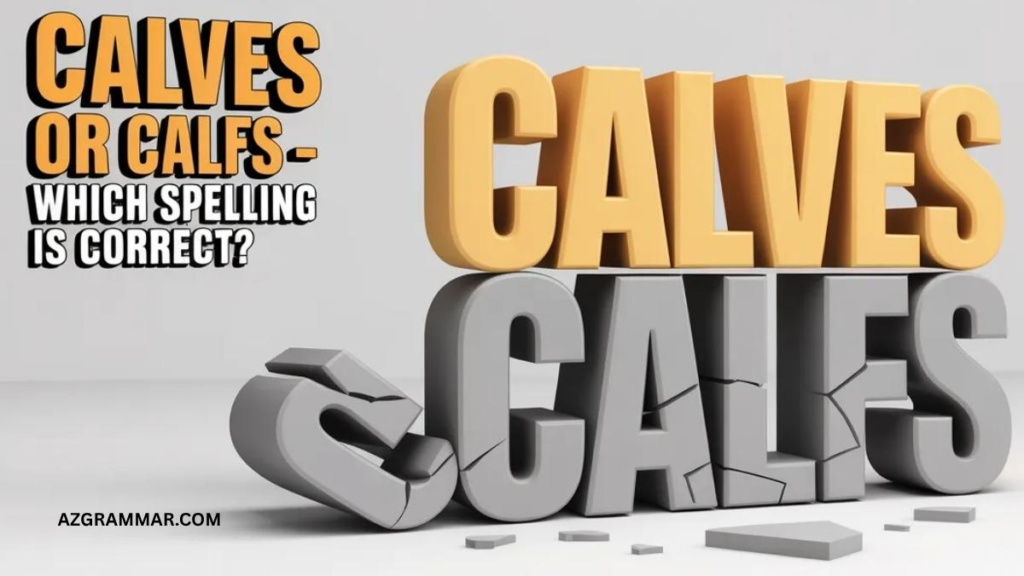
- The correct plural of calf is calves, not calfs
- This follows the f → ves rule in English grammar
- Example: The farmer takes care of several calves on his farm.
👉 Bottom line:
“Calves” is correct. “Calfs” is incorrect in standard English.
Authorized or Authorised: Stop Making This Common Mistake
What Does “Calf” Mean?
Before understanding the plural form, it’s important to know what calf actually means.
Animal Meaning (Most Common)
A calf is:
- A young cow
- Also used for young animals like elephants, whales, and giraffes
📌 Example:
The calf stayed close to its mother.
Human Body Meaning
“Calf” also refers to:
- The muscle at the back of your lower leg
📌 Example:
After running, my calves were sore.
Important Insight
Even though the meanings are different:
- The plural form stays the same → calves
✔️ calf (animal) → calves
✔️ calf (muscle) → calves
Why the Plural Is “Calves” (Grammar Rule Explained)
English has both regular and irregular plural nouns.
Regular Plurals (Easy Rule)
- Add -s or -es
- Example: book → books
Irregular Plurals (The Real Story)
“Calf” is an irregular noun, meaning it does not follow the standard rule.
Instead, it follows the:
👉 f → ves Transformation Rule
When some words end in -f or -fe, they change to -ves in plural form.
Examples:
- calf → calves
- leaf → leaves
- knife → knives
Why Does This Rule Exist?
This comes from Old English pronunciation patterns:
- The “f” sound softened into a “v” when pluralized
- Over time, spelling adapted to reflect pronunciation
📚 Linguistic Fact:
Many irregular plural forms are based on historical speech patterns, not modern logic.
Easy Memory Tip
👉 If a word ends in f, try replacing it with ves
If it sounds right, it probably is.
Vaccum or Vacuum: The Correct Spelling Explained
Are All Words Ending in “F” Changed to “VES”?
Clear Answer: No ❌
Not all words follow this rule.
English is full of exceptions, which is why learners often get confused.
Why Exceptions Exist
English evolved from:
- Germanic languages
- Latin
- French
Because of this mix:
- Some words kept old patterns
- Others adopted simpler plural forms
Words That Follow the Same Rule (f → ves)
Here are common words that follow the same pattern as calf → calves:
- calf → calves
- leaf → leaves
- half → halves
- knife → knives
- life → lives
Pattern Recognition Tip
Most of these words:
- Are older English words
- Have been used for centuries
Common Exceptions to the Rule
Now let’s look at words that do NOT change to “ves.”
- roof → roofs
- belief → beliefs
- chef → chefs
Why These Words Don’t Change
- Many are modern or borrowed words
- They kept the simple +s plural rule
Quick Tip to Avoid Confusion
👉 If unsure:
- Check a dictionary
- Or remember common pairs like:
- leaf → leaves (changes)
- roof → roofs (does not change)
Calves vs Calfs – Side-by-Side Comparison
| Word | Correct? | Usage | Example |
|---|---|---|---|
| Calves | ✅ Correct | Plural form | The farmer raised calves. |
| Calfs | ❌ Incorrect | Not standard English | ❌ Avoid usage |
Key Takeaway
There is no standard situation where “calfs” is correct in modern English.
CC’ed or CC’d: Which One Is Right for Professional Emails?
Why Do People Say “Calfs”? (Common Mistakes Explained)
Even native speakers sometimes make this mistake.
Here’s why:
- Overgeneralizing plural rules
People assume every word just adds “s” - Influence of regular noun patterns
Most English words follow simple rules - Lack of awareness of irregular forms
Not everyone memorizes exceptions - ESL learner confusion
English learners often apply consistent logic
Real-Life Example
❌ Incorrect: There are many calfs in the field.
✅ Correct: There are many calves in the field.
How to Use “Calves” in Sentences
Understanding usage is key to mastering grammar.
Animal Context Examples
- The farmer fed the calves early in the morning.
- The calves followed their mother across the field.
Body Part Context Examples
- She stretched her calves after the workout.
- His calves became stronger after months of training.
Everyday Conversational Usage
- My calves hurt after walking all day.
- We saw newborn calves on the farm.
Formal vs Informal Usage
| Context | Example |
|---|---|
| Formal writing | The calves were examined by a veterinarian. |
| Informal speech | My calves are killing me after leg day! |
Calf vs Calves – Understanding Singular and Plural Forms
Let’s break it down clearly:
| Form | Word | Example |
|---|---|---|
| Singular | Calf | The calf is (young). |
| Plural | Calves | The calves are grazing. |
Quick Usage Tips
- Use calf when talking about one
- Use calves for more than one
- Never use calfs
Mini Practice Quiz (Engagement Section)
Test your understanding 👇
Fill in the blanks:
- The farmer owns five ______.
- My ______ hurt after running.
Multiple Choice:
Which is correct?
A) Calfs
B) Calves
Answers:
- calves
- calves
- ✅ B) Calves
Calves in Real Language Usage
How Native Speakers Use It
Native speakers always use:
- Calves for plural
“Calfs” is rarely used and considered incorrect.
Common Phrases
- Muscular calves
- Baby calves
- Sore calves
Contextual Usage
| Context | Sentence |
|---|---|
| Farming | The calves are healthy and active. |
| Fitness | Strong calves improve athletic performance. |
| Biology | Calves depend on their mothers for nutrition. |
Modelling or Modeling: Which Spelling Is Correct?
Related Grammar Concepts You Should Know
Understanding this topic helps you master broader grammar rules.
Irregular Plural Nouns
Examples:
- man → men
- child → children
- foot → feet
Singular vs Plural Forms
- One item → singular
- More than one → plural
Basic English Spelling Rules
- Add -s (most cases)
- Add -es (words ending in s, sh, ch)
- Use -ves (some f-ending words)
Vocabulary Building Tip
Learning patterns like calf → calves improves:
- Writing accuracy
- Speaking confidence
- Reading comprehension
Reference Cambridge Dictionary Definitions
Here’s a trusted source for clear Grammar:
FAQs
What is the plural of calf?
The correct plural of calf is calves. This applies to both meanings of the word whether you are referring to a young animal (like a baby cow) or the muscle in the lower leg. For example: The farmer takes care of several calves.
Is “calfs” ever correct in English?
No, “calfs” is not correct in standard English. It is a common mistake, especially among learners, but it is not accepted in formal or informal writing. The correct form you should always use is calves.
Why does calf become calves instead of calfs?
Calf becomes calves because it follows the f → ves rule used in some irregular plural nouns. In older forms of English, the “f” sound changed to a “v” sound when pluralized, and the spelling later adapted to match pronunciation. This is why we write calves instead of calfs.
Are all words ending in “f” changed to “ves”?
No, not all words ending in “f” follow this rule. While some words change to ves (like leaf → leaves), others simply add -s (like roof → roofs). English has many exceptions, so it’s important to learn common patterns and memorize irregular forms.
What are examples of words similar to calf?
Some words follow the same plural pattern as calf. These include:
- leaf → leaves
- knife → knives
- life → lives
- half → halves
These are all examples of irregular plural nouns that use the f → ves transformation.
What is the plural of calf (animal vs body part)?
The plural is the same in both cases: calves.
- Animal: The calves are grazing in the field.
- Body part: His calves are sore after exercise.
The meaning changes based on context, but the plural form does not.
Why do people commonly write “calfs”?
People often write “calfs” because they apply the regular plural rule of adding “-s” to words. Since most English nouns follow this pattern, it feels natural. However, calf is an irregular noun, so this logic does not apply.
How can I remember the correct plural of calf?
A simple trick is to remember similar words like leaf → leaves. If you already know one example of the f → ves rule, you can apply it to calf → calves. Practicing with examples and reading regularly also helps reinforce the correct form.
Is “calves” used in both formal and informal English?
Yes, “calves” is correct in all contexts formal writing, academic work, and everyday conversation. It is the standard plural form recognized in all types of English.
What is the plural of similar words like “half” or “leaf”?
Here are the correct plural forms:
- half → halves
- leaf → leaves
These follow the same f → ves rule as calf → calves, making them useful for learning and remembering the pattern.
Conclusion
Understanding the difference between calves or calfs is simple once you know the rule. The correct plural of calf is calves, and this applies in all contexts whether you are talking about animals or the muscles in your legs.
This happens because calf follows the f → ves rule, which is common in several irregular plural nouns like leaf → leaves and knife → knives. While English does have exceptions, calf is not one of them so “calfs” is always incorrect.
The key takeaway is to remember that English plural rules are not always consistent, but learning common patterns and exceptions can make a big difference in your writing and speaking.
👉 Final rule to remember:
Calf → Calves (✔ correct)
Calf → Calfs (❌ incorrect)
By applying this rule and practicing with real examples, you’ll avoid this common mistake and improve your overall grammar accuracy.

James Walker is an English language educator and grammar enthusiast dedicated to helping learners improve their writing and communication skills. As an author at AZ Grammar, he simplifies complex grammar rules into clear, practical lessons suitable for students and beginners. With a passion for language learning and education, James focuses on making English grammar easy, understandable, and useful for everyday communication and academic success worldwide.
Email: azgrammar29@gmail.com
Website: azgrammar.com