
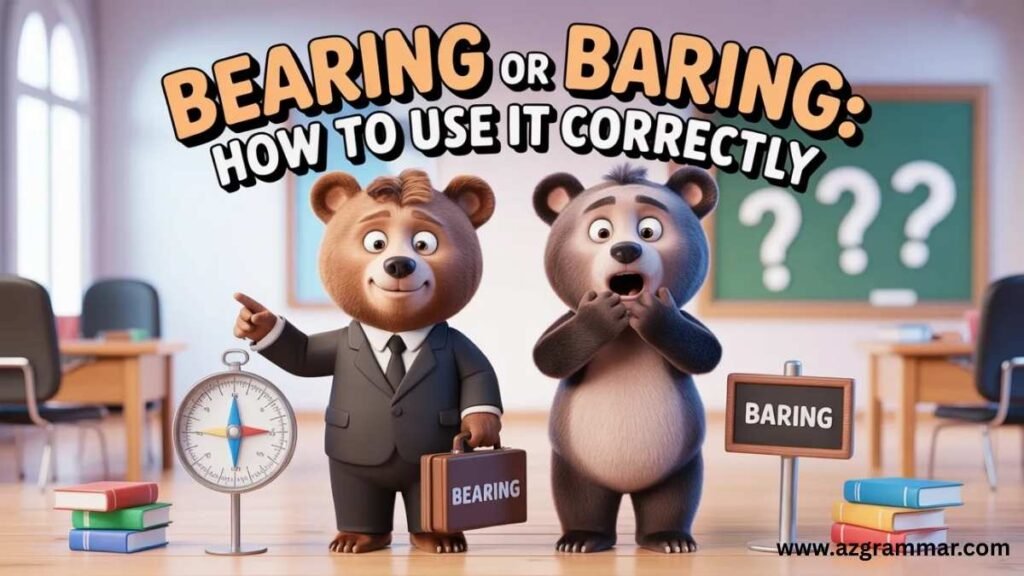
Words that sound the same can easily trip up even confident writers. One of the most common examples is the confusion between bearing and baring. At first glance, these words seem interchangeable because they are pronounced exactly the same. However, they carry completely different meanings.
Understanding the difference between these two homophones can dramatically improve your writing clarity. Whether you’re drafting a professional email, writing an academic essay, or composing a social media post, using the correct word helps you communicate more precisely.
This guide explains bearing or baring: how to use it correctly, with clear definitions, examples, grammar insights, and memory tricks to ensure you never confuse them again.
Quick Answer: Bearing or Baring?
Let’s start with the simplest explanation.
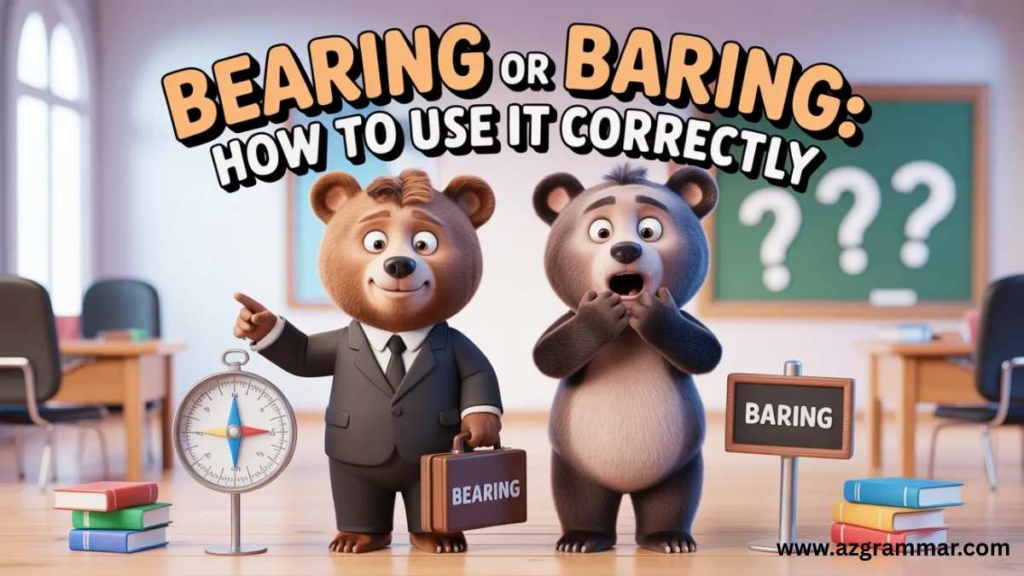
Bearing refers to carrying something, direction, or attitude.
Baring means revealing or uncovering something.
Here is a quick comparison:
| Word | Meaning | Example |
|---|---|---|
| Bearing | Carrying something, direction, or attitude | “She arrived bearing gifts.” |
| Baring | Revealing or uncovering | “The dog was baring its teeth.” |
If the sentence involves bringing something, navigation, or behavior, use bearing.
If the sentence involves exposing or revealing, use baring.
Messege or Message: What’s the Correct Spelling?
Why Bearing and Baring Sound the Same
The confusion between bearing and baring comes from a linguistic phenomenon called homophones.
What Are Homophones?
Homophones are words that:
- sound the same when spoken
- have different meanings
- have different spellings
English contains many homophones because its vocabulary evolved from multiple languages, including Old English, French, and Latin.
Examples of common homophones include:
| Word Pair | Meaning Difference |
|---|---|
| their / there / they’re | possession, location, contraction |
| your / you’re | possession vs “you are” |
| hear / here | sound vs location |
| brake / break | stop vs destroy |
Because bearing and baring sound identical, writers sometimes rely on context rather than spelling memory. When the context is unclear, mistakes happen.
What Does “Bearing” Mean?
The word bearing comes from the verb bear, which means to carry, support, or endure.
The word has several important meanings depending on context.
Carrying or Bringing Something
One of the most common uses of bearing involves carrying or delivering something.
Examples:
- “She arrived bearing gifts.”
- “The messenger was bearing important news.”
- “The traveler came bearing supplies.”
In these sentences, bearing means bringing or carrying something to someone.
This usage often appears in formal writing or storytelling.
Direction or Orientation
In navigation and geography, bearing refers to direction.
Pilots, sailors, and hikers use the term frequently.
Examples:
- “The ship adjusted its bearing toward the harbor.”
- “Follow the compass bearing north.”
- “The GPS confirmed our bearing toward the destination.”
A compass bearing represents a specific directional angle measured from north.
Example:
| Direction | Bearing |
|---|---|
| North | 0° |
| East | 90° |
| South | 180° |
| West | 270° |
Navigation systems rely heavily on this concept.
Unphased or Unfazed Which One Is Correct?
Attitude or Behavior
The word bearing can also describe someone’s manner or behavior.
Examples:
- “Her professional bearing impressed the interview panel.”
- “He maintained a calm bearing during the crisis.”
- “The officer displayed a confident bearing.”
In this sense, bearing relates to:
- posture
- attitude
- composure
- conduct
Professional environments often emphasize good personal bearing.
What Does “Baring” Mean?
The word baring comes from the verb bare, which means to uncover or expose.
This meaning focuses on revealing something physically or emotionally.
Revealing or Uncovering
Examples:
- “The dog was baring its teeth.”
- “She stood baring her shoulders in the sunlight.”
- “He was baring the truth about the situation.”
In each case, baring involves exposing something that was previously hidden.
Emotional Expression
The word also appears when discussing emotional openness.
Examples:
- “The speech involved baring personal experiences.”
- “She was baring her soul during the interview.”
- “The author wrote a memoir baring painful memories.”
In these situations, baring represents emotional vulnerability.
Writers and speakers often use this word when discussing honesty and openness.
Bearing vs Baring: Side-by-Side Comparison
To make the distinction clearer, consider this comparison table.
| Feature | Bearing | Baring |
|---|---|---|
| Meaning | Carrying, direction, or attitude | Revealing or exposing |
| Root word | Bear | Bare |
| Common phrases | Bearing gifts, compass bearing | Baring teeth, baring emotions |
| Context | Navigation, behavior, delivery | Exposure or emotional honesty |
Recognizing the root word makes the difference easier to remember.
Real World Examples of Bearing and Baring
Understanding grammar becomes easier when you see real examples.
Everyday Conversation
Examples include:
- “He arrived bearing flowers.”
- “The dog was baring its teeth at strangers.”
These sentences demonstrate common daily usage.
Professional Communication
Both words can appear in workplace contexts.
Examples:
- “Her confident bearing impressed the clients.”
- “The documentary involved baring uncomfortable truths.”
Correct spelling ensures clear professional communication.
Literature and Storytelling
Writers often use these words to create vivid imagery.
Example:
“The warrior marched forward with proud bearing, baring his sword to the enemy.”
This sentence uses both words correctly.
Signer or Signor What’s the Real Difference?
Common Grammar Mistakes with Bearing and Baring
Because the words sound the same, writers sometimes reverse them.
Examples of incorrect usage:
- “She came baring gifts.” ❌
- “The dog was bearing its teeth.” ❌
Correct versions:
- “She came bearing gifts.” ✔
- “The dog was baring its teeth.” ✔
These mistakes occur because the brain processes sound faster than spelling.
Why Writers Often Confuse Bearing and Baring
Several factors contribute to this confusion.
Homophone Confusion
Since the words sound identical, writers may rely on phonetic spelling.
Fast Typing
When typing quickly, people often choose the wrong spelling automatically.
Autocorrect Limitations
Spellcheck tools detect spelling errors but not always contextual mistakes.
Vocabulary Gaps
English learners may not know the difference between bear and bare.
All these factors increase the likelihood of confusion.
Easy Memory Tricks to Remember the Difference
Here are simple tricks to remember the correct usage.
Trick One
Bearing = Carrying something
Example:
“She arrived bearing gifts.”
Trick Two
Baring = Bare means uncovered
Example:
“The dog was baring its teeth.”
Trick Three
Ask yourself a question.
If the sentence involves:
- carrying something
- direction
- behavior
Use bearing.
If the sentence involves:
- exposing something
- revealing emotions
Use baring.
Naive or Nieve: Which One Is Correct?
Bearing in Technical and Professional Fields
The word bearing also appears in several specialized fields.
Mechanical Engineering
In engineering, a bearing is a machine component that reduces friction between moving parts.
Examples include:
- ball bearings
- roller bearings
- thrust bearings
These components allow machines to operate smoothly.
For example, car engines often contain dozens of bearings to support moving parts.
Navigation and Aviation
In navigation, bearing refers to direction measured relative to north.
Pilots use bearings constantly.
Example:
“Maintain a bearing of 180 degrees toward the runway.”
This concept is essential in aviation, maritime navigation, and GPS systems.
Psychology and Leadership
In leadership training, bearing describes a person’s professional presence.
Good leadership bearing includes:
- confident posture
- calm demeanor
- clear communication
- emotional control
Military leadership programs often emphasize personal bearing as a core skill.
Reference Cambridge Dictionary Definitions
Here’s a trusted source for clear Grammar:
FAQs
What is the difference between bearing and baring?
Bearing usually means carrying something, direction, or attitude. Baring means revealing or uncovering something. Even though they sound the same, their meanings are completely different.
Is it bearing gifts or baring gifts?
The correct phrase is bearing gifts, which means bringing or carrying gifts. “Baring gifts” would mean revealing gifts, which is not the intended meaning.
What does bearing mean in a sentence?
The word bearing can refer to carrying something, direction, or behavior.
Example: “The traveler arrived bearing important news.”
What does baring mean in English?
Baring means revealing or exposing something that was previously hidden.
Example: “The dog was baring its teeth.
Are bearing and baring homophones?
Yes, bearing and baring are homophones. They sound the same when spoken but have different meanings and spellings.
Why do people confuse bearing and baring?
People confuse these words because they are pronounced the same. When writing quickly or relying on sound, it is easy to choose the wrong spelling.
How can I remember the difference between bearing and baring?
A simple trick is:
- Bearing = carrying something
- Baring = bare means uncovered
This memory rule helps you quickly choose the correct word.
Can bearing refer to direction or navigation?
Yes. In navigation, bearing refers to a direction measured with a compass.
Example: “The pilot adjusted the plane’s bearing toward the airport.”
Usage Trends and Why This Word Confusion Is Common
Search data shows that many people frequently look up bearing or baring.
Why?
Several reasons explain the trend.
- English contains many homophones
- grammar education varies widely
- professional communication demands accuracy
- non-native speakers verify word meanings
Grammar clarification articles often attract significant search interest because writers want to avoid embarrassing mistakes.
Final Thoughts:
The confusion between bearing and baring disappears once you understand their meanings.
Remember this simple rule:
- Bearing relates to carrying something, direction, or behavior.
- Baring means revealing or exposing something.
By recognizing the context of the sentence, you can choose the correct word every time.
Clear grammar improves communication, builds credibility, and strengthens your writing skills.
Now that you understand bearing or baring: how to use it correctly, you can write confidently without second-guessing yourself.

James Walker is an English language educator and grammar enthusiast dedicated to helping learners improve their writing and communication skills. As an author at AZ Grammar, he simplifies complex grammar rules into clear, practical lessons suitable for students and beginners. With a passion for language learning and education, James focuses on making English grammar easy, understandable, and useful for everyday communication and academic success worldwide.